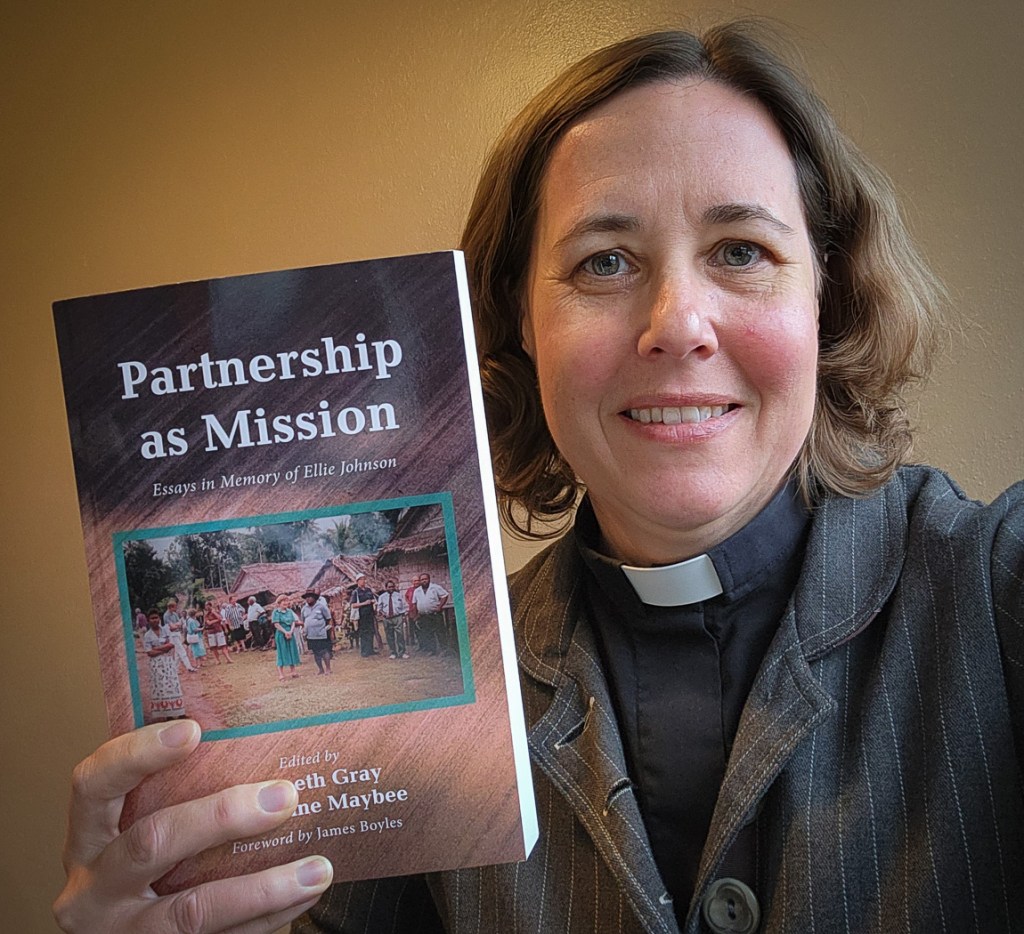
Rev. Alecia Greenfield, priest, activist, artist will host a launch in Vancouver on Sunday, April 21 — details soon
An update on my little book project — Partnership as Mission
READER RESPONSE
This is a such a well written book, creatively addressing a most vital, if not the most vital issue for those of us who claim to follow Jesus through the lens of a the life and enduring influence of a most remarkable “Bahnbrecker” (trail-blazer) Ellie Johnson.
—Curt Bergen / Musician, Victoria BC
A great read. Took me about 8.5 hours. Have now re-read some chapters. I find myself searching within for my own answers to many questions; am I really understanding my own identity-history, and what it has meant for those around me, the land, us as part of “creatureliness”. . . and how I (and we all) need to evolve to bring the changes that are needed if we are not to become extinct . . . but rather to bring new life (including to the woodland caribou and forests . . . and all life.
—Norma J Hill / Writer, teacher, and blogger, Penticton BC
This book needs to have the widest possible readership—Required reading for every bishop and clergy person in parish ministry. It suggests a total transformation within the Anglican Church of Canada with other ecumenical partners as to how we move forward in a world which, every day, is more stressed and in many ways broken.
—Ray Fletcher / Priest, Telkwa BC
Every theology student should read this book.
—Terry Reilly / Mission coordinator, Winnipeg MN
MY NEW BABY
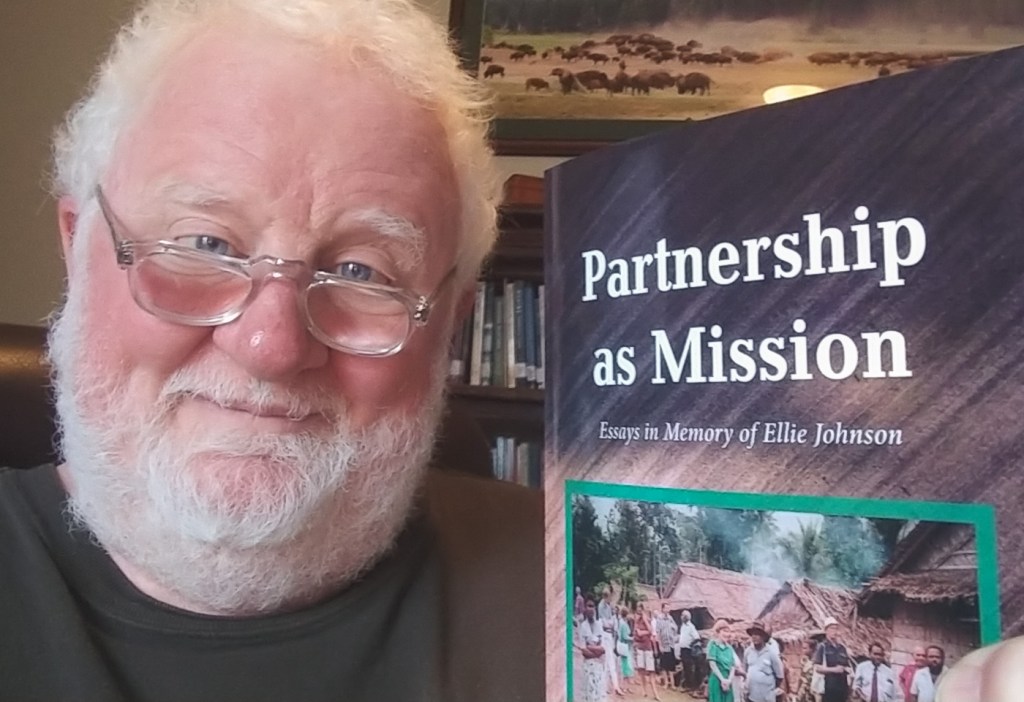
I feel like a parent with my first child. This particular literary baby has grown quickly since its birth in early November 2024. The promotional process is new to me—my days are adventurous, curious, sometimes confusing, and somewhat unpredictable. I want to show my new kid off—to family, friends, and colleagues—watching and listening carefully for the reactions of readers to what is a uniquely Canadian set of reflections on mission.
In their infancy, Kathie and I wondered how our friends, family, neighbours, and colleagues would react to newfound our bundle of joy. Now I yearn to hear from you, dear readers about this eclectic selection of essays.
Do you like the cover?
Have you cracked the spine and read a chapter or two?
Do the ideas connect with your life, your faith, your concerns, your gratitude?
What new conversations have occurred?
Some readers engage quickly and easily; others need time and encouragement to tackle subjects which may be unfamiliar to them. For many, diving into an academic collection of essays is daunting. So I try to help folks find a way in to the chapter texts.
For some, especially for those who might identify as history buffs, the section on residential school response connects well with current national events and experiences. Where words like “residential school survivor” once triggered memories, shame, and rapid heartbeats, today “search the landfill” identifies that the healing and reconciliation journey is far from over. For others, the stories of Ellie Johnson’s relationships with colleagues and leaders are of primary interest. The testimonies given by family, friends and colleagues in Section One are beautiful and inspiring.
Presently, I want to direct readers to Section Four which reflects on the missional context today. Even the words “missional context” puzzle many. While groups such as KAIROS (Ecumenical Justice Initiative) continue to shape their work around justice advocacy and educational programmes, I find generations younger than me are slow to engage with this work. If Canadians of all ages are concerned about affordability, access to housing, social inclusion, geopolitical activity, global conflict, and the climate crisis, I suggest there is work to be done by all of us as we are able and gifted, to identify and oppose injustice as we are variously called.
Each of these challenges—to life, liberty, and love—deserve the attention of research, a forum for conversation, and leadership that will channel energy wisely and in a timely manner. So yes, I am proud of the material found in Section Four—for instance, a detailed analysis of the connection between migration, climate change, and place offered by Dr. Jesse Zink. I am fascinated by Sylvia Keesmaat’s proposal for a new approach to theological education (for everyone, not just clergy). Personally, I enjoyed ruminating on the language we use including ecojustice; I was likewise inspired by Jarem Sawatsky’s naming of healing our relationship with the land.
Speaking of the book as a whole, and recalling the endorsements noted above, both Maylanne and I hope that the discernments and discoveries that surfaced in Ellie’s day will “continue to mean much to us now that she has died.”* In other words the mantle of leadership and of speaking truth to power has passed “from generation to generation, in the church, and in Christ Jesus.”** Amen.
*Funeral liturgy, The Book of Alternative Services
** Service of Holy Eucharist, The Book of Alternative Services
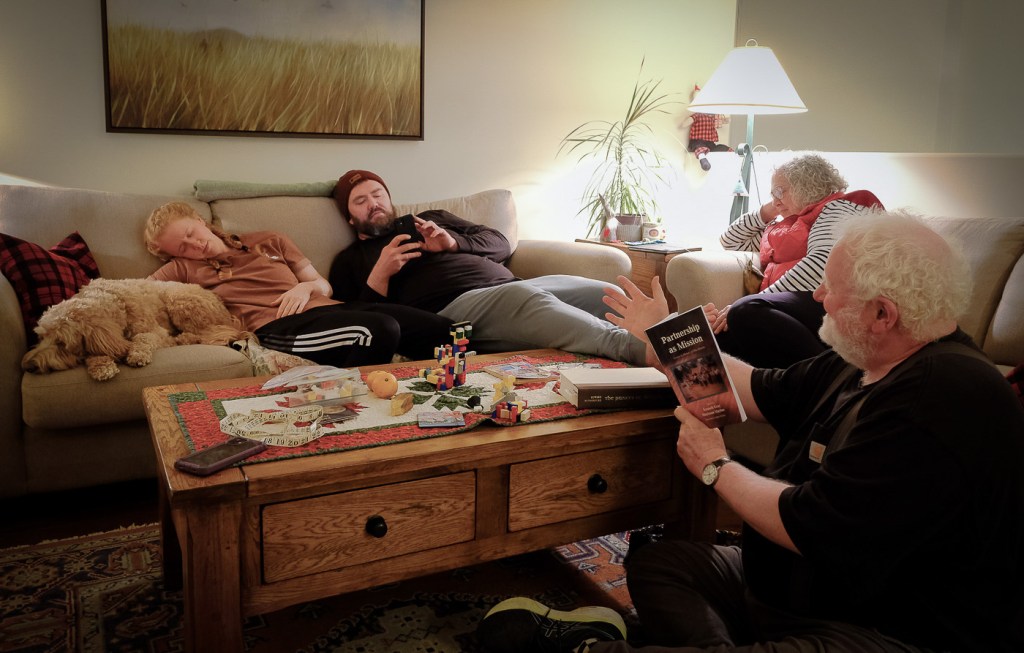
Not everyone is as thrilled as I am with the content of the book. Sigh!
 Take Note - Reflections on life, music, politics, retirement and more by Ken Gray
what a great Christmas Card picture!
LikeLike
It is indeed.
LikeLike