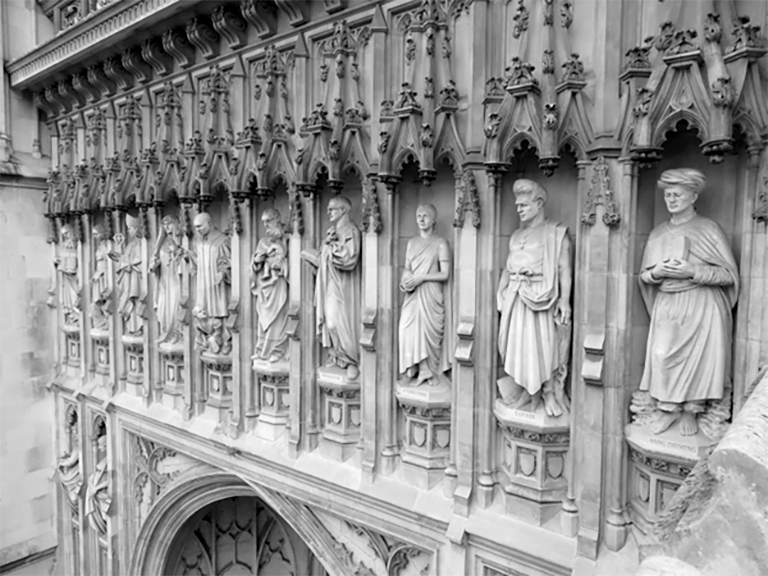
One of the PNG martyrs was Lucian Tapiediucian Tapiedi He is one of the ten Modern Martyrs of the Anglican Church in the 20th century. The Martyrs statues were unveiled in 1998 above the west door of Westminster Abbey, he is second from the right
[Art More, Summerland BC writes] I am pleased to share the story of the martyrs of PNG during the Second World War. Here is an account by Archbishop David Hand. This occurred in 1942 during WW2 when the Japanese forces were moving south towards Australia. They had fought their way across various islands to reach the island of Papua New Guinea near Popondetta. Then the plan was to cross the island along the Kokoda Track to Port Moresby from where they would launch their invasion of Australia.
As the thrust of the Japanese invasion approached Papua New Guinea in 1942, Bishop Philip Strong broadcast over the radio a message to his staff which has become famous in the annals of missionary history. He said:
We could never hold up our faces again, if for our own safety we all forsook him and fled when the shadows of the passion began to gather around him in his spiritual body, the Church in Papua. Our life in the future would have been burdened with shame and we could not come back here and face our people again; and we would be conscious always of rejected opportunities.
The history of the church tells us that missionaries do not think of themselves in the hour of danger and crisis, but of the Master who called them to give their all, and of the people they have been trusted to serve and love to the uttermost. His watchword is none the less true today, as it was when he gave it to the first disciples: ‘Whosoever would save his life will lose it, and whosoever will lose his life for my sake and the gospel’s shall find it.’
We could not leave unless God, who called us, required it of us, and our spiritual instinct tells us he would never require such a thing at such an hour. No, my brothers and sisters, fellow workers in Christ, whatever others may do, we cannot leave. We shall not leave. We shall stand by our trust. We shall stand by our vocation.
Papua is a body, the Church: God will not forsake us. He will uphold us; he will strengthen us and he will guide us and keep us through the days that lie ahead. If we all left, it would take years for the Church to recover from our betrayal of our trust. If we remain—and even if the worse came to the worst and we were all to perish in remaining—the Church will not perish, for there would have been no breach of trust in its walls, but its foundations and structure would have received added strength for the future building by our faithfulness unto death. This, I believe, is the resolution of you all.
I know there are special circumstances which may make it imperative for one or two to go (if arrangements can be made for them to do so). For the rest of us, we have made our resolution to stay. Let us not shrink from it. Let us trust and not be afraid. To you all I send my blessing. The Lord be with you.
What happened?
To a man and woman, all the bishop’s staff stood by their people until it became clear that that course might imperil their people. The bishop himself was bombed and machine-gunned. He escaped injury, despite travelling freely and fearlessly around his diocese to care for, and encouraged his staff and people, as well as acting as senior chaplain to the military.
Among those who died were two Gona sisters, teacher Mavis Parkinson and nurse May Hayman. They were handed over to the Japanese, and bayoneted to death at Ururu where an altar-shrine now marks the spot.
Elderly and holy Father Henry Holland, having served in Papua New Guina for twenty-five years, first as a lay evangelist, and latterly as a priest as Isivita, stacks of whose translations of the Scriptures into the Orokaiva language were scattered and lost when the Japanese looted his station; he and John Duffill, his close colleague, were both killed.
Father Vivian Redlich of Sangara, who refused to abandon his Sunday Mass when warning came that the Japanese arrival at his camp was imminent and Lucian Tapiedi, his devoted teacher-evangelist who had said to his married colleagues: “Take your wives and families to the bush and hide. I am single; I’ll stay with the fathers and sisters; it doesn’t matter if the Japanese get me”; the Sangara missionary-teachers Lilla Lashmar and Margery Brenchley, who had laid the foundations of the Church’s educational work in the Orokaiva area, all perished.
John Barge, recently posted to open up work in a totally unevangelized area, refused to “go bush” with the nearest Roman Catholic priest. Forced to dig his own grave he was then shot into it by Japanese guns.
Many people blamed Bishop Strong for not taking out all his staff to safety. But it was, ultimately, their own choice. To the world, it seemed a waste, a tragedy, a failure—like Calvary. But look what God has done with it—with their “defeat.” He has turned it into victory. Look at the rise of the Martyrs’ School in their honour—a living organism, not just a memorial, serving God and the nation. Look at the fruit of the martyrdom in the ability of the Orokaiva Church to resurrect after the Lamington eruption. Look at the post-World War II leap forward into inland Papuan areas, the New Britain Resurrection and the great “putsch” into the New Guinea Highlands.
Yes, “the blood of the martyrs” has once again proved to be “the seed of the Church”—here, in this country. Thanks be to God.
 Take Note - Reflections on life, music, politics, retirement and more by Ken Gray
Leave a comment