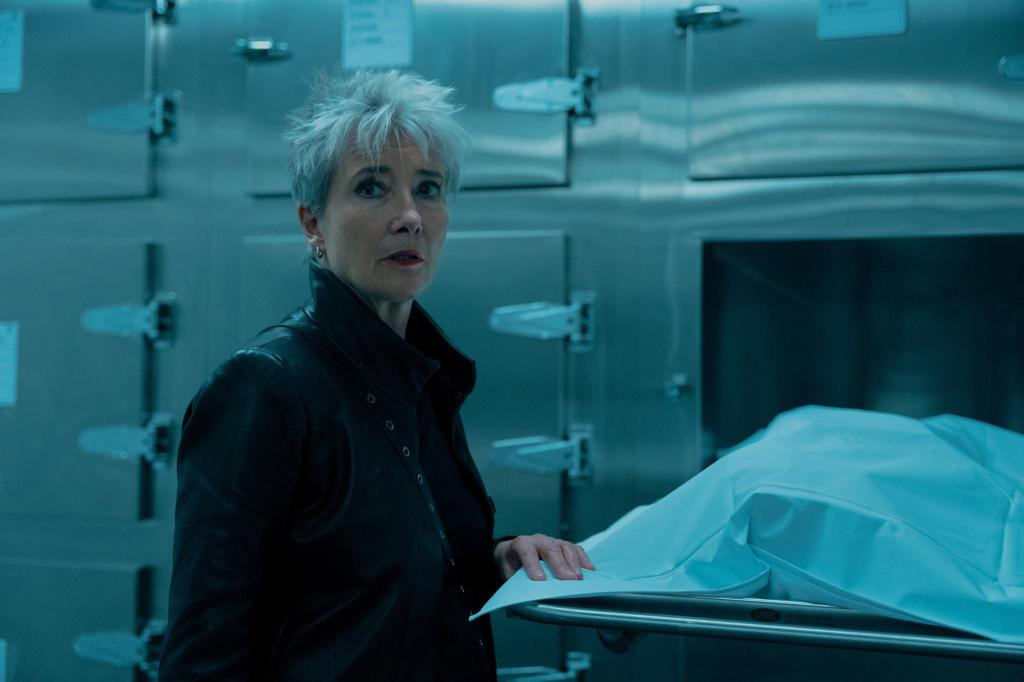
Kathie and I are working our way Emma Thompson’s new four-part suspense series on Apple-TV, described by Wenlei Ma on THE NIGHTLY as “a great show with an unusual tone that, like Slow Horses, generously peppers wry humour between the drama and thriller elements. It keeps things moving along without ever getting bogged down in capital E emotions.”
Thompson is truly an actress for all seasons and styles. From the exuberance of Much Ado About Nothing to the comic forays of Love Actually and Pirate Radio, to tender roles in Wit and Good Luck to you Leo Grande; to the stylish Remains of the Day and Howards End, Thompson brings her full self and very best to every role. Our list of favourites is below. What’s on your list? Do tell.
Down Cemetery Road 2025
Why didn’t they ask Evans? 2022
Good Luck to you Leo Grande 2022
Pirate Radio 2009
Love Actually 2003
Wit 2001
Primary Colors 1998
The Remains of the Day 1993
Much Ado about Nothing 1993
Peter’s Friends 1992 (Just discovered this recently)
Howards End 1992
[Wenlei Ma]
Emma Thompson walked into a Hollywood meeting not long after winning an Oscar — the room buzzing, producers smiling, contracts waiting — and calmly said no. The role was worth millions, but the script’s only woman existed, as she put it, “to make a man feel clever.” Her refusal landed harder than any acceptance speech. It wasn’t rebellion for rebellion’s sake — it was principle. That moment defined her: a woman who would rather walk away from power than compromise her truth.
From the start, Emma Thompson was never built for decoration. Long before the gowns and gold statues, she was a Cambridge comedian with messy hair and razor wit, performing sketch comedy that sliced through hypocrisy and pomposity. “Comedy taught me survival,” she once said. “If you can make them laugh, you can make them listen.” That sharp intelligence became her armor — and her weapon — in an industry that preferred its actresses ornamental, not opinionated.
Hollywood tried to mold her into quiet gratitude. She resisted. Studios wanted charm; she offered challenge. When one executive complained that her female characters were “too angry,” Thompson replied, “They’re not angry. They’re speaking.” And she meant it.
When she adapted Sense and Sensibility, no one believed she could write. She spent six years crafting the screenplay by hand, through exhaustion and doubt, sometimes crying over ink-stained pages. “It was agony,” she said later. “But I wanted to write women who felt real — who made choices, not tea.” Her agony became art. The film won her another Oscar, making her the only person in history to win Academy Awards for both acting and writing. Yet the victory wasn’t about trophies — it was about ownership. She had written her way into a system that had no space for her voice, and in doing so, she widened the door for others.
Thompson’s defiance didn’t stop on the page. She led protests against human trafficking, called out Hollywood’s ageism with biting honesty, and once walked off a film set after producers demanded a teenage co-star lose weight. “I’m not standing next to that,” she said. In a world where silence keeps the machine running, she chose disruption.
Her strength, though, isn’t loudness — it’s precision. She doesn’t shout; she chooses her words like scalpel strokes. Every “no” she’s ever said has been an act of creation — cutting away what diminishes women, carving space for authenticity. “There’s power in refusal,” she once said. “It’s how you build something worth standing in.”
Emma Thompson didn’t conquer Hollywood by playing its game. She rewrote the rules, one sentence, one character, one boundary at a time. Her legacy isn’t just in the films she made — it’s in the ones she refused to make.
Because sometimes the bravest act in a room full of power is not to accept the script they hand you — but to pick up the pen and start writing your own.
Visit the takenote.ca HOME page for a colourful display of hundreds of other blogs which may interest or inspire you
 Take Note - Reflections on life, music, politics, retirement and more by Ken Gray
Leave a comment