Part of our popular blog series
Ken Helps around the House
Few things are as adversarial in our house as conversations around loading the dishwasher. The management of finances, choices in relation to interior decoration, or the planning of vacations all pale in comparison. It’s a sensitive issue, packed with emotion, influences by ego and some sort of perfectionism. Spoiler alert: Pride comes before the fall.
I have been loading dishwashers for many years now. I remember hauling our ancient machine across the kitchen floor, attaching the clumsy hose system connectors to the sink faucet. Through the years we lived with various brands and designs, the tray layouts being the most demanding challenge—How to get the stuff in with good function in mind and yes, visual appeal.
Admittedly my visual impairment does present certain challenges irrelevant for those with 20/20 correctable visual acuity. A stainless steel interior beneath glassware and the shadows cast by kitchen lighting create certain problems for me. I “may” overcompensate as I strive to find “a place for everything,” and to ensure that everything is in its proper place.
My goal is to work with technology to create efficiencies for water distribution throughout the cleaning chamber. Hence my requirement that dishes be rinsed carefully prior to placement in the washer. Possibly readers will remember the movie Edward Scissorhands, during which an appliance technician is explaining to a buxom housewife, who is clearly hungry for physical intimacy, that “pre-rinsing helps the washer to save both water and electricity and to clean more efficiently.” His advice however is like casting pearls before swine (well, actually breasts).
Since I was a little boy, admittedly before we had a dishwasher, I was told to “Rinse the plate, pop it in the dishwasher, press start . . . repeat forever . . .” Such a procedure is however rejected by none other than the home-economics savvy Wall Street Journal who opines that “it’s actually more beneficial to not rinse your dishes before putting them into the dishwasher” (italics mine). “Most modern dishwashers have sensors inside of them to figure out how long to run a cycle, and even if you press ‘normal’ on the panel, the length and temperature of the cycle can vary depending on how dirty the sensor detects the dishes to be.”
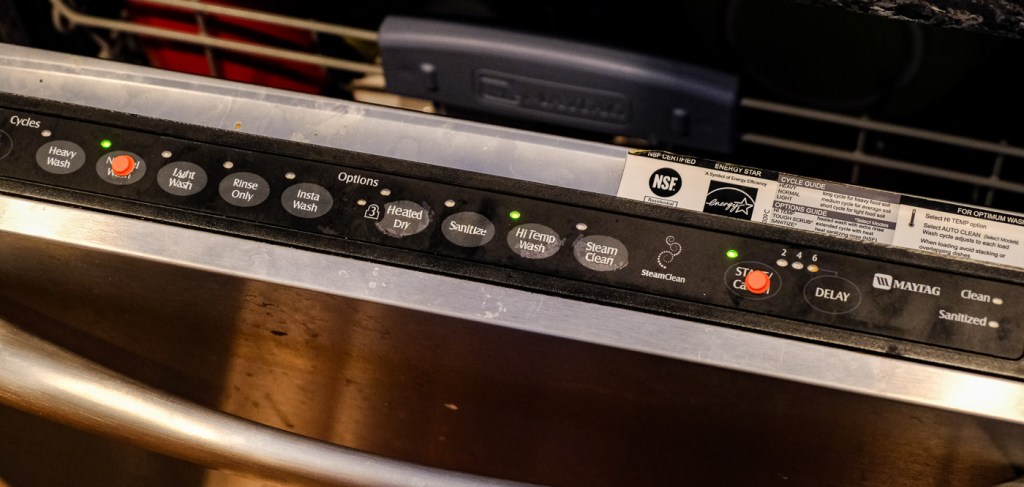
Well let’s leave that controversy for the moment; what do they know anyway; bitcoin yes, dishwashing, no! Let’s talk about how to load the dishwasher itself. Several months into living in our new condo, and with another Whirlpool dishwasher to master, I have discovered that some things are identical to our old one, and some things are new. It is a lovely machine, extremely quiet to operate, and it does indeed get things clean. (I still maintain that this is because of my pre-rinsing—and the dog’s occasional lick of the lower dish basket—more dishcussion required—Nuff said.)
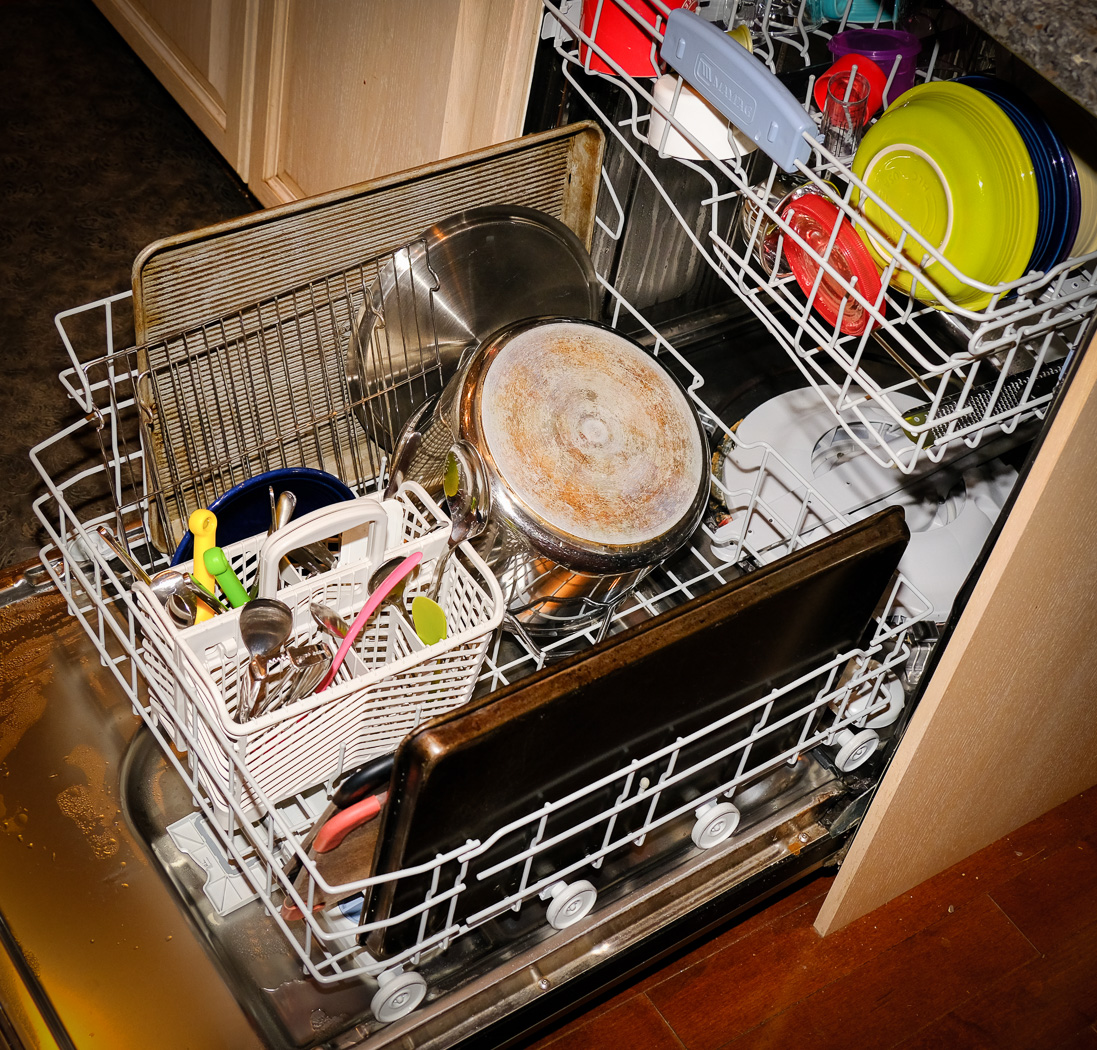
It has taken me some time to develop a new loading routine. The tines are not in the same place as with previous models. Also research has shown that with this model Whirlpool has redesigned their lower tray several times. One would hope that an optimal solution will soon be found, but not with ours, an obviously “lesser breed” compared with more recent models.
The trays come with all sorts of extra bits and pieces, with all sorts of little clips which allow me to insert tooth picks, chopsticks, and meat skewers. These add-ons are perplexing at best; I have removed them to storage, along with a funny rack which flips up and down for no obvious reason or advantage. Of course, I don’t have the manual which shows how they might be used—I could find the manual online, but that’s a lot of work. What I need is a basic tray design with a modest variety of tines and holders. No fancy add-ons. It’s like LEGO; you may remember the basic sets we enjoyed as kids. These were collections of blocks—red, white and black, with a splash of yellow. You used your imagination to create new miniature worlds. LEGO sets now do the imagining for you, providing sculpted shapes and figures, each connected by at least two round connectors, all re-creations of Battlestar Galactica, Pirates of the Caribbean, and the like. Bring back the true construction sets I say; help users of all ages to do their own creative work.
Back to the dishwasher. Here is my procedure:
- Start with glassware and mugs. Load these along the close side of the top rack, two rows full with overflow along the far edge, unless wine glass space is required—These trays are deep, and if more height is necessary because of stem length you can drop the upper tray accordingly
- Next, lay large utensils along the top tray, alternating handle direction to ensure flow and spray. Make sure they sit well and won’t slide down to the lower rack, or heaven forbid, melt themselves on the heating coil—modern sculpture may result, along with a costly repair.
- Using the tines on the upper rack, install the medium size soup bowls—our wonderful dishwasher-friendly Fiestaware sits well in its own multi-coloured universe even when the door is shut. They positively glisten once cleaned.
- Moving down to the lower rack, start with the large and medium plates. Smaller plates go either side of the utensil holder. Utensil holder design continues to evolve, I must say not entirely satisfactorily. The trick is to store utensils in a way which allows cleaning to occur without injury to human hands upon removal. Knives down, though forks must be up. We all need to work on this together. Space travel to Mars is on the horizon—but let’s get this problem fixed first please.
- Once I removed all the funny optional gadgets I opened up a lot of room (on what some call “the car deck”) for larger items—I can now insert crock-pot dishes, Dutch ovens, baking trays, and cork cutting boards. There is often space for mixing bowls and larger measuring cups.


There’s more to say, but for now, you get my drift. In an increasingly disordered world, its good to know that in some places, order precedes delight. There is a particular architecture to my approach–good technique allows for good design to accomplish good objectives. There are few things in life as satisfying as to open the dishwasher the next morning and to discover sparkly clean, gleaming, sanitized dishware, ready to do it all again, say after dinnered day. So much fun; so much joy. And food, glorious food.
 Take Note - Reflections on life, music, politics, retirement and more by Ken Gray
….and then there’s the Weissers who use theirs merely to drip dry what we wash up in the adjacent sink
LikeLike
Do you put it on when you go to bed? I do however I was told never do that! It could catch on fire!
LikeLike
Yes, it lulls me to sleep.
LikeLike