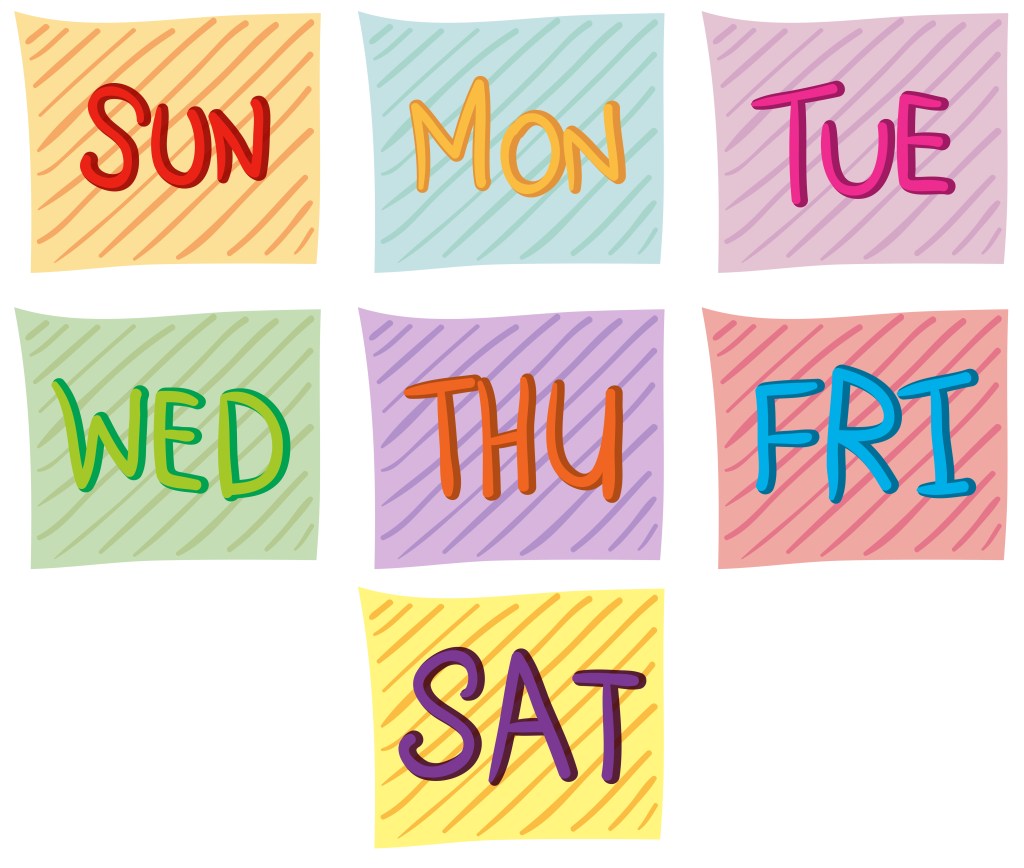
Should I feel threatened by the seven-day week? Some say YES, and their anxiety is beautifully crafted in a New Yorker article “How the Week Organizes and Tyrannizes Our Lives.” Harvard history professor Jill Lepore explains how “work schedules to TV seasons to baseball games, the seven-day cycle has long ordered American society. Will we ever get rid of it?” Or I ask, should we?
Consider some history: “A week” is mostly made up. There have been five-day weeks, eight-day weeks, and ten-day weeks. There’s got to be a reason for seven, but people like to argue about what it could possibly be.” Let’s stick with what we know: “1 week = 7 days = 168 hours = 10,080 minutes = 604,800 seconds.” That’s very clear, though some have tried other schemes. French revolutionaries tried to institute a ten-day week. Bolsheviks aimed for a five-day week. I say NO, people—don’t even think about it—here in BC we can’t even get rid of daylight savings time—which would be most helpful and less confusing.
Seven days as a week just works, and it works well, at least for my needs. Let’s get rid myself of Donald Trump, Pierre Poilievre, climate denialists, and mediocre photographers. I have no interest in dismantling the week. My days are complex enough with New York Times puzzles and games. I actually enjoy the stable and predictable rhythms of the week, though I must say that its cadences certainly change upon retirement. I often wonder what day it is, sometimes as early as Tuesday; sometimes Wednesday, or on Thursday which often feels like Friday.
And as for the weekend, I now appreciate the famous question posed by the Dowager Countess, who seated at the Downton Abbey dinner table one evening asked the commoner, Matthew, “What is a weekend?” For the DC, every day was the same, a quite boring consequence of life fueled by immense wealth and inherited privilege.
A weekend is a period of time which concludes a week, the beginning of which has been hotly contested through the centuries. Who cares, I wonder—well some do—so let’s try and understand why such matters are so important to so few.
Start with The Week: A History of the Unnatural Rhythms That Made Us Who We Are. We learn that at various times and in various places elections tended to be held on Mondays and Tuesdays, public feasts and weddings on Thursdays, and public executions on Fridays. Good to know. Plan ahead—book now to avoid disappointment. Even households had their own weekly rhythms: Mend on Mondays, iron every Wednesday, sweep the floors on Friday, inspect the pantry every Saturday.
Compare these routines with Google, today’s chronological lovechild. Organized around twelve months divided into seven-day weeks, more than five hundred million people around the world use Google Calendar, where you can toggle from days to weeks to years. Google knows where you are every day this week, and where you’ll be every day next week, and you don’t much need to mind the day, or know whether it’s a Thursday or a Tuesday, even if you’ve got someone to meet, or a train to catch; Google will send you a reminder. It will ring like a doorbell. It will blink like a traffic light. In sum, Google knows . . .
So if Google knows, and tells us so, why change? Does not such precision make for a more just and compassionate world? Hmm . . . maybe not. I recently discovered that Google does not know that Costco Kelowna has moved. Several times it directed Kathie and me to the old location. Tell that to Canadian Tire who will soon re-develop the old Costco site.
Imperfection admitted, a change in quantitative order will not produce a more healthy, socially moral and compassionate community. The organization of time does however help build community as individuals gather, collectively, and hopefully, for good purpose. Whether sharing in the arts, in sport, in commerce, in faith, or through politics, the structure does not produce the outcome. It does however facilitate the gathering.
So then, should Monday night football shift to Wednesday Pickle Ball? And Saturday afternoon baseball to Tuesday evening bowling? Should TGIF change to “thank Google it’s Thursday?” Should Wednesday remain “hump day”—tell that to the dogs at the dog park—they’ll love it. Should the Thursday grocery flyer arrive on Tuesday?
If the only thing to remain constant, is change, I continue to argue that some things should never change. Death and taxes—no change. Classical Laws of Thermodynamics—no change. Seniors’ day on BC Ferries, no change—except on those days when no ship or crew can be found.
No. Enough is enough. Despite historical experiments, including ludicrous ideas broached by religious fanatics and wealthy socialites, the arguments for changing the week, are frankly, weak.
 Take Note - Reflections on life, music, politics, retirement and more by Ken Gray
….so well put, with wit and your usual charm
LikeLike
Thank you for the chuckle 🙂 Just what I needed!
LikeLike