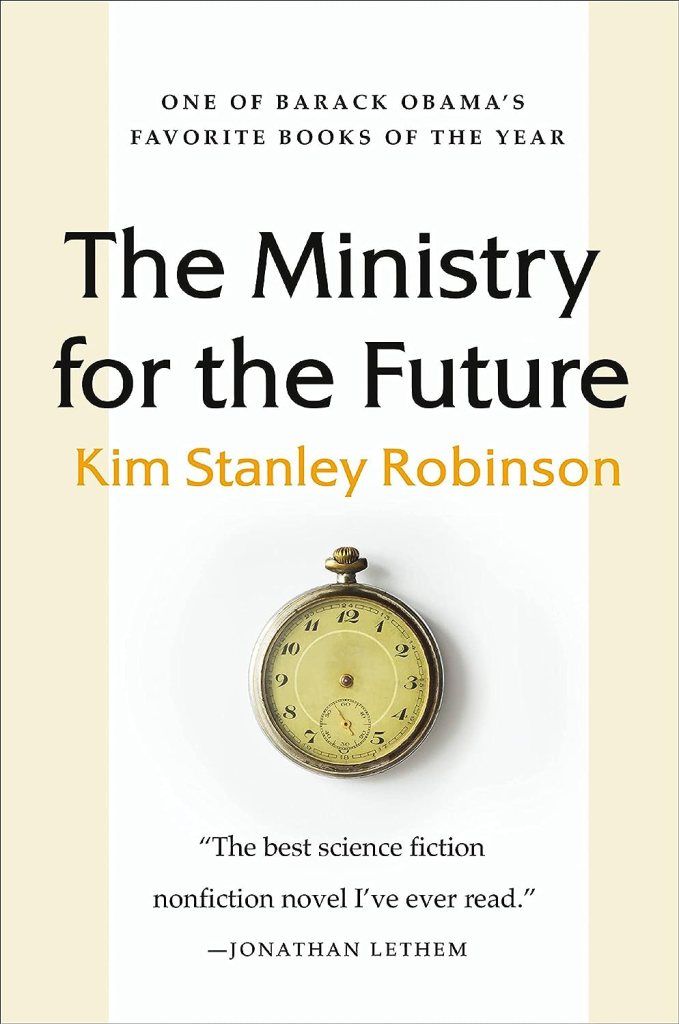
“This is the best book I have ever read.” These are not my words but those of a Berkley liturgical scholar who reads and publishes on Christian worship. Her unexpected outburst concerned Kim Stanley Robinson’s The Ministry for the Future: A Novel (Orbit, 2020).
Described on the cover by American novelist Jonathan Lathem as “the best science fiction, non-fiction novel I’ve ever read” and as one of Barack Obama’s favourite books of the year, it does not disappoint.
Through the emerging medium of climate-fiction—a combination of fiction and non-fiction—Robinson’s story is both intriguing and effectively told. Commencing just a few years in the not-so-distant future, in 2025, and finishing twenty years later, the physical settings, the science, the politics, the economics, and the social experiences described are familiar and relevant.
Early in the twenty-first century it became clear that the planet was incapable of sustaining everyone alive at Western levels.
At the outset, a region of India experiences a heat wave, so severe that thugs steal air conditioning equipment at gunpoint, while a dip in a local lake provides no relief from the stifling heat as the water is as hot as the air. There is no escape the devilish heat. Fiction you say? Not according to Bill McKibbon who writes in the New York Review of Books:
Such a heat wave is not unlikely—in fact, it is all but guaranteed. We came pretty close in California in September, when temperatures even in communities near the ocean like San Luis Obispo hit 120 degrees Fahrenheit, albeit at a lower humidity. Over the last few years we’ve seen record-breaking combinations of heat and humidity in Middle Eastern cities—the heat index has approached 160 degrees Fahrenheit in places like Dhahran, Saudi Arabia, and Bandar, Iran.
Frank, an NGO worker narrowly survives the heatwave though with significant physical injury and serious PTSD. As a lifelong victim of the climate crisis he knows the need for social, environmental, economic, and political change. He wonders however how to make things happen as nothing seems to actually change. He was sick of doing nothing, of nothing happening.
People had a very hard time imagining that catastrophe could happen to them, until it did. So until the climate was actually killing them, people had a tendency to deny it could happen. To others, yes; to them, no.
Sure, people talk, and talk, and talk. Without revealing their real ambitions.
Washington . . . where assholes congregate and bray loudly about the God-given right to kill everything in creation without restraint, we could usually make corridor creation work quite well.
Life, business, industry, transportation and travel, economics, land use, treatment of animals—all are ignored by persons of influence, those oblivious to the needs of a dying planet.
There is no Planet B, and it’s very likely that we require the conditions here on earth for our long-term health. When you don’t take these new biological discoveries into your imagined future, you are doing bad science fiction.
Into such a frightened future, steps Mary Murphy, possibly inspired by Mary Robinson (former President of Ireland) and Christiana Figueres (former secretary of the UNFCCC* process) who leads a newly created United Nations Ministry for the Future, a group assembled in response to the Indian heatwave, to determine how to enact the commitments of the 2015 Paris Agreement.
Quartered in a pristine and manicured Zurich, Mary’s leadership forms the backbone of the story, even as Mary is kidnapped, forcibly educated by Frank, pushed and pulled by financial and political leaders, also beset by her own doubts and anxieties.
She must determine how to respond to Frank’s challenge: What will change? And how will such change occur? And through what means?
While she remains committed to dialogue, she discovers that within her own ministry there are a variety of shadowy tactics in play, some unethical, some definitely illegal. What kind of power is required to drive change, to create systems that would lead to real economic reform and social transformation, and a re-balancing between the biosphere and humanity. What means justify particular ends and outcomes?
You couldn’t change things with just an idea, no matter how good it was.
To get anywhere in this world you must hitch your tiger to your chariot.
So if a new economics, based on degrowth and a reversal of the practice of shifting wealth from the poor to the rich, how might such a revolution be set in place? Who will lead the world in a new way? At one point, global financial leaders gather at the annual global Davos conference, where they are captured and subjected to a series of indoctrination exercises. What is typically viewed as just a bunch of rich guys partying becomes a school for economic transformation. As one may expect, the participants fail the final exam. They are addicted to a conservative neoliberal way of doing business as usual, based on the accumulation of wealth for a privileged few, who regard creation as their personal and corporate possession. Profit is the goal.
Not profit, but biosphere health, should be the function solved for; and this would change many things. It means moving the inquiry from economics to political economy, but that would be the necessary step to get the economics right. Why do we do things? What do we want? What would be fair? How can we best arrange our lives together on this planet?
Theory turns to practice as Mary convinces national leaders to attempt a financial revolution. Instead of profit the goal is now biosphere restoration. As the great turning is commenced, an experiment of incomprehensible proportions unfolds, amidst great trepidation:
She had urged them to create a new currency of their own collaboration, based on carbon sequestration, and exchangeable on currency exchanges; money like other money, but backed by the central banks working together, and securitized by the creation of really long-term bonds, bonds with a century pay-out at a guaranteed rate of return large enough to tempt anyone interested in fiscal stability.
As might be expected, resistance was fast and furious, but:
The social cost of carbon was finally getting injected into the price of fossil fuels, and that old saying, ridiculed by the fossil fuels industry for decades, was suddenly becoming the obvious thing, as being the most profitable or least unprofitable thing: Keep it in the ground.
The advantage of assembling a vast array of scientific data, of history, sociology, philosophy, economics, and religion, and placing all this material (which at times is quite an information dump) in an engaging story, is that seen through the lives of others, we can relate as we receive similar information and share similar experiences.
Growth! Growth! This was the world’s current reigning religion, it had to be admitted: growth. It was a kind of existential assumption, as if civilization were a kind of cancer and them all therefore committed to growth as their particular deadly form of life.
Beyond the politics and the economics, the biosphere emerges as an essential meeting space for a new kind of community. Properly managed, all these components contribute to a new experience of humans within creation itself. Robinson calls it family.
Mass action, yes, but the mass is suddenly family, they are all on the same side, doing something important.
Lest we the reader understand that all revolutions, all system management, and all tactics are human actions, he leaves room for something more: Grace.
It doesn’t come on command or to a schedule, grace isn’t like that, it touches down on you in unexpected moments, a matter of accidents, but you have to be open to it too.
With gratitude, I give the final word to Bill McKibbon
In The Ministry for the Future, it all kind of works. Yes, there’s a great and savage depression, and ongoing ecological wreckage, especially in the acidified oceans. But by the 2050s the level of carbon dioxide in the atmosphere has begun to drop, and fairly fast—down five parts per million per year, maybe even headed back to the 350 mark that the climate scientist Jim Hansen set as the boundary for some kind of civilizational chance.
And yes, with Ruth Myers, this may also be the best book I have ever read.
*United Nations Framework Convention on Climate Change
Readers might enjoy a review by Johsua Rothman in the New Yorker here.
Robinson’s understanding and appreciation of life’s duties and delights is quite remarkable and thoughtful. A second blog will list a number of short quips about life and community.
 Take Note - Reflections on life, music, politics, retirement and more by Ken Gray
Leave a comment