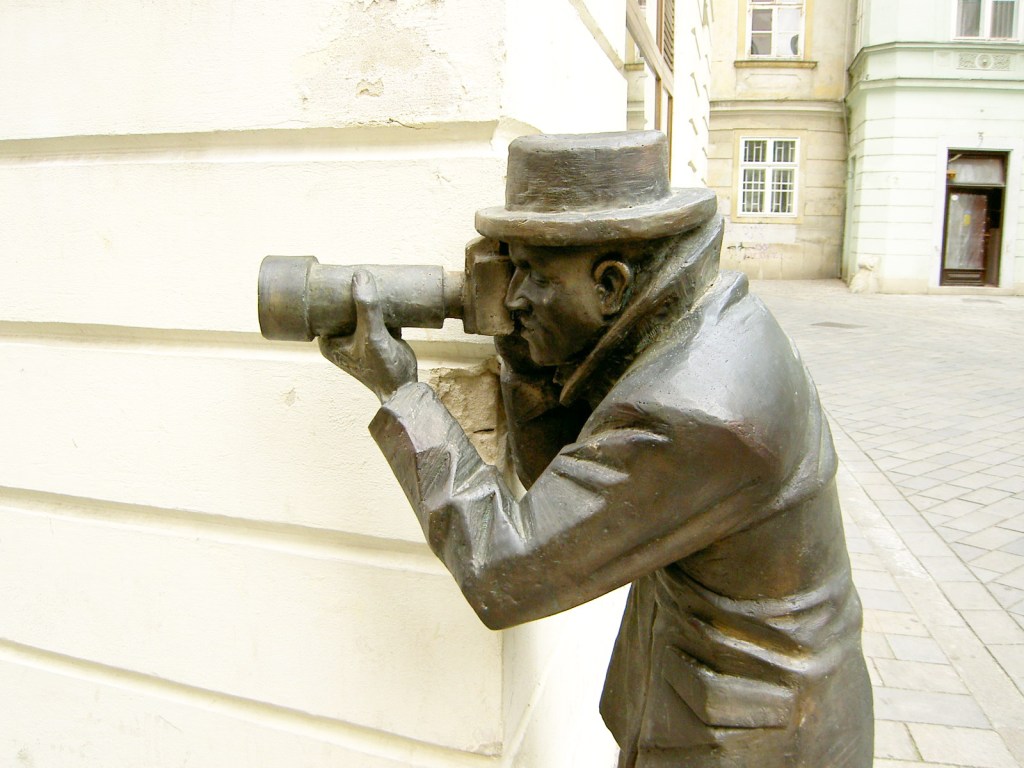
Statue of a paparazzo by sculptor Radko Mačuha in Bratislava, Slovakia
Vermin; the bottom-feeders of journalism; the worst version of photographic artists.
My initial thoughts about paparazzi—those independent photographers who take pictures of high-profile people; such as actors, musicians, athletes, politicians, and other celebrities, including royals—was poor to say the least.
I had just watched Season 6, Episode 2 of The Crown: “Two Photographs” a fictional version of events leading up to the death of Diana, the Princess of Wales, and Dodi Fayad in a Paris roadway tunnel. Blame for the tragedy is clearly laid at the feet of a frenzied paparazzi in pursuit of a seemingly reckless Diana—except we did learn afterwards that their car was travelling at twice the speed limit in a confined space driven by a chauffeur who made a very fatal choice.
Using photographic practice—both of journalism and portraiture— the cold open features interviews with two distinctly different photographers. First, we have Mario Brenna, the real-life paparazzo who allegedly earned $5 million for the world rights to the first photos documenting Princess Diana and Dodi Fayed’s romance. Brenna chillingly talks about how paparazzi must “be like hunters, killers.”
In contrast, we have Brenna’s polar opposite: the fictional sedate Scottish portrait photographer Duncan Muir (dude wears a tweed coat and drives a dependable Volvo), who has picked up a side hustle taking pics of the royal family.
Two very different photographers; two very different settings for royal activity. Diana secretly (?!) cannodles with a lover on a yacht in a sunshine summer, versus Charles and his boys shooting in the damp Balmoral highlands. Each gets a photographic treatment—one welcome, and one very unwelcome. Both images are attractive to a voraciously curious, almost voyeuristic public, who will discover both in the dailies—The Telegraph and The Mirror what they are told is “the truth.” Remember Pilate? “What is truth.” Truth can be spun in all directions with long lenses and creative imagination.
Both Charles and Diana need photo journalists and photographers to connect them with an adoring public. Whether they need the paps is another matter. Whether in Italy, France, England or New York, the paps are everywhere, with everyone, constantly. That said, and to return to my opening comment—I have always despised the paps—my research opened my eyes to a few things.
- Paparazzi are photo-journalists on steroids. They serve the needs of their subjects. While her immediate need is for privacy, in other contexts Diana needed the paps to raise the profile of her projects. Charles needs photographers )though not paps) to help him and all the royals connect with a distantly curious though confused public.
- Photographers often ask “what’s in the bag” that is, what equipment other photographers use and carry whether their subjects be people, places, or perfitude. Henry Flores of BOZZPHOTO uses standard pro equipment—for those who care, he’s a Canon shooter. He carries around about 10K worth of equipment daily—hence his occasional use of bear spray—not so much the bazooka-like equipment (600mm+) of his more scurrilous competitors which cost four times that amount. For Henry, discretion is important, unlike many modern-day paps who physically invade the space of their subjects, with little concern for image quality, and less capacity for respect.
- As with other photo-artists, it’s a job, one requiring skill and a desire for adventure. In The Insane Lives of Paparazzi Miles Diggs takes us on a daily image scrounge through the streets and canyons of Manhattan. His office is his car. His craft combines photo journalism with wildlife photography. Speed is essential; you must discover where and when to show up; you must become the “artful dodger” of the street, no longer picking pockets but picking the right location.
- You need to be first to publish your images as other competitors will get the same shot. Few paps get five or six figure payouts. Many of Miles’s shots get $50-$250 a pop. He hopes one day to make $1M a year. See what happens.
The truth about paparazzi photography is that we despise it and love it at the same time. Perhaps this also explains why so many modern artists have been drawn to it. As well as transmitting the illusion of authenticity and the whiff of transgression, paparazzi photography taps into our darkest, most voyeuristic desires –terrain often explored by great art.
Yep, it’s great work if you can get it; and are prepared to work for it; but, do you want it?
 Take Note - Reflections on life, music, politics, retirement and more by Ken Gray
Leave a comment