Anyone familiar with the work of artist Maude Lewis must visit the Art Gallery of Nova Scotia, and in particular the Maude Lewis gallery when visiting Halifax.
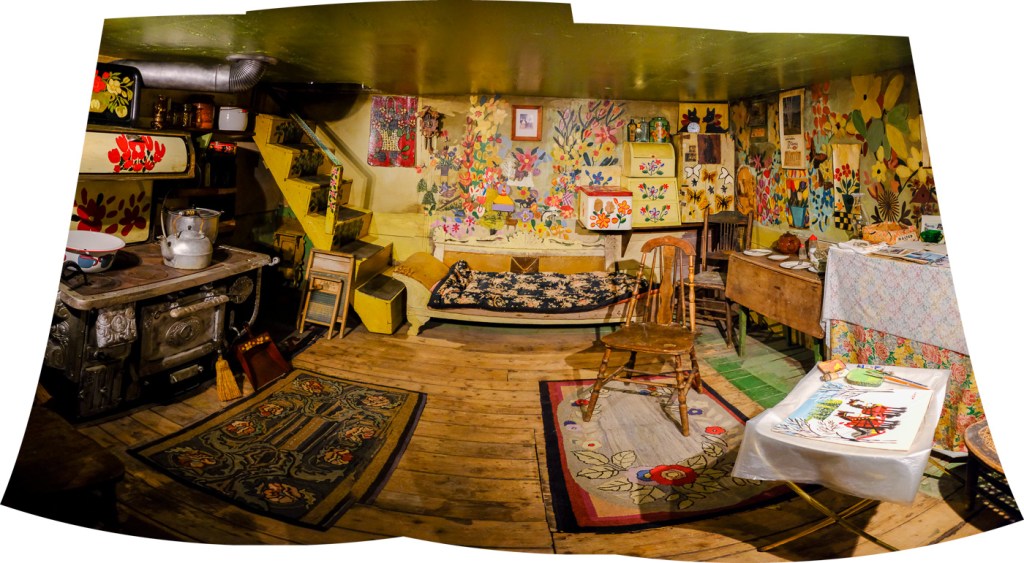
Surrounded by works from the provincial collection, and from collections of generous benefactors, visitors are met not only with samples of her art, but by her actual house, transported, renovated, and installed as a testament to this most creative and resilient Nova Scotia painter.
[From the gallery website] Maud’s story has often been portrayed as one of isolation, embracing the myth of an idyllic rural Nova Scotia, reinforced by her incredibly popular nostalgic and optimistic paintings of that landscape and community. Taking a closer look at Maud’s development as an artist, this updated exhibition challenges the notion that poverty, lack of formal training, physical disability, and rural life meant Maud wasn’t exposed to outside artistic influences.
This exhibition embraces Maud as an artist who took inspiration from a wide range of graphic media, her surroundings, and her childhood memories, and transmuted them into something that is distinctly her own.
After the death of Maud Lewis in 1970, and subsequently of her husband, Everett Lewis, in 1979, their lovingly painted home began to deteriorate. In reaction, a group of concerned citizens from the Digby area started the Maud Lewis Painted House Society; their only goal was to save this valued landmark.
After reading about Maude Lewis, Kathie and I learned of her evolution as an artist and her remarkable ability to navigate some tragic life experiences, all told in the 2016 film, Maudie.
Maudie is a biographical drama film directed by Aisling Walsh and starring Sally Hawkins and Ethan Hawke. A co-production of Ireland and Canada, it is about the life of folk artist Maud Lewis, who painted in Nova Scotia. In the story, Maud (Hawkins) struggles with rheumatoid arthritis, the memory of a lost child, and a family that doubts her abilities, before moving in with a surly fish peddler (Hawke) as a housekeeper. Despite their differing personalities, they marry as her art gains in popularity. The film was shot in Newfoundland and Labrador, requiring a re-creation of Lewis’ famously small house.
Maud’s art demonstrates more than raw talent. Her art speaks to the very best of the human spirit. Her ability to rise above the tragedies that constantly beset her, even as she was abused and exploited, inspire, and delight us. She found a way to make what was dreary, beautiful. If Malcolm Muggeridge could describe Mother Theresa in the words “Something Beautiful for God” I would say that Maude Lewis shares with us something beautiful for everyone.
While our own individual experiences obviously vary, Maud Lewis found a way to create beauty all around here, not defiantly, but persistently. The small size of her home ironically serves to amplify the huge influence her works continue to inspire and delight new generations of admirers.
Next time you are in Halifax, well, you know what to do. And do spend time with the AGNS online resources including audio and video tours of the gallery and introduction to her oeuvre.
 Take Note - Reflections on life, music, politics, retirement and more by Ken Gray
Leave a comment