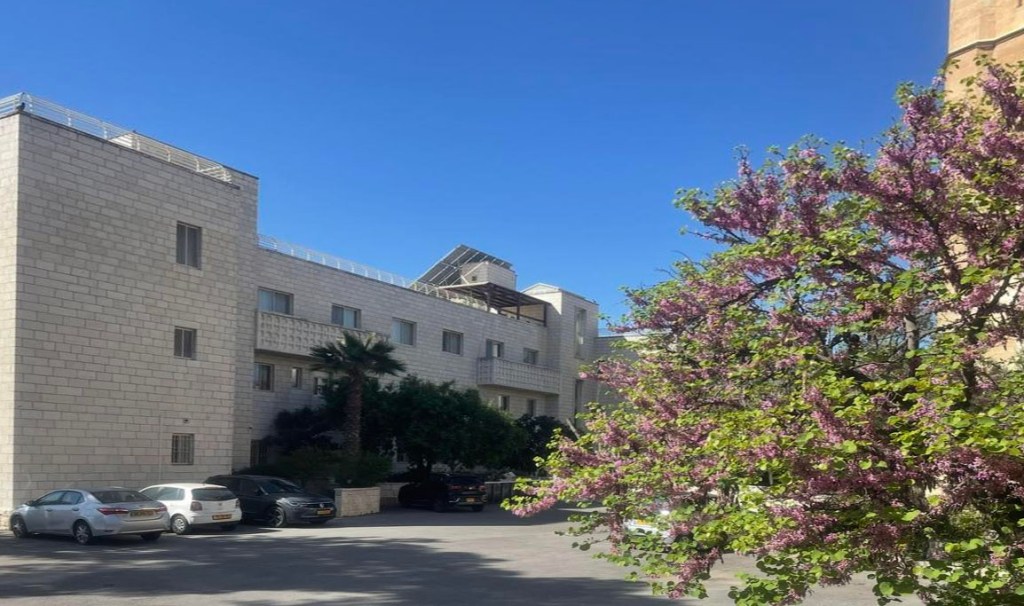
A report from the Anglican College in Jerusalem
Here we go again. The ministry of the College has been inhibited in so many ways over these past years. Yet again, just as pilgrim visits were beginning slowly to re-start, we have been thwarted as full-blown war returns to these lands.
Tragically, far more energy, effort imagination, and finance goes into war-making as compared to peacemaking.
So missiles and drones are all too easily the preferred option. Now a ‘preemptive attack’ brings fear and danger back to Jerusalem, Palestine, Israel, and Iran. Indeed, to the entire region. If only humanity ‘knew what makes for peace’ as Jesus himself bemoaned when he gazed upon Jerusalem from the Mount of Olives. The bold goals of war are so rarely if ever realised when the reality of the cost of war is assessed. The arrogant claims of defeating evil by killing and destruction falter when the bombing ceases.
The Blessed Remnant of the College and Diocesan staff who continue in post despite the lack of pilgrim groups, have to deal with the disappointment of their continued absence caused by cancelled flights and the dangers of travelling. The bomb shelter is our refuge when the air raid sirens sound, which is often.
But most of all our hearts break for all those whose lives are in the direct line of fire. Iran does not have the defence mechanisms of Israel and many citizens, who wish to throw off the shackles of a wicked regime, will not be assisted by the military onslaught on their country. Indeed, many will lose their lives. And other innocents will die throughout the region. And with attention focused elsewhere, the conditions for Gazan and West Bank Palestinians will worsen further.
As Christians we must redouble our efforts, our words and actions, for peace. The road to peace can only pass through justice to reach the destination. We ask for your prayers, not only for peace but also for the righteous living which Jesus taught in his Sermon on the Mount:
Blessed are the poor in spirit,
Blessed are those who mourn,
Blessed are the meek,
Blessed are those who hunger and thirst for righteousness,
Blessed are the merciful,
Blessed are the pure in heart,
Blessed are the peacemakers,
Blessed are those who are persecuted because of righteousness.
AND THIS from College Dean Richard Sewell
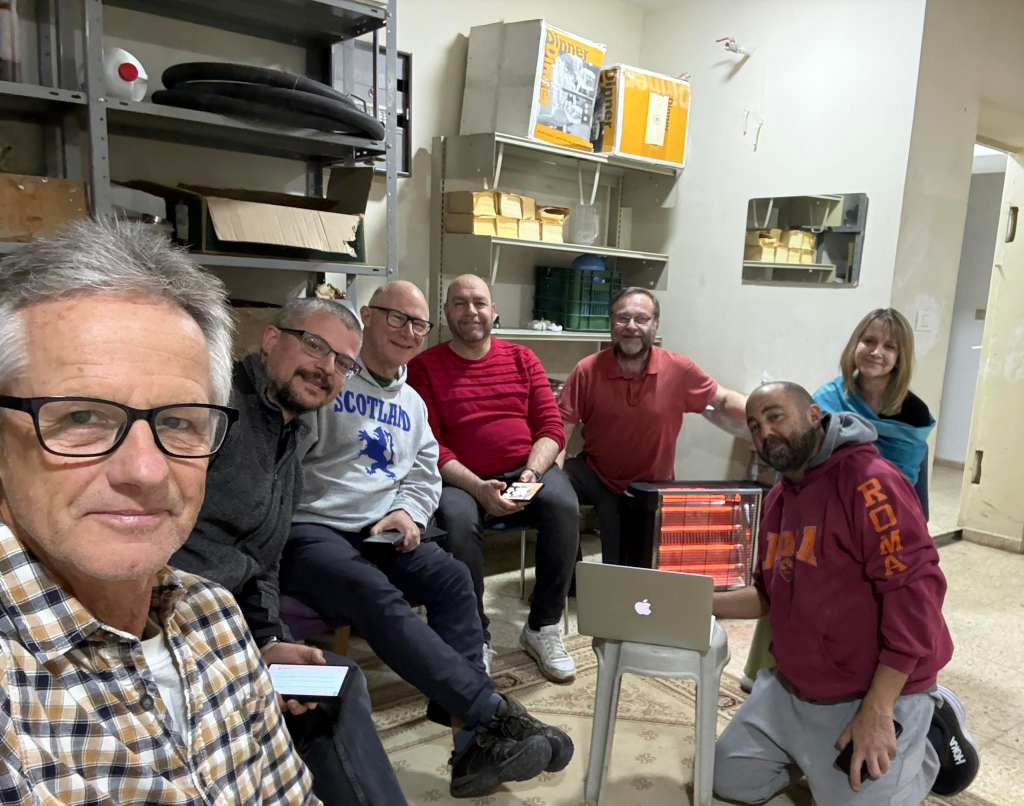
College staff sheltering in place in the safe room
IT BEGINS with a sound on your phone. The message reads: “Due to the detection of missile launches, alerts may be activated in your area.” Then you know that you must prepare. End whatever it is you are doing, and ensure that you are near a shelter. Most often, up to ten minutes later, a loud and different alarm will sound on your phone, telling you to get to a protected area within 90 seconds.
This is what happened at 8.30 a.m. on Saturday in Jerusalem. All those working and resident in St George’s College at that time — and we did have a UK Methodist minister visiting us — appeared from different quarters in the bomb shelter in the college basement.
It is expected that institutions and public buildings will have bomb shelters. In the predominantly Jewish areas of Israel, it is required by law that there is a public shelter within three minutes of any location. In the predominantly Palestinian areas of Israel, the Government has not invested in such facilities. In our location — Occupied East Jerusalem — we are fortunate to have a good-quality protected area in our building, as facilities near by are otherwise very few.
In the first three days of the present war with Iran, we must have gathered in that rather basic accommodation at least 20 times, day and night. Even from the bunker, we can hear the crumping sound of the shooting down of missiles overhead by Israel’s missile-defence system, the “Iron Dome”.
Sometimes, we feel a shudder from the force of it. Described in these terms, it all sounds frightening, but, in all honesty, the danger is not all that great. Iran’s missiles are aimed at Tel Aviv, Haifa, and elsewhere, and almost always outside Jerusalem. Occasionally, however, missiles go astray and land within a mile or two of the college and St George’s Cathedral, which sit within the same beautiful compound. Usually, within 15 to 40 minutes, we receive the “All Clear” message, and we are free to leave the bomb shelter, picking up where we left off before the interruption.
THE practical issue of running for safety is one element of the experience of living through war, but, of course, there is so much more to it than that. Our hearts are heavy with the knowledge that people not so very far away will be dying. The planes flying overhead are not on practice runs, but are flying on or returning from a bombing mission, with the intention of killing people.
Also, more than ever before, all of this is a regional conflict. All of the countries that are presently involved are a part of our Anglican Province, composed of three dioceses: Jerusalem, which covers Palestine, Israel, Lebanon, Syria, and Jordan; Iran; and Cyprus & the Gulf (including Yemen and Saudi Arabia).
We have clergy and lay personnel throughout the region, and, in most of it, we also have churches and congregations. The people affected by the bombing, wherever the bombs fall, are in a real sense “our people”: they are not distant and foreign individuals with whom we have no connection.
We all feel the pain of this terrible and terrifying war, which has affected so many people and nations. As the Archbishop in Jerusalem, Dr Hosam Naoum, said in his pastoral letter to the Province this week, the Christians of the region should “refuse to see their neighbours as enemies”, and we must remain “bridge-builders . . . and keep the doors to reconciliation open”.
WHEN a vast military force is deployed on both sides, aimed at achieving goals that always seem to put the welfare of ordinary people low down the priority list, it is all too easy to despair at the prospects for a real and lasting peace.
So much money, effort, and imagination are invested in the ways and means of war. So little energy, imagination, and funds are directed towards the establishment of peace. Consequently, it is no surprise that the ways of war all too often prevail.
During the exhausting days of war during the past two-and-a-half years, I have so often reflected on Jesus’s angst-ridden words on the Mount of Olives. As, aware of his impending destiny, he approached Jerusalem, he gazed upon the Holy City and said: “If only you had known what makes for peace.”
It is surely a plea to us as well, to perceive and to strive for the things that make for peace. The world’s media presently have an all-enveloping interest in the ways, means, and impact of war. But when the missiles and drones fall silent again, what effort will be employed to heal and rebuild? We are still asking that question with great feeling in relation to Gaza. In the light of such abject human failure, may the Lord guide us into the ways of righteousness and peace.
The Very Revd Canon Richard Sewell is the Dean of St George’s College, Jerusalem.
Visit the takenote.ca HOME page for a colourful display of hundreds of other blogs which may interest or inspire you
 Take Note - Reflections on life, music, politics, retirement and more by Ken Gray
Leave a comment