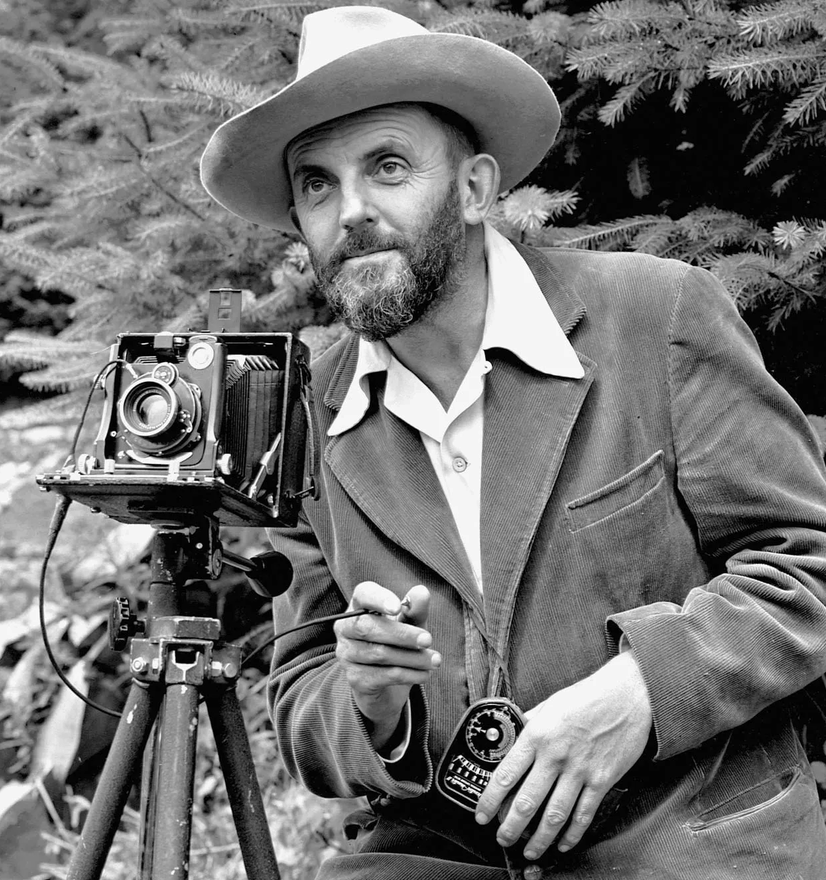
Ansel Adams (1902–1984) was a renowned American artist and one of the most influential landscape photographers of the 20th century. He is best remembered for his stunning, high-contrast black-and-white images of the American West, particularly the wilderness of Yosemite National Park. Adams was a master of technical precision. In 1932, he helped form Group f.64, a collective that championed sharp focus and the full range of the gray scale. He famously developed the “zone system,” a method that allowed photographers to visualize and control the final look of an image before even taking the shot. Unlike earlier photographers who focused on geology, Adams was known for capturing the “weather” — the transient, changing moods of the natural world. [Britannica]
In the rarely seen documentary video below, Adams narrates his own in-situ process. Many photographers today — especially those who are accustomed to automatic in-camera and post-production processes — can only marvel at the skill, effort, and dedication to craft demonstrated in Adams’ work. His philosophy is simple: Technique “is being able to do what you want to do when you want to do it.”
It must also be said that the amateur can’t seem to get things right; the professional can’t afford to get things wrong. Additionally, if you can’t get the shot you want today, come back tomorrow; and the next day; and the next.
Video transcript:
Techniques are simply a means of bringing about in the print the image as visualized by the artist before he operates the shutter. The justification for technique is being able to do what you want to do when you want to do it.
Rice, the tessar, the triplet; protar, ektar, extner are the competent, the ectanon the cook C5 K2 X1 G A the long the wide the normal.
After we have composed our image on the glass, we of course think of the tonal values of the print, and that means that we have to evaluate the brightnesses of the subject. We do this by the use of exposure meters. We can take average readings or instant light readings, or best of all, we can take photometric readings of small areas of the subject.
SEI ASA f-stop, t-stop, reflectance, incidence, brightness, intensity, strobe, wink, flash, bounce, natural.
Darkest shadow, eight candles per square foot. Light on wet sand, 2000 candles per square foot. Place shadow on zone one. High value will fall on zone nine. Normal minus development indicated. I keep a record of everything: film, lens, filter, lens extension, lens aperture, shutter setting. Above all, where I’ve placed important values on the exposure scale, and what development I will use to retain them in the negative. The negative looks adequately sharp all over, and. Shadow density is exactly on the right zones. A little camera flare helped the shadow density as expected. Dust brushed off the negative. Here goes for a test exposure. 1 2 3 4 5 6, The image is coming up quite well balanced. Here’s the final print. Shadows come through as expected, and the high values are okay. There is nothing mysterious about technique. It’s really nothing in itself, except as a means to an end.
Visit the takenote.ca HOME page for a colourful display of hundreds of other blogs which may interest or inspire you


Leave a Reply