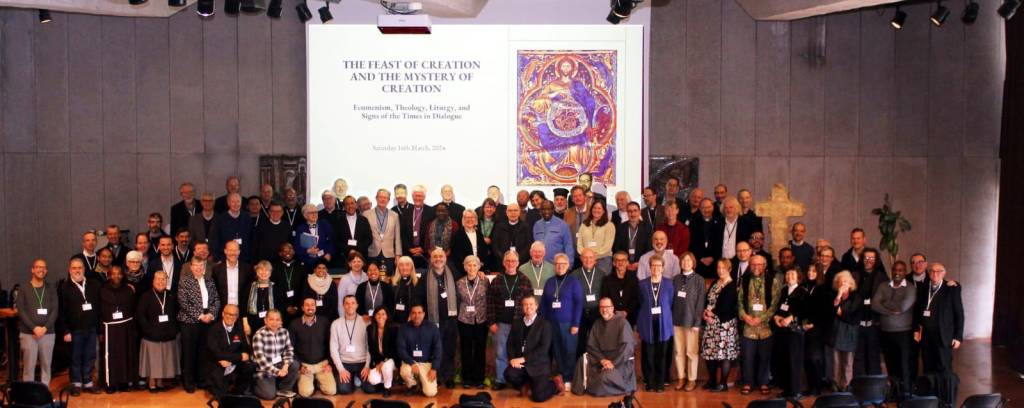
Ecumenical participants gathered in Assisi–others joined online
Today’s blog provides a brief overview of Anglican engagement with the global Season of Creation (Sept 1 – Oct 4, The Feast Day of St. Francis). This text was presented by Dr. Rachel Mash, secretary of the Anglican Communion Environmental Network (a post I held from 2005-2018) on March 15, 2024 during an ecumenical meeting of liturgists and church leaders: THE FEAST of CREATION: and the MYSTERY of CREATION, a gathering both in-person in Assisi, Italy and online. I was able to participate online from the early-morning (0300) coffee-infused haze of my own home. Here are Dr. Mash’s comments.
The Anglican Communion is a family of churches, independent and inter-dependent such as the Church of England, or Southern Africa, or the Philippines. It has been fascinating to see how the Feast of Creation has grown organically with little shoots coming up in different ways in different places!
In Southern Africa we first heard of the Feast of Creation from two sources—the Catholic Archdiocese of Manila and the Season of Creation movement in Australia. Lutheran pastor Norman Habel had produced materials on different themes for Earth Sunday, Forest Sunday etc. So we produced our first liturgy in 2008!
As the Anglican Communion Environmental Network we took a resolution (15.01) to the Anglican Consultative Council in New Zealand in 2012, “to consider the inclusion of a season of Creation in the liturgical calendar.”
The shoots continued to spring forth! In Canada Dean Ken Gray was (I think!) single-handedly promoting THE Feast of Creation with beautiful liturgies at St. Paul’s Cathedral, Kamloops BC.
In the USA, my Sister Rev Margaret Bullitt-Jonas continues to write liturgies for the Season of Creation, a liturgical time now authorized in sixteen Dioceses of the Episcopal Church, with more expressing interest.
In the Church of England the Feast of Creation was adopted by individual schools and parishes as part of an ecumenical initiative.
In Australia individual churches were influenced by Norman Habel and started to celebrate the SOC.
In Scotland an ecumenical movement was promoted by the Scottish group Eco-congregations. Other congregations worldwide received materials via the World Council of Churches. And so the small shoots keep on growing.
In 2016 the Anglican Communion Environmental Network joined the Ecumenical Season of Creation steering committee comprised of Laudato si’, Lutheran World Federation, and the WCC, as founding members.
There are many shoots that of which we are not aware, those communities where God is touching hearts and lives and liturgists!
And now we stand at a kairos moment. For many of us, the Feast of Creation is a time to celebrate God the Creator and to preach and pray about our responsibility as earth keepers.
And yet we are learning something deeper and I give thanks to my Italian fratelli and sorelli for opening our eyes. This is a season of Criazone— the act of Creation! Not just a season of il criato —the created environment. It is not a “Christian World Environment Day”—no! It is time to celebrate the start of the story of salvation history—The Feast of Creation is a Christological feast. So what are the signs of the times for us?
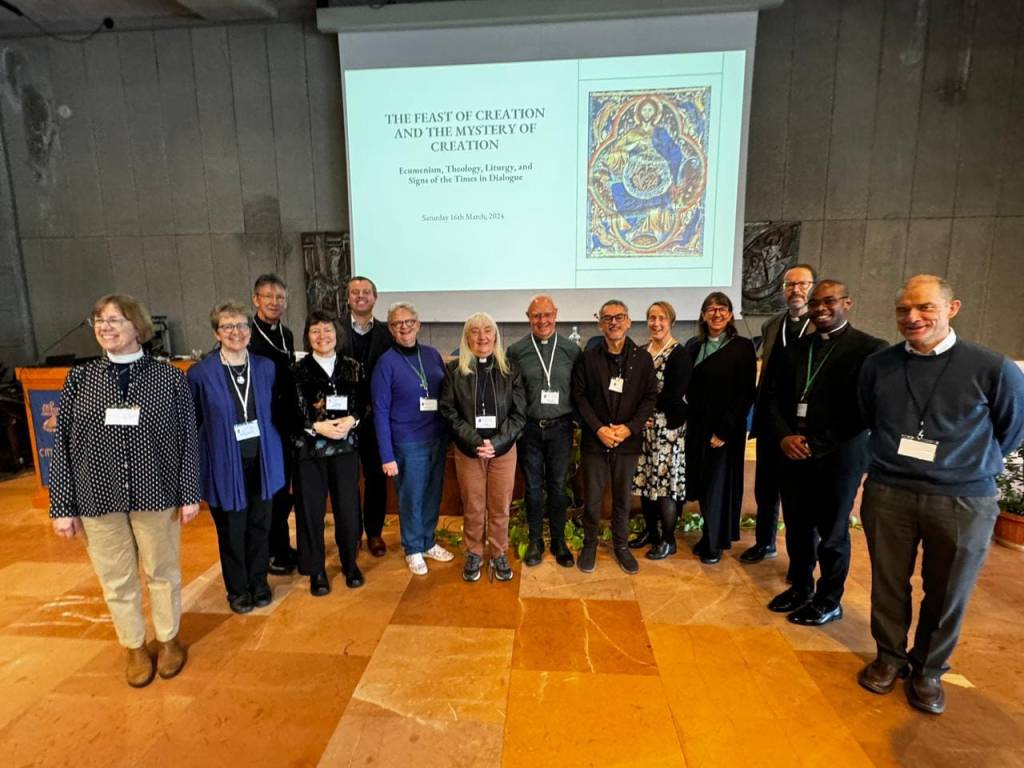
Anglican in-person participants and presenters
The first sign is to confess that we have ignored the fact that salvation is not just for human beings—God’s plan is for the whole cosmos.
In the beginning God created the heavens and the earth—and In the beginning was the Word, and the Word was with God, and the Word was God. Through him all things were made. And God placed Adam and Eve in this beautiful garden planet and gave humanity the first commandment—work the land and look after it. (Genesis 2:15) And we failed to obey him, and sin entered paradise; we became greedy and we ate beyond the limits—and in Genesis 3 we see the breakdown in relationships between God and humans, between humans and each other and also with the land. (Genesis 3:17). Cursed is the ground because of you; through painful toil you will eat of it all the days of your life. And so because God loved the whole cosmos, not just the people, but the eco-systems, the whole web of life—He sent his only begotten son to die to bring reconciliation with God, between humans and with the Earth. (Colossians 1: 20)
God was pleased through Christ to reconcile to Himself all things, whether things on earth or things in heaven, by making peace through his blood, shed on the cross. We hear the groans of Creation (Romans 8:22) but these are not groans of despair but of re-creation—the pains of childbirth. God who created the universe through Christ and reconciled the whole cosmos through Christ is recreating and renewing the whole of creation. Let us embrace the Feast of Creation as the start of salvation history which points to the re-creation and renewal of creation.
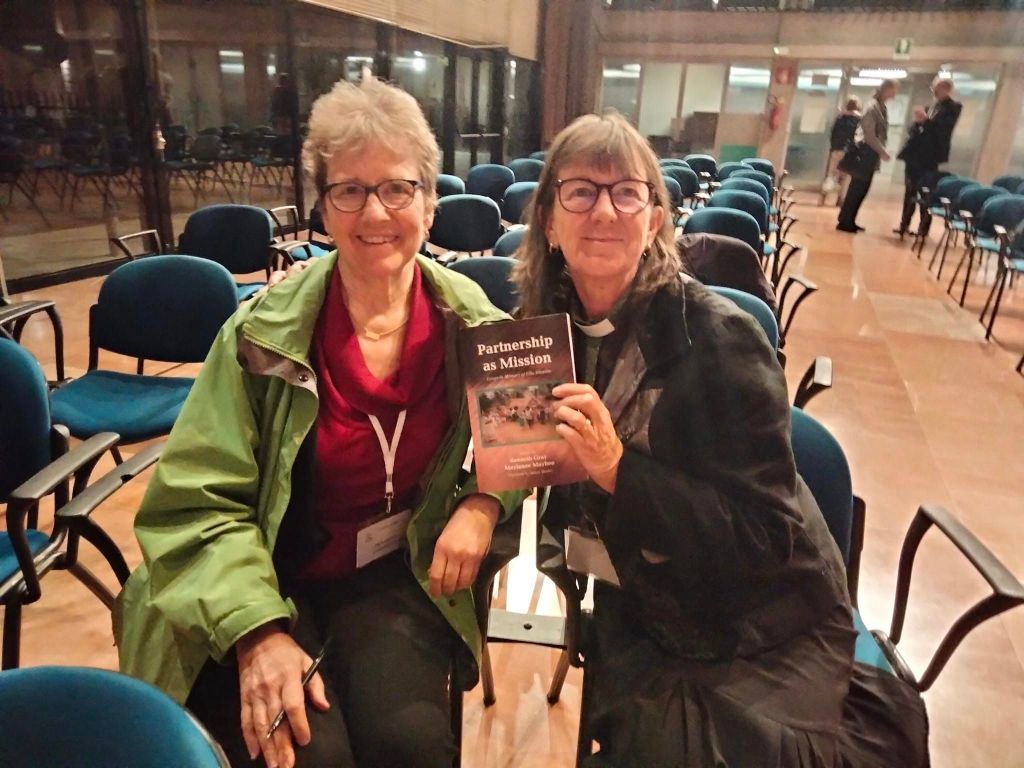
Deacon Maylanne Maybee presents Dr. Mash with a copy of Partnership as Mission, a book she co-edited with Ken Gray
A second sign of the times is that we need to hear the voices of young people. Each year with the ecumenical Season of Creation we invite young people to hear the voice of the spirit and choose the theme. Last year it was Let Rivers of Justice flow. (Amos 5:24)
So what is a river? It starts with tiny raindrops—us as individuals; your parish environmental group; the leader of prayers on the environment on Sunday morning. And those other drops that form a stream? Your Archdiocese embraces the World Day of Prayer for Creation and then the stream becomes a river; Laudato si’; the Renew our World movement, the Anglican Communion Environmental Network. And others. But it is only when those rivers come together that a mighty river of justice is created that can mountains.
Yes, this is a kairos moment.
 Take Note - Reflections on life, music, politics, retirement and more by Ken Gray
Thanks again and again Ken….this is what we are about at our roots. I’ve subscribed and may I add, a book that I’m reading may interest you: Sacred Earth Sacred Soul by John Philip Newell, Celtic wisdom. Trev.
LikeLike
I know the book well. K
LikeLike
How wonderful!
PS I went to St. Lawrence Anglican Church in Coquitlam this Sunday with my sister and her husband 🙂
LikeLike
And the walls (did not) come tumbling down.
LikeLiked by 1 person