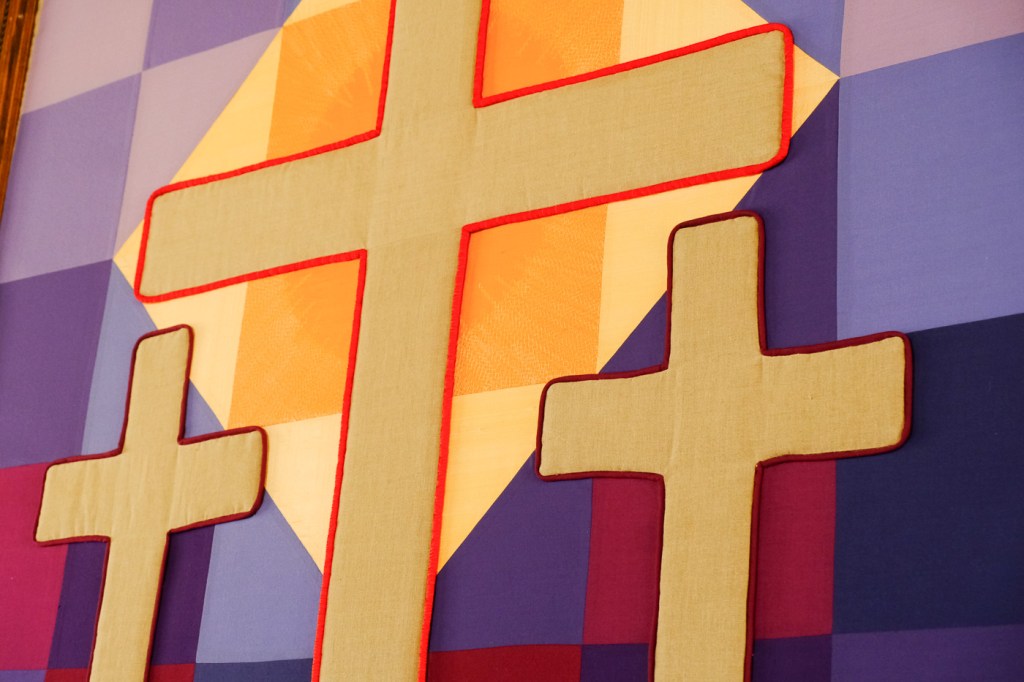
A sermon preached on Palm Sunday, March 24, 2024 by the Ken Gray at St. Stephen Anglican Church in Summerland BC
Today is a day of texts and stories, one of the longest set of lections in our three-year lectionary cycle. Consequently today is not a day for long sermons so I will be as concise as possible. There is a lot to take in today. I will do my best.
As a choirboy I remember loving the scriptures of Holy Week. No more fuzzy parables. No more confusing (and for a kid) abstract controversies—Who should throw the first stone? Who healed that woman? And why? Very puzzling were Paul’s thoughts on who can sleep with whom?
No, Holy Week and Easter stories were exciting, action oriented, fast-moving narratives that captured my childhood attention. Celebration became violence, but that didn’t seem to trouble me—after all I watched the Viet Nam War on television with my parents, confident that such violence would never touch my own life in Victoria’s Oak Bay residential neighbourhood. The air-raid siren sounded twice yearly, though I never knew why.
In the passion narrative we hear today, celebration turns to struggle, then to betrayal, which turns to violent death in the literary space of a few chapters in each of the four Gospels. If you have watched the Angel Studios multi-season series about the life of Christ, The Chosen (available free online, also on Netflix) you will be familiar with a storytelling style that offers a glimpse into what might have been the context and experience of Jesus and his disciples throughout his earthly ministry, including his passion.
As a child, and sometimes even now, I read the gospels as public events, and not as The Chosen depicts them, as sometimes intimate events occurring under the cultural radar of the occupied Judah and Israel of the day. Holy Week Season Four is not yet available for streaming so I remain curious to see how these later episodes will depict the triumphal entry into Jerusalem, a travel we re-enacted earlier. We are accustomed to lively shouts of praise—Hosannas everywhere—and grand music and visual spectacle as we commemorate this event. Such an interpretation may be exaggerated.
I always thought of the triumphal entry into Jerusalem as something akin to the Victoria Day parade in my hometown of Victoria—typically over one hundred marching bands, fire trucks, military hardware, and clowns throwing candy (can’t do that now). A huge public parade with people and palms? Or a less dynamic entry into the Holy City? Hosannas from a fickle crowd, which disappeared quickly, almost completely by Good Friday. In short order Jesus is betrayed, bruised and beaten, marched towards a sanctioned murder and death, largely ignored, solitary, and alone, but for a paltry few fearful supporters waiting at a distance.
Meanwhile, today, in Trumpian America (aka make Trump great again), where the latest salvo of extremist hatred—last weekend’s declaration of the non-human status of so-called illegal immigrants: “these are not persons” declares the xenophobic and racist former president—we have heard such things before; remember 1933-1938. A further horror is that his republican base and leadership seem not to care about such immoral and ethically destructive speech and behaviour, as in their view he is the gateway to power—for such people the ends justify the means.
If this describes our own day, remember how Pilate mixed the blood of Galileans with their sacrifices, let alone the practice of crucifixion as a regular practice. Then and now, evil lurks and acts. The passion story is both ancient and contemporary. The powers of good and evil play their cards seemingly in deadly competition. John the gospeller notes that the light shines in the darkness and will never be overcome (John 1:5), but there is certainly darkness. The author of the Letter to the Ephesians knows well the struggle between good and evil, and the necessary resolve, reliance, and courage to battle it:
Finally, be strong in the Lord and in his mighty power. Put on the full armor of God, so that you can take your stand against the devil’s schemes. For our struggle is not against flesh and blood, but against the rulers, against the authorities, against the powers of this dark world and against the spiritual forces of evil in the heavenly realms. Therefore put on the full armor of God, so that when the day of evil comes, you may be able to stand your ground, and after you have done everything, to stand. (Ephesians 6:11-13)
They were not easy times when Jesus entered Jerusalem to embark on his passion journey. These are not easy times globally in our day. In our human incarnation—flesh joins spirit as spirit invests in flesh— we are not identical to Jesus though we are called to follow him, drawing on Ephesians, to stand with him, in truth and through love. Born in the mid-5th century BCE the Greek Eryximachus [ERIK-SI-MAKE-US) maintained that for health to flourish, “the one who is able to separate fair love from foul, or convert one into the other … can reconcile the most hostile elements in the constitution and make them loving friends.” In a similar vein, when love “is at the centre of the whirl, in it do all things come together so as to be one only.”
Former Archbishop of Canterbury, Rowan Williams notes that “when we as Christian believers try to engage with the society around us, with the culture, the politics, the economics of our age, what we seek to do is not simply to lay before that culture a set of propositions about God. It is to uncover before that culture the depths of human possibility: to say that humanity is more than this (King Lear), this, and this; to say that self-giving in death and sacrifice is possible for human beings; to say that forgiveness and reconciliation are possible for human beings.”
We discover such truth from the place in which we live and move, through the means and opportunities available to us. I remember from my Sooke days a Roman Catholic electrician named Larry Rumsby. He told me of his first peace march, a time when he decided to step off the sidewalk and join the parade, the pilgrimage, a time when he knew he had to take a stand. I pray that we all might find opportunity to somehow join the parade, with Jesus at the head, leading a believing and loving community of justice-seekers. Amen.
 Take Note - Reflections on life, music, politics, retirement and more by Ken Gray
Well said!!!
LikeLike