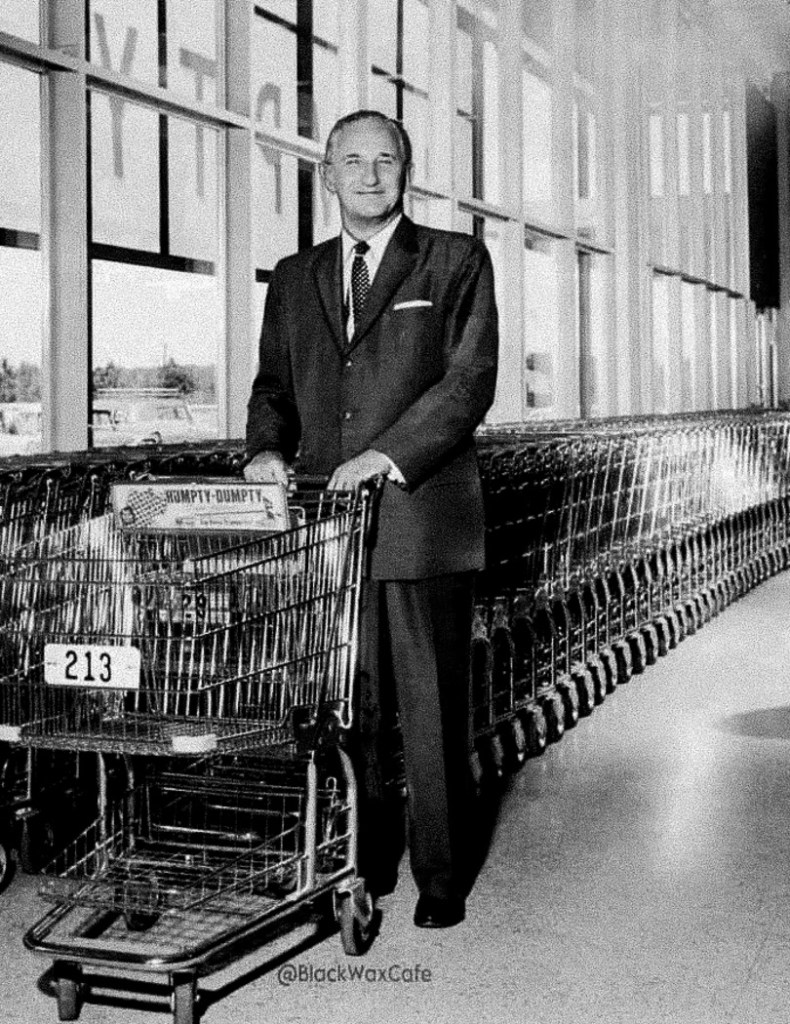
Photo: Goldman with one of his carts in 1960
In a previous post I complained about people who did not return their grocery carts to the storage area once they had placed their groceries in their car in the supermarket parking lot. I raised serious questions about safety, employment practices, sustainable space, community standards including respect for others, and general tidiness principles.
While hardly overwhelming, the response to my post has been significant; most people clearly agree that to return the cart to the caddyshack is an appropriate demand on consumers, possibly with the exception of single mothers with more children than fingers, and an anxious dog on a hot day.
Imagine my delight to stumble upon a history of the grocery cart. Sure, we all think that carts have always been there, that they have been part of the cultural history of all ages in every place. Surely in London’s Victoria and Albert Museum there is a gallery for carts, buggies, and conveyor belts. I will check next time I am in the UK.
Indeed some might claim that the world has always been “Cartesian,” where “a thinking system that embodies all knowledge” finds expression and illustration in and through simple consumer practices, all supporting the ordering, purchase, transportation, delivery, storage, cooking, and eventual consummation of food around the dinner table.
When you think about it, it’s such a brilliant system. And thank God, literally, for Sylvan Goldman, the Oklahoma grocer who in 1937 invented the shopping cart.
Goldman had a business problem that was keeping him from increasing what we today would call in-store sales. (Yes Virginia, there was life before Jeff Bezos and Amazon warehouses.)
The women who came to Goldman’s grocery stores (and in the thirties, they were mostly women) stopped shopping when their hand-carry baskets were full. I can just imagine Goldman sitting in his office after a long Saturday pondering the problem and thinking “how can I grow my business by making it easier for these women to shop?”
With a bigger basket, his customers could buy more things. Since the basket would be too heavy to lift, Goldman put it on wheels, using a folding chair for the frame. His “prototype” was kind of clunky, but Goldman figured it was good enough for a market test.
Like most entrepreneurs, Goldman discovered that his target market was hugely resistant to change. He studied his customers’ objections. Women said the cart reminded them of pushing a baby carriage, and men resisted because pushing a cart didn’t feel “manly enough.”
Confident that he was on to something, Goldman hired male and female “ringers” to shop for groceries, pushing carts. He also added a greeter to offer carts to shoppers as they came into the store. It worked. The carts caught on, Goldman patented his invention, and earned his way to becoming of Oklahoma’s philanthropic multimillionaires.
Goldman also sought to grow his business by providing better service to his customers. And, like any outstanding entrepreneur, he had a solid exit strategy, ending up licensing his shopping cart patent to a company that improved the product to the telescoping baskets we use today.
So what, you may ask, does the future hold for grocery carts? Can we somehow map out a particular cartography for grocery cartage? If we don’t have in our hands a picture of the future, can we at least agree on a cartoon?
If we now have 5G for phones (5th generation) what is cart generation 3.0? Certainly, part of the picture will be drones, but how many, and how much weight could they carry? Imagine a typical COSTCO cart—let’s say, 150 lbs.—filled to the brim with groceries, toiletries, kids games, clothes, canoes, and books— one would need a Goodyear Blimp to raise and carry sch a load past the content checker.
GPS and Amazon-style home delivery is likely next. These apps can now open your garage and front doors. They can find the pantry. Why not bypass the parking lot and send purchases home. In fact, one could shop online in real time, breezing down the aisles as prospective homebuyers already consider their next real estate purchase.
Of course, there’s AI. Look up your purchase history, with comparisons to others in your age and socio-economic bracket. Incorporate data related to gender identity, education, political views, environmental sensibility, taste and tolerance, all choices shaped by economic realities tempered by your net worth and debt risk-aversion.
Seeing how Trump followers have now adopted the bandage as a sympathy and commitment symbol, amplified by the Gen-X and younger generational preference for portable communication devices, and you could order whilst jogging, gym workouts, distance swimming, and poker games.
Truthfully, the future is yours and technology is your chauffeur. Did such ideas come to Sylvan Goldman in the early 20th century. Not identical ideas certainly, but ideas of similar importance, imagination, and profound impact. Absolutely. Never say, never. See you at the check-out.
 Take Note - Reflections on life, music, politics, retirement and more by Ken Gray
There’s a Canoe in my Costco Cart!
I am left wondering if the women took the carts home full of groceries. Surely they did not all have cars.
Get Outlook for iOShttps://aka.ms/o0ukef
LikeLike