Eleventh Sunday after Pentecost, Sunday, August 4th, 2024
A sermon for the congregation of St. Saviour, Penticton BC
The Very Rev. Ken Gray
Do not work for the food that perishes, but for the food that endures for eternal life, which the Son of Man will give you. For it is on him that God the Father has set his seal.” Then they said to him, “What must we do to perform the works of God?”
In the second of four consecutive readings from the sixth chapter of John’s Gospel, bread is front and centre in every sense of the word. Before we share bread together, let’s start with some local history. If you haven’t been there recently, you should go, to The Grist Mill in Keremeos.
In 1872, Barrington Price (1841-1913), an English gentleman from an upper-class family moved to the Similkameen Valley to take-over the Hudson Bay Company’s ranch-land and trading post. Success soon followed. By 1877 Price opened a water-powered mill to turn locally grown wheat (grist) into flour and an associated store. Together, the mill and store served the needs of the local settlers, First Nations, and miners travelling on the historic Dewdney Trail.
At first, the Grist Mill produced a whole wheat flour with a simple, single grinder; however in the early 1880s Price imported new, state-of-the-art machinery from James Jones of Louisville, Kentucky. Then, through several stages of grinding, flour was carefully peeled from the bran to produce white flour, a new invention of that era.
Unfortunately within a decade, Mr. Price’s business started to decline due to changes in transportation in British Columbia. In 1885, the completion of the Canadian railroad through valleys far to the north caused the horse trails through the Similkameen to become unimportant trade routes.
Touring the site several years ago, then curator Cuyler Page explained that the grinding of grain is the world’s oldest industry—I say, industry; the world’s oldest profession is something different. Bread has been present in all cultures (possibly excluding the Arctic), one way or another since time immemorial.
[From Britannica] Bread, a baked food product made of flour or meal that is moistened, kneaded, and sometimes fermented. A major food since prehistoric times, it has been made in various forms using a variety of ingredients and methods throughout the world.
The first bread was made in Neolithic times, nearly 12,000 years ago, probably of coarsely crushed grain mixed with water, with the resulting dough probably laid on heated stones and baked by covering with hot ashes. [Yum] The Egyptians apparently discovered that allowing wheat doughs to ferment, thus forming gases, produced a light, expanded loaf, and they also developed baking ovens.
Flatbread, the earliest form of bread, is still eaten, especially in much of the Middle East, Asia, and Africa. The principal grains used in such breads are corn (maize), barley, millet, and buckwheat—all lacking sufficient gluten (elastic protein) to make raised breads—and wheat and rye. Millet cakes, naan, and roti (crisp whole-meal cakes) are popular types in India. Teff, wheat, or sorghum is used to make injera, a spongy flatbread common in Ethiopia and Eritrea. Chapati is a popular wheat flatbread in much of East Africa, and wheat pita bread is served throughout much of the Mediterranean region and the Middle East. Corn is used to make the small flat cakes known as tortillas, important throughout much of Latin America, and in Brazil small cakes are made from cassava. The list goes on.
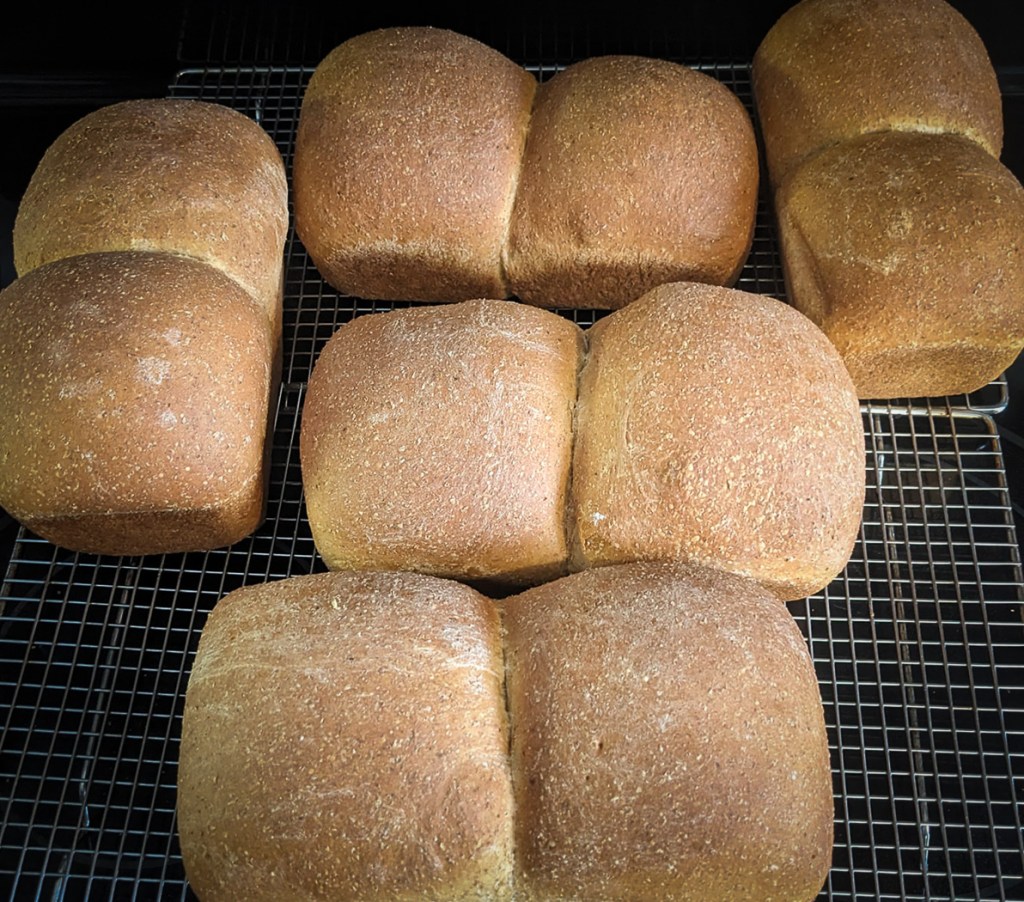
My favourite, Sourdough, is made by combining flour and water and then setting it aside for a period of a few days. During this time, yeasts that are naturally present in the air combine with the mixture and begin to ferment, which creates the sour flavour noted in its name.
This history explains why bread is an ideal symbol for Jesus to use in describing our hunger for God and God’s gift to the world. From the traditional hymn, “Guide me O thou great redeemer” the refrain “Bread of heaven” is not sung only at Rugby matches (was it sung recently in Paris as the Canadian Women’s 7s took home an Olympic silver medal? I cannot say). The bread of heaven is God’s Real Presence, available through the sharing of Holy Eucharist, through the strengthening connection nurtured through prayer, as spiritual insight is discovered in Holy conversation, while gifts of food are shared with the needy—to families, friends, and colleagues of all ages, around supper tables, in the “fields of our dreams,” and on our local and global streets.
The best thing about Jesus’ gift of Himself to us who are hungry, symbolized by the taking, thanksgiving, breaking, and sharing of bread, is that the resource is inexhaustible. This is exactly John’s point. As the Samaritan woman at the well quickly learns, “Everyone who drinks of this water will be thirsty again, but those who drink of the water that I will give them will never be thirsty.” (John 4:13-14) The true nature of God’s gift in Jesus can be trusted, regardless of circumstance, now and forever. This is the discovery of and by faith.
True confession time now: Kathie and I have lost faith—in washing machines. The proud owners of an ancient and rusting relic we finally decided to upgrade. This old machine looked tatty, but it worked, over and over again. We were warned that newer machines are less durable and sometimes problematic. For us, this prophecy has come true. We are sad, even angry; we have lost faith in the integrity of the manufacturer and the technology of our day.
We have not however lost faith in the bread Jesus offers amidst the needs of this crazy world.
Did you know that last Thursday was Lammas day? If you did, well done; I didn’t. A colleague reminded me: Today is Lammas Day, midpoint between the Summer Solstice and the Autumn Equinox. The medieval church celebrated this day as the day of the feast of first fruits, the first of the harvest. It is called Loaf Mass because churches would bless the first bread baked from the first fruits of the harvest. In the Church of England, loaves blessed in church can also be used for Holy Communion in the same service, bringing the agricultural celebration within the context of the Eucharist.
Once again, nature is our teacher. From the physical elements of creation comes Holy wisdom through the filter of experience. To the question: “What must we do to perform the works of God?” I suggest that context is everything. Were we all residents of the devastated Town of Jasper we would be asking hard questions right now. How could this happen? What went wrong? Could it happen again? How do we rebuild? These are all essential queries. There is however a further layer of questions occasioned by the climate crisis: How do we live together as global heating intensifies? What are the forests teaching us as fires exhibit new behaviors; and how must industry, government at all levels, and the economy change given the prophetic witness of science?
Such questions, about our future and the future of our world, are very, very scary. The world we have known and enjoyed will not be what our descendants will experience. At the same I do trust— and frankly, I can do nothing but trust—that the bread of life found in Jesus will be sufficient for whatever I, and you will face. So I can still pray:
Creator, from the depth and breadth of creation, we thank you. Amen.
 Take Note - Reflections on life, music, politics, retirement and more by Ken Gray
Leave a comment