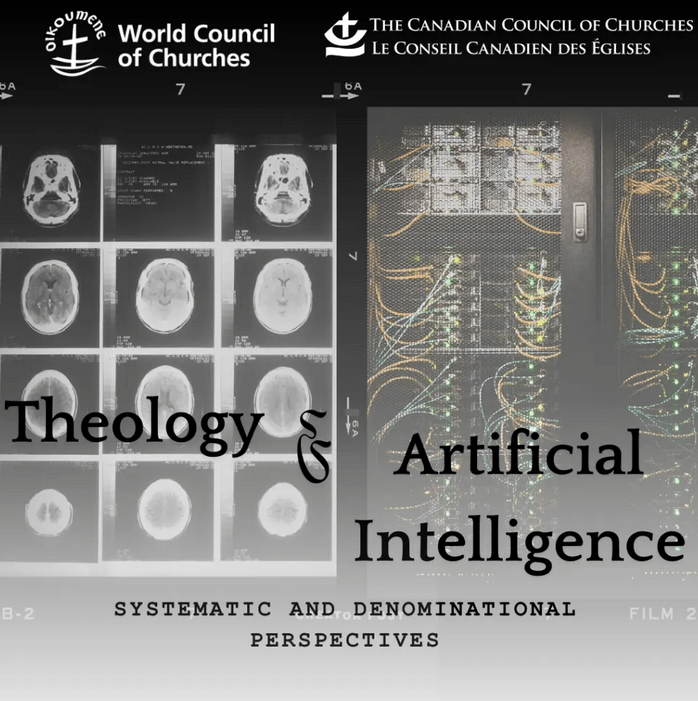
OK, I admit it; I fell asleep during a recent Canadian Council of Churches online seminar titled: “Theology and Artificial Intelligence: Systematic and Denominational Perspectives” which occurred Tuesday, Oct 1, 2024. No worries however, as there will likely be a recording available. If not, AI will come to my rescue. Researching via Perplexity (an NYT favourite) I found the following online seminar summary:
[Italicized text is AI generated]
Artificial Intelligence (AI) has sparked significant theological discussions and raised important questions for religious thinkers. Here are some key theological perspectives on AI:
Many theologians emphasize the distinction between humans created in God’s image and AI created by humans. This view holds that:
- Humans possess a unique moral agency and consciousness rooted in being made in God’s image
- AI, while impressive, lacks the same type of consciousness and moral status as humans
- Using AI for religious practices like robotic ministers raises concerns about downplaying human participation
Admittedly, I do know a few enfleshed “robotic ministers;” I also share concerns about moral consciousness; and yes, I do consider myself as “made in God’s image, warts and all. AI might be an improvement. Such observations do require us “ministers of religion” to re-think our roles and capabilities, especially as the day of professionally trained lay and ordained leadership diminishes and, in some places, has already disappeared.
AI presents epistemological issues for theology, including:
- Difficulty discerning truth in AI-generated theological content due to algorithmic opacity and potential biases
- Risks of blindly accepting AI interpretations of religious texts without human theological expertise
- Need for critical reflection to maintain integrity of religious understanding
Obviously bias (theological, political, cultural, epistemological)
affects all ministers, especially preachers. The question arose in the Q&A section (for which I was awake and wholly engaged) about AI as a resource for informally trained and variously experienced preachers. In our conversation we compared and contrasted AI algorithmic generated research and textual assembly, over and against sermons from seminary graduates having extended ministry experience. As you may have guessed, there was no single experience or consensus amongst those gathered online.
Some theologians see AI as part of the unfolding of God’s creation, requiring theology to adapt, just as it has to other scientific developments.
If there are challenges with AI integration into all faith communities, some advantages are imagined:
- AI may humble humanity by showing we’re not as unique as once thought
- Traditional understandings of human nature and consciousness may need revision
- AI opens new avenues for exploring old theological questions about the soul, free will, and human purpose
Other operational advantages might include:
- Automating administrative tasks to allow more time for pastoral work
- New ways to engage with scripture and spiritual practices
- Prompting deeper reflection on human calling and the nature of work
Now I cannot promise that the above content all originated from sections of the meeting I missed due to my after-lunch slumber. The content above was definitely covered in a general way during the Q&A. Sources were listed in notes and I suspect that if I conducted a similar search in a few weeks’ time more from the CCC meeting would find its way into a final text.
Until then, AI continues to raise complex theological issues; many see it as an opportunity for constructive engagement between faith and technology rather than inherent conflict. As my own Anglican Church of Canada attempts to restructure its operations, commitments and leadership in a time of rapid and widespread change AI will be a large part of our conversation. Ongoing dialogue and critical reflection will be crucial as AI continues to develop.
 Take Note - Reflections on life, music, politics, retirement and more by Ken Gray
Leave a comment