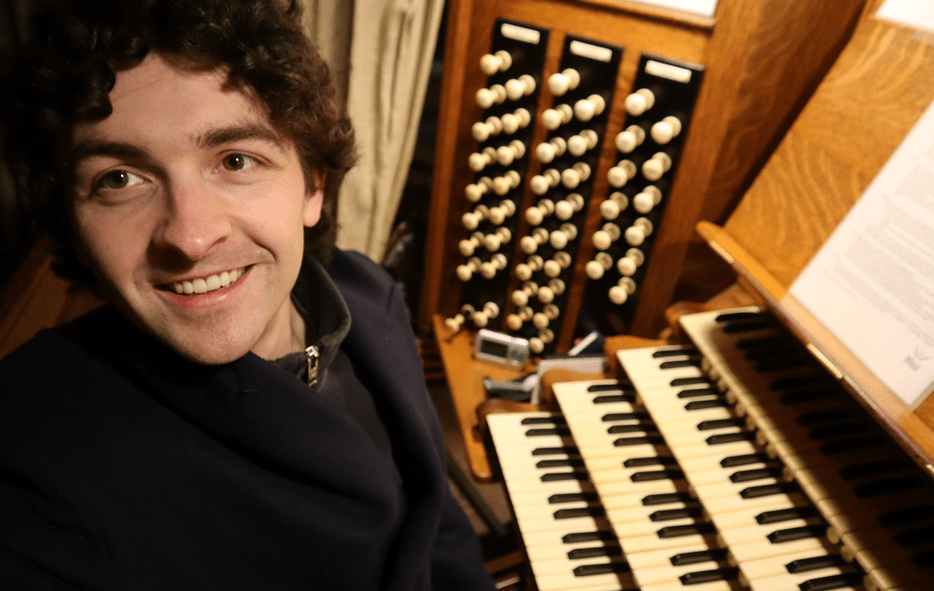
I am so grateful for readers who send me ideas for blogs and other publications. So thank you Ray Fletcher and Karen Pidcock who each in their own way and time directed me to The Salisbury Organist, Ben Maton.
Ben Maton loves music, and sacred music in particular. He loves rural England and the west country in particular. Familiar with its cities he spends much of his time in small English villages, where travels take him down country lanes, carriage ways and bridle paths. He loves the ambience of small village churches, some which are well maintained and still calling residents to Christian worship. Many of these are equipped with small though very beautiful organs which he plays for us through his global YouTube channel.
On his website, he writes: “I grew up in Salisbury, learning the organ firstly at St Martin’s Church and later Salisbury Cathedral. After education at Bishop Wordsworth’s School I went on to Oxford University to read Music, where I was an organ scholar at St Peter’s College, playing for weekly evensong services in the college chapel and assisting with the running of the choir. Working with Jeremy Summerly, I took choir rehearsals, directed choral scholarship auditions and conducted services and performances at formal dinners. Following graduation in 2018, I returned to Salisbury where I have been a full time musician ever since.”
[Ken Gray] Following such an education one would expect him to be appointed as music director to a large parish church or cathedral. Such musicians typically attempt to build a career as a recitalist, to seek out choral directorships, and if circumstances permit to record and publish their own compositions. Think of Anna Lapwood (Pembrooke College, Cambridge and organist of the Royal Albert Hall), or Sarah MacDonald (Selwyn College, Cambridge, Ely Cathedral girls programme, composer, author, and president of the Royal College of Organists).
Ben Maton went in a different and very interesting direction. He describes his unique vocational journey [subscription required but worth the small cost] towards becoming a YouTube star this way:
“Those of you who know me well will be aware that I don’t like ‘performance’. In a classical context, this word conjures images of a showman in a suit, bow tie or concert dress (think Virgil Fox, Carlo Curley, or Cameron Carpenter . . .”
[Salisbury Organist] “When I discuss my dislike of performance, I really mean the immense process of preparation. Preparation both of the sheet music (to meticulous detail) and mental preparation for the frightening circumstances of the concert . . . I used to be completely unfair on myself by agreeing to stressful concert engagements, working tirelessly and beyond the fee I had been allocated, simply to overcome the problems with failing church organs, poor visibility of the conductor and unforeseen hinderances . . .
I wanted to be able to express myself as a musician, to explain the detail behind the music, without the nerves and the horror. So I turned to YouTube. YouTube came about not as a conscious choice, but because performance was banned during the Covid pandemic . . . [Eventually] I felt confident recording organ pieces on the little village church organ at Woodford, with a microphone at the back of the nave and a camera by the music desk. The audience was listening, but only after I had finished playing. This curious, isolated form of performance became enjoyable and fulfilling, and I began to wonder how I could express myself further. The answer: introduce the music, tell a story, talk about the composer or say something descriptive and meaningful about the piece. Hey presto!”
[Ken Gray] Currently, Ben’s YouTube channel has 3.5 million views and 35,000 subscribers where he teaches music, history and poetry from Southern England’s most beautiful village churches. If you haven’t watched The Salisbury Organist you’re in for a treat. Here are two suggestions for viewing, both featuring music for the Advent season:
- In Dorset’s loneliest chapel Ben takes us to St. Lawrence, Affpuddle, Dorset (gotta love that name), a parish church dating back to 987 CE. Ben’s two performances of Er ist ein rose gesprungen, the first a typical chorale setting in hymnic form, and the second, Brahms instrumental prelude which opens most Advent Carol services, both sound well on the Bevington and Sons of London (1794-1956) one-manual instrument. You will quickly notice how much Ben loves this music; he loves the organs, and the places where they sound and lead music. There is so much warmth flowing from this man.
- In a different context, the Salisbury Organist takes us to the loft of Wells Cathedral, Somerset for a close examination of the Willis/Harrison and Harrison four-manual instrument. Now in dire need of repair (the choir organ is now inoperable and many other deficiencies require a large fundraising campaign to accomplish necessary repairs and upgrades). Ben was invited to play a recital as part of a series of concerts to raise the profile of the rebuilding project. Instead he has produced a marvellous video showcasing this significant instrument. It is worth watching the video in its entirely, and yes, please contribute as you are able.
I conclude by pointing readers to a section on The Salisbury Organist’s website titled Funerals. Listening to the history and Ben’s rendition of The Old Rugged Cross (a piece most organists like me abhor) Ben’s heart for those bereaved comes clear as he describes the role of music in funeral settings. As mentioned above, there is so much love shared in and through this man.
As a somewhat cynical and time-hardened priest and organist myself, I am inspired and so grateful for the music and ministry of The Salisbury Organist.
 Take Note - Reflections on life, music, politics, retirement and more by Ken Gray
….one wonderful post. Thank you.
LikeLike