The more he rejects Jesus’ teachings, the more MAGA rejoices
Steve Burgess 1 Oct 2025 – The Tyee
“Love your enemies,” said Jesus, “and pray for those who persecute you.”
“I hate my opponents,” said Donald Trump.
Trump’s statement, delivered from the podium at the Arizona memorial for murdered activist Charlie Kirk, makes him anti-Christ. Not the apocalyptic Antichrist of the Book of Revelation — Trump lacks the capacity for that gig — but simply someone whose moral code is diametrically opposed to the teachings of Jesus.
Yet Trump’s fiercest supporters come from the ranks of people who claim obedience to Christ surpasses every other earthly consideration. Some openly identify themselves as Christian nationalists, who believe the United States should become a theocracy. How is it that so many American Christians are devoted to a man for whom the Bible is either an upside-down prop or just another tacky piece of gold-coloured merch on the MAGA website?
“I don’t think Christian nationalists are the first people to confuse the emperor with God,” says Sara Miles.
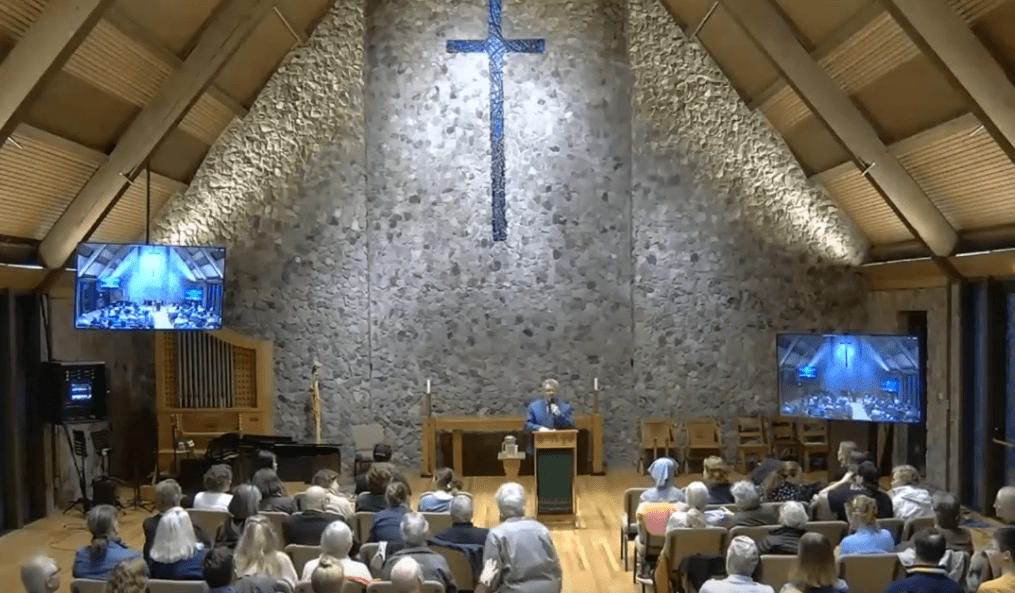
The San Francisco-based author and founder of St. Gregory’s Food Pantry recently spoke at the Vancouver School of Theology in a lecture on faith and politics. Like many other progressive Christians, Miles has watched the political alliance between Trump and evangelical Christians with concern. But as she points out, we’ve seen it all before.
“They’re not the first people to say, ‘We’re on the inside, you’re on the outside. This is our tribe.’ It comes out of a long history. White Christians were able to sustain their faith through these sort of horizontal religious structures in which they were divinely ordained to conquer Indigenous Peoples, and kill Jews, and use Christian symbols to enslave people.
“And I think it’s important to say that every religion has its liberatory impulses and its authoritarian impulses. I remember a friend in church once coming to me, crying, and saying, ‘I can’t believe the Buddhist monks are killing people in Burma.’ But every religion can have this element.”
“Christianity has always been political, from the beginning,” Miles says. “It’s not fair to say there’s this sort of pure faith out there that’s just metaphysical. It’s always been political. Jesus lived in political times. His followers lived in political times. You had to deal with war, you had to deal with pain, you had to deal with revenge. It’s not new, and it has a very specific political trajectory that’s brought us to this moment.”
The Bible is full of arguments. (It is yet another depressing feature of fundamentalism that, while proclaiming the supremacy of the Bible, many evangelicals stubbornly ignore its complexity.) One of the Bible’s key doctrinal disputes involves the question of faith versus works. The New Testament chapter James 2 makes the case for putting your money where your mouth is: “What doth it profit… though a man say he hath faith, and have not works?… If a brother or sister be naked, and destitute of daily food, And one of you say unto them, Depart in peace, be ye warmed and filled; notwithstanding ye give them not those things which are needful to the body; what doth it profit? Faith, if it hath not works, is dead…”
Miles believes this extends to Jesus’ admonition to love your enemies. “I think when you say ‘Love your enemies,’ it’s not really about your feelings,” she says. “It’s about what you do.”
Fruit good and bad
But the practical aspect of Christian forgiveness and charity has always been a matter of dispute. Martin Luther, founder of the Protestant movement, countered that faith, not works, is what matters. Luther believed faith would make you a good person who naturally did good things. But he did not accept the inverse, that good works made you a good person. Without faith in Christ, he believed, your good works were an empty show. “If you believe, you shall have all things,” Luther wrote. “If you do not believe, you shall lack all things.”
As we see after every new school shooting, the opposite is more often the case today. Pious Republicans typically offer “thoughts and prayers” without action. In a country where Christianity is an almost mandatory requirement for higher office, it is inevitable that what passes for faith will frequently be a hollow performance. In such an environment, people of good conscience will always be well advised to judge others by their works. “You will know them by their fruits,” Jesus said. “A good tree cannot bear bad fruit, nor can a bad tree bear good fruit.”
The Christian Movements That Want to End Canadian Self-Rule
Luther spun that Gospel passage in a particular way, saying that Christian faith is what makes a good tree. But can any serious Christian look at the vile malignancy that is Donald Trump and declare his fruit good?
“There are a bunch of arguments in the Bible,” Miles says. “But it’s hard to find a teaching that you should shill cryptocurrency to enrich yourself. You should oppress the stranger, take food away from the hungry and watch the sick get sicker.”
In the most extreme interpretation of the sola fide doctrine — justification by faith alone — one is righteous simply by speaking the magic words and joining the Christian club. Those who fail to do so become the enemy.
Even Martin Luther seemed to move toward a tribal Christianity as time passed. In 1523 Luther had shown his opposition to antisemitism, writing: “If I had been a Jew and had seen such dolts and blockheads govern and teach the Christian faith, I would sooner have become a hog than a Christian.”
Twenty years later Luther’s attitude had turned completely. On the Jews and Their Lies was published in 1543, calling Jews “poisonous envenomed worms” and offering Christians this advice: “… set fire to their synagogues or schools…. I advise that their houses also be razed and destroyed… [and] safe-conduct on the highways be abolished completely for the Jews.”
Worldly victories
Group identity ultimately triumphs over group philosophy. When it does, the faithful will follow anyone who can promise victory. In this environment a leader like Trump need not be a moral example. Anyone who smites the declared enemies of the righteous is an instrument of God, no matter how many porn stars were paid off or sex traffickers palled around with. John Fea, a history professor at Messiah University in Pennsylvania, told USA Today: “The politics of character in American evangelicalism is over. It’s all policy-driven.”
To be fair, not every spiritual warrior is advocating violence. Some are fighting for justice. At the beginning of Trump’s second term, the Council of Bishops of the African Methodist Episcopal Church, the largest Black Christian denomination in the United States, wrote: “We must recognize that we are at war and fighting, as the Book of Ephesians warns, ‘against spiritual wickedness in high places.’ Elected, ordained, appointed, nationalist, terroristic forces. This fight is not simply political; this is spiritual warfare. Therefore, we must put on ‘the whole armor of God’ and fight the good fight of faith.”
“As soon as you hear ‘spiritual warfare,’” Miles says, “you think the Crusades, the Inquisition, the Holocaust, any bloody interfaith thing. But I think what’s really interesting about what the bishops were saying is we’re not wrestling against flesh and blood, but against the rulers of the darkness of this world. Some people are going to say, ‘Well, I don’t believe in the devil.’ But I think there are all kinds of fighting that people are doing.”
“To me,” Miles says, “what seems most heretical about the Trump version of Christianity is that I believe at the heart of faith — Christianity, or Islam or Judaism — is the realization that we’re not God, that there’s a power bigger than we are. Questions of good and evil, of ultimate judgment, of suffering and love, those are really big questions, and we don’t know some of it. There’s a complete unwillingness to say, ‘I don’t know what’s right here.’ To me, it seems that you’re creating an idol out of your faith, rather than having the appropriate reaction — realizing you’re not God.”
“I’d love to smite my enemies,” Miles says rhetorically. “I’m mad at them. But are you going to take seriously the idea that all human life is precious? Or are you just going to say, well, ‘We matter and the rest don’t’? That’s the Christianity that justified the conquest and slaughter of Indigenous people, the enslavement of African people and the ongoing beating up of poor people in the name of Jesus.”
People coming together in positive ways to push back at such brute expressions of power [was] the theme of Miles’ talk in Vancouver last Thursday. She addressed “the spiritual, practical, and political implications of solidarity, at a time when communities — including faith communities — are painfully divided,” according to the Vancouver School of Theology website.
It’s a rich topic, no doubt. That the United States is at war with itself may be the only thing about which Americans can currently agree. That the president openly declares his hatred for at least half the population suggests, however much lip service American Christians might pay to their faith, that the words of Jesus are unlikely to bring the nation together.
Watch the lecture here.
Visit the takenote.ca HOME page for a colourful display of hundreds of other blogs which may interest or inspire you
 Take Note - Reflections on life, music, politics, retirement and more by Ken Gray
Excellent explanation! (but sad …)
LikeLike
Excellent explanation! (but sad …)
LikeLike