The politics of humiliation and the God who listened to Mary
Many thanks to Betty-Ann Xenis for this suggestion.
Derek Penwell on Substack – Dec 12, 2025
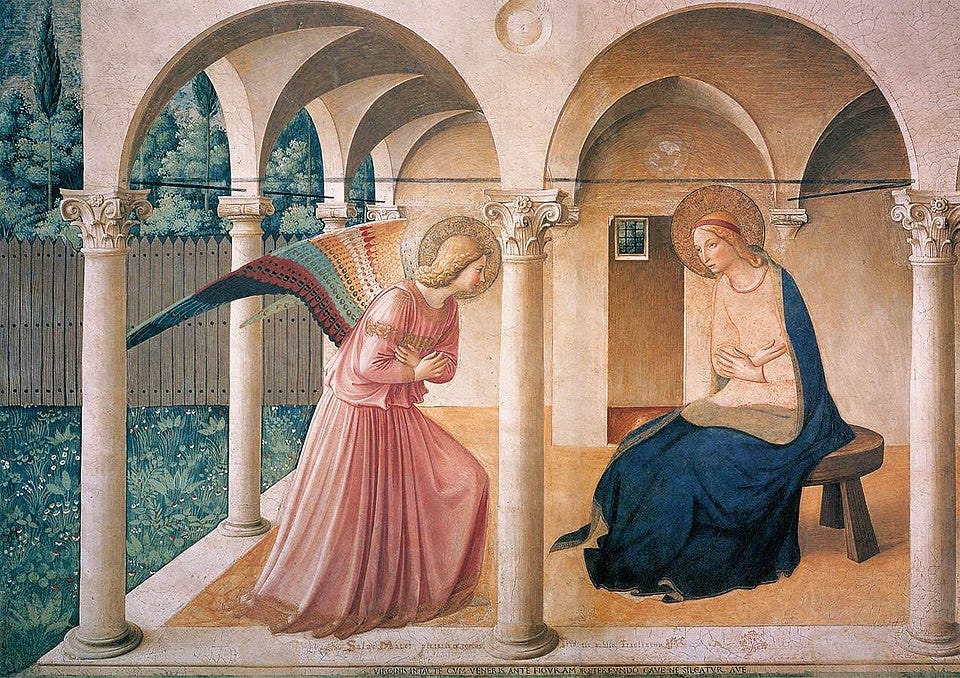
Mary asked, “How can this be?” but heaven didn’t call her nasty.
Quiet, piggy. Ugly inside and out. Stupid and nasty.
Can you hear the beat?
Say the insult. Shrink the woman. Dodge the question.
We’ve heard this song before. The performers play different instruments, but the score is the same one that has been played throughout history: a woman asks a question. A man in power feels his hackles rising. But instead of answering, he reaches for the sharpest tool in the shed.
Let’s face it, this isn’t a debate between equals. It’s not a disagreement governed by Robert’s Rules. These are rhetorical broadsides or, better yet, incantations. Spells cast to shrink a woman down to punchline size. If you can make her the joke, you never have to face the truth she’s holding up like a mirror.
This isn’t merely rudeness or thin skin looking for a fight. This is choreography, the careful footwork of domination, rehearsed for centuries. Authoritarian power has always traveled faster and gouged deeper wounds than reason.
But look who gets targeted. Again and again, it’s women doing their jobs. Women asking the follow-up question, refusing to accept a non-answer wrapped in bluster and swagger.
When male power feels threatened, it reaches for the oldest story it knows: make her small. Make her body or intelligence the issue instead of her question. Turn her competence into a character flaw, then excuse the viciousness by laughing it off as a joke or rationalizing it as folksy plainspokenness.
Maybe what rattles these guys most is the lingering suspicion that women can see what they’re trying to hide. Maybe it’s that a woman with a follow-up question is the child in the crowd pointing at the emperor’s bare backside while the cowed applaud the invisible finery.
We’re in Advent now. And Advent tells a very different story about power.
When the God of the universe chose to enter human history, to risk everything on flesh and vulnerability, God didn’t choose a king or a strongman or anyone practiced in contempt. God chose a teenage girl in occupied territory. Unwed. Unimportant by every measure that mattered to the powerful.
And when Mary asked her question, when she pushed back and said, “How can this be?” God didn’t mock her. Didn’t call her nasty. Didn’t tell her to sit down and shut up. Instead, God’s messenger answered her. Took her seriously. Treated her question as worthy of an actual response.
Then God waited.
Listening for her response. Gabriel stayed while Mary processed, questioned, and found her footing. And when she said, “Let it be with me according to your word,” she wasn’t rubber-stamping a decree. She stepped into a vocation with her eyes open.
That’s the kind of trust God extends.
And what did Mary do with it?
She sang.
She opened her mouth and out came the Magnificat, one of the most politically dangerous songs ever written. The powerful pulled down from their thrones. The lowly lifted up. The hungry filled. The rich sent away empty.
Mary didn’t just accept an assignment. She announced a revolution.
And God didn’t tell her to soften it, to be polite, to tone it down. God let her words stand as Scripture. We still sing them today, though we often sand off the splinters so we don’t have to feel how sharp they are.
This is the God we claim to worship. A God who trusted a woman with everything, who let her voice shape how we understand what heaven is doing on earth.
And yet.
We watch men who call themselves Christians cheer when women are demeaned for doing their jobs. We watch Jesus’ name get stitched onto the banner of people who treat female journalists like servants who dared to speak before being spoken to.
We watch the Christ who was carried in a woman’s body, nursed at a woman’s breast, and announced first by women’s voices get reduced to a mascot for fragile men who can’t abide a question without throwing an insult.
This isn’t about one guy’s boorish behavior. It’s about public instruction.
Whatever gets modeled from the highest office teaches everybody else what’s acceptable. It trains school boards, workplaces, churches, and living rooms about how to handle dissent. And, eventually, everyone’s standing in it and talking about it like it’s part of the prevailing weather patterns.
So if we love Jesus, the one first entrusted to a woman, we ask the clarifying question. “Who benefits?”
It’s certainly not democracy. It’s neither truth nor the common good. And it’s definitely not the woman targeted.
The beneficiary is the man in power, relieved of the burden of answering for anything. The insult acts as a shortcut around responsibility. Everybody laughs, the question evaporates into the ether, and power stays untouched, convinced it owns the room and the rules and the air we all breathe.
But here’s what we can’t forget:
This trick only works if everybody plays their assigned parts. Everything gets to stay the same if we treat humiliation as entertainment and let dignity be conditioned on staying quiet enough, small enough, pleasant enough.
The only way to ram a stick in the spokes is for us to refuse.
But how?
We keep the focus on the “nasty” question that started it all. We stand with those who’re targeted and refuse to rationalize cruelty as “personality” or “style.” We insist that public office still requires public accountability, not a punchline and a smirk.
Advent shows us something about power that the palace always forgets. Real strength doesn’t powder its face with contempt.
The authority that spoke galaxies into being entered the world through a woman’s body and trusted her to say yes.
The God who could have commanded instead invited. The Word made flesh began as a whisper to a girl brave enough to ask how.
That’s the power we’re apprenticed to. Not the fragility behind the microphone. But the quiet, world-birthing trust that believes women’s voices and women’s questions and women’s bodies are worthy of respect and agency.
Because power that can’t tolerate questions isn’t strong enough to be trusted. And any culture that laughs along is teaching itself how to make the very people God trusted first disappear.
But a society that learns to listen the way God listened to Mary?
That society might just be pregnant with something new.
Visit the takenote.ca HOME page for a colourful display of hundreds of other blogs which may interest or inspire you
 Take Note - Reflections on life, music, politics, retirement and more by Ken Gray
Leave a comment