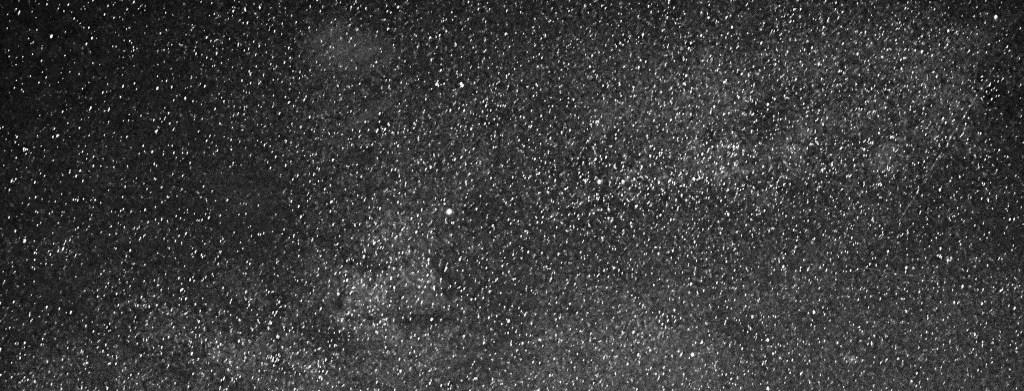
Photo credit: Michael Shapcott
A sermon for the congregation of St. Stephen, Summerland, Epiphany 2025 – The Very Rev. Ken Gray
Before one sets off on an Epiphany journey it’s important to know which star to follow. There must have been dozens of bright lights in the Middle Eastern sky, many visible to the ancient unaided human eye. We now know, however, that if we could see all the suns, stars, and planets simultaneously, the night sky would in fact be white. “And the light shines in the darkness but the darkness will never be overcome.”
As the mystical, mythical magi set out, how did they know which star to follow? Was it the largest? Or the brightest? Was it an odd shape? And what did these overland travelers need to bring? And how could they safely proceed? There was no map, or a list of things to bring, or a promise of specific outcomes. It was a most imprecise, unpredictable, and risky adventure, except for the guiding light of a single star:
A cold coming we had of it,
Just the worst time of the year
For a journey, and such a long journey:
The ways deep and the weather sharp,
The very dead of winter.’
And the camels galled, sore-footed, refractory,
Lying down in the melting snow.
There were times we regretted
The summer palaces on slopes, the terraces,
And the silken girls bringing sherbet.
Then the camel men cursing and grumbling
And running away, and wanting their liquor and women,
And the night-fires going out, and the lack of shelters,
And the cities hostile and the towns unfriendly
And the villages dirty and charging high prices:
A hard time we had of it.
—T S Eliot, Journey of the Magi
Well that was then, and we stand here now. According to Arthur C Brooks writing in last week’s The Atlantic magazine, the ancient Christmas (actually Epiphany) story of the Magi contains a message that can guide our modern search for happiness.
A much-loved Christmas story tells about the journey of the Magi—the three Wise Men who came seeking the baby Jesus in Bethlehem. “Where is He who has been born King of the Jews?” they ask. “For we have seen His star in the East and have come to worship Him.” The essence of the tale is their unshakable faith in a worldly sign—a star in the sky—which the Magi trusted would guide them to the savior of the world.
With the Christmas story itself according to the gospeller, Luke now behind us, Matthew takes us, at a later time, on a different journey.
This story has inspired Christians for more than two millennia to believe that they can find metaphysical truth and eternal life by following something tangible—the words in a book, say, or a physical sacrament. For some nonreligious people, this belief might seem nonsensical or superstitious. Yet almost everyone acts in some analogous way in their regular life.
Before us lies a simple truth — We all need a star to follow. To place our hope and ambition in any human or physical star is problematic however. As The Man in Black says in The Princess Bride, “get used to disappointment.” There are so many false stars available. Not every light is real light: “Jesus spoke again to the people, he said, “I am the light of the world. Whoever follows me will never walk in darkness, but will have the light of life.” (John 8:12)
Arthur Brooks goes on to suggest that we all need “proxy stars,” points of light along the way, signposts to help us keep moving towards and alongside Jesus, the ultimate star, the only star worth following. For me, proxy stars are not so much destinations, as they are ways and means along the way. For the purposes of this sermon I sat down to name my proxy stars: Curiosity, creativity, compassion, justice, wisdom, peace, and community. (I am sure baseball is in there somewhere.)
At the beginning and end of the day, we need to find the right star to follow. For Christians, Jesus, the light of the world, is now “God with us,” flesh and blood amidst us, revealed millennia ago, instructive and inspirational for us in our day, a path forward through the darkness to light, through the practice of giving and receiving love.
Back in the day when dinosaurs roamed the earth, when I was rector here some thirty years ago, I introduced a program call the STAR program. It was a liberal, progressive theological response to the very conservative ALPHA program. It was well structured and theologically robust. A few months ago, someone wrote me to thank me for hosting the program here. It had a significant influence on their own spiritual journey. They found a good star to follow.
Nathan Steinmeyer, a Ph.D. candidate at Tel Aviv University where he specializes in the history and sociology of the Late Old Babylonian Period comments on biblical archeology in relation to the Magi journey with these words:
Unfortunately, the Gospel of Matthew is of little help in pinning down what the Star of Bethlehem may have been. Despite the interpretive efforts of numerous scholars, Matthew’s description remains too vague, allowing for an incredible array of possible explanations before one even considers the many other phenomena that the ancients would have factored into their understanding of the sky . . . [We cannot] know what the Magi saw that night more than 2,000 years ago, we ourselves would need to be able to experience and know the world as they did. Perhaps those are things best left to the imagination rather than to modern science.
Speaking of imagination, why not turn to the musical arts, and to the gospel song: Rise up shepherd and follow:
There’s a star in the East on Christmas morn;
Rise up, shepherd, and follow;
It will lead to the place where the Christ was born;
Rise up, shepherd, and follow.
Chorus
Follow, follow;
Rise up, shepherd, and follow.
Follow the Star of Bethlehem;
Rise up, shepherd, and follow.
Leave your sheep, and leave your lambs;
Rise up, shepherd, and follow;
Leave your ewes and leave your rams,
Rise up, shepherd, and follow.
3 If you take good heed to the angel’s words;
Rise up, shepherd, and follow;
You’ll forget your flocks, you’ll forget your herds;
Rise up, shepherd, and follow.
Here is Pete Seger’s take on the traditional text and tune.
Visit the takenote.ca HOME page for a colourful display of hundreds of other blogs which may interest or inspire you
 Take Note - Reflections on life, music, politics, retirement and more by Ken Gray
Leave a comment