And other short stories about leaders who lie
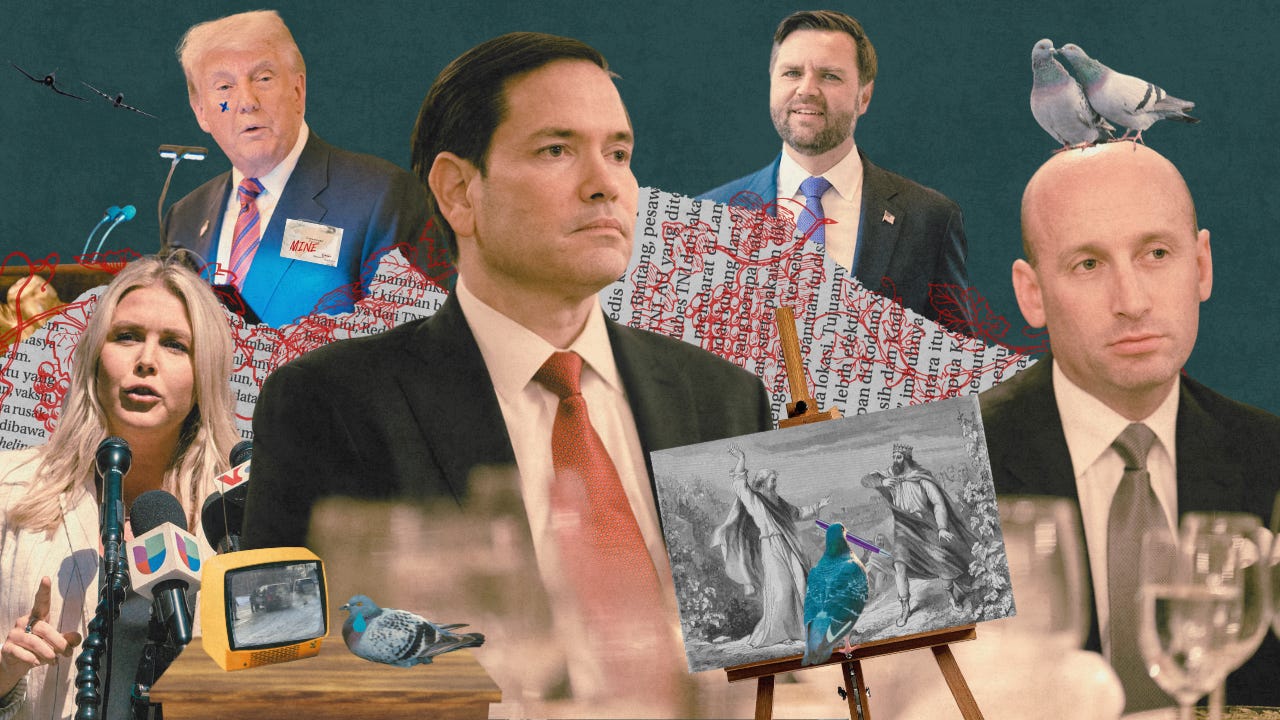
Graphic assembled in Canva. Photos L-R: Karoline Leavitt (Bruce Chaff CC 4.0), Donald Trump, Marco Rubio, JD Vance, Stephen Miller (all public domain)
Story by Bri-anne Swan on Substack and the Wilderness Times – Jan 11, 2026
[Bri-anne Swan] It’s difficult to escape the fatigue that sets in as the world unravels in public.
This is not the same kind of weariness as simply having too much going on. This kind of tired runs so much deeper. It is spiritual. The kind of exhaustion that comes when there doesn’t seem to be a solid place inside yourself to stand, because everything is slippery with spin, outrage and the constant suggestion that maybe you’re the one who is unreasonable simply for being alarmed.
It isn’t only that there is disinformation all over the place and all at once. But we are also witnessing, in real time, that when, say, a reporter asks a straightforward question — Will the U.S. rule out using force to annex Greenland? — the answer is a performance of contempt, as if accountability is a quaint hobby for people who just don’t understand how the real world works.
None of this is new.
In fact, I think what’s playing out is a very old script. Powerful people take what they want and then manufacture a story that makes it all sound so reasonable.
And if you have a Bible close by and want a story that captures this particular moment…
You can flip to 1 Kings 21, and the story of Ahab, Jezebel and Naboth.
If you don’t have a Bible on hand, here’s the scene.
Ahab is a king. He lives in a palace. He has more power and resources than he could ever reasonably need. Despite this, he sees a vineyard that belongs to a man named Naboth. It’s right next to his palace. How convenient! How useful!
And Ahab wants it.
He goes to Naboth and says, essentially, Your vineyard should belong to me. Name your price. I’ll trade you. I’ll buy it. Just give it to me.
And Naboth says no.
He says no because the vineyard is his family’s inheritance. It’s the place his ancestors planted themselves into the earth. There are some things you don’t sell, even when a king is asking. Perhaps especially when a king is asking.
So Ahab goes home and sulks like a spoiled child who has been told he cannot lick the frosting off someone else’s cake.
The Bible says he throws himself on his bed, turns away his face and refuses to eat.
Harumph!
It’s almost funny. It’s definitely pathetic. You can just imagine what his posts on Truth Social might look like.
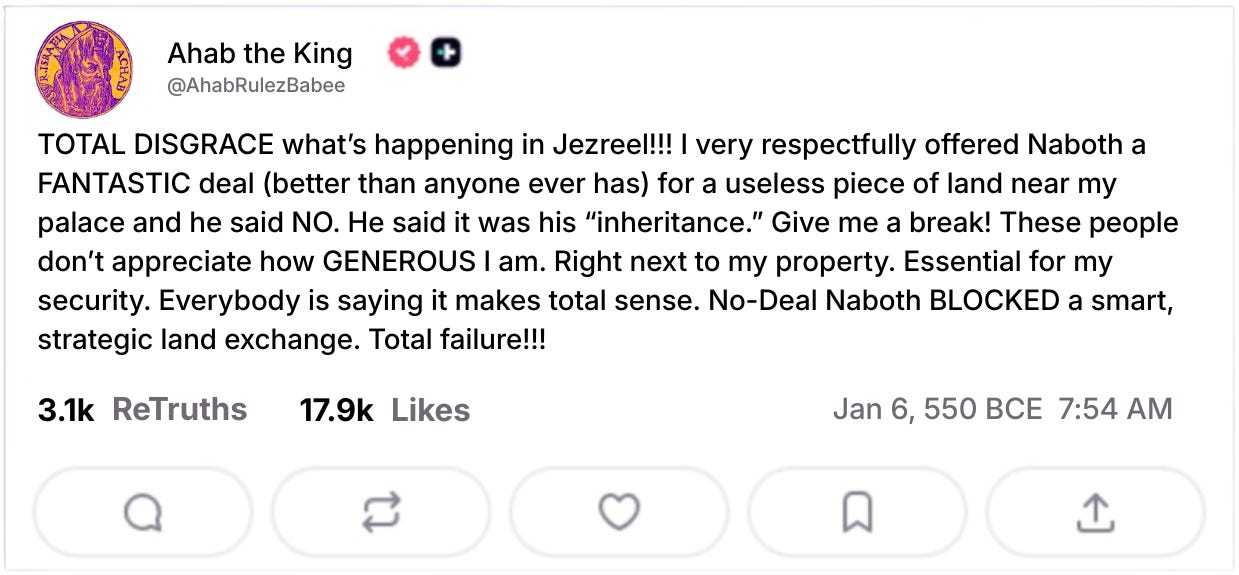
Enter Jezebel. The queen. The fixer. She hasn’t forgotten how the world actually works. She goes to Ahab and says, “What the @#$! is your problem? Are you a king, or what?
And then, after what I only imagine as literature’s greatest eyeroll, she says to Ahab, “Don’t worry. I’ll get you your vineyard.”
Jezebel writes letters in Ahab’s name, seals them with his seal and sends them to the elders and nobles in the city. She instructs them to proclaim a fast, to put Naboth in a place of honour and then to bring forward two scoundrels to accuse him.
What do they accuse Naboth of?
Cursing God and the king.
And it works.
Naboth is dragged out and stoned to death.
And then Jezebel goes to Ahab and says, Get up. Dude’s dead. Take the vineyard.
Political propaganda makes state violence look like a logical consequence to poor choices and behaviour. It can even make murder look like a moral outcome.
And because it is done through official channels (letters, seals, elders, public rituals) it gives everyone involved just enough distance from the blood to pretend their hands are clean.
For a moment, our story seems to end the way these stories too often do. The powerful win, the vulnerable die and everyone else learns the lesson of don’t say no.
But then the prophet Elijah shows up.
Elijah meets Ahab in the (stolen) vineyard, and he says: I know what you did.
Ahab tries to deflect. I imagine him standing there, totally incredulous. Perhaps he even wore a scorn Stephen Miller would be proud of.
Because that’s another tactic: if you can’t deny the truth, you can label the truth-teller as an enemy. If you can’t win on facts, you can turn it into a loyalty test, either for the speaker, or their audience.
But Elijah doesn’t take the bait. He just names the thing.
He tells Ahab that God is not fooled by official narratives that don’t match the truth. Prophets aren’t in the business of making kings feel better. Their job is to break the spell. They are also inconvenient because they refuse to be gaslit, insisting that truth matters.
What moves me about this ancient story — this week and most weeks lately — is how familiar it feels.
We are living in a moment where we are witnessing a world leader and his bootlickers attempting to take what they want without having to answer for it. They want to be able to hurt people and then tell a story that makes the harm look necessary, even virtuous. They hope people will believe those killed by government agents, including Renee Good this week, had it coming — despite overwhelming evidence to the contrary.
And the strategy is not only the lie, it’s the atmosphere of the lie — the overwhelm, the speed, the noise, the constant shifting of attention so that nobody has time to stay with one thing long enough to fully understand it. Understanding leads to asking for accountability, and this particular U.S. administration has an anaphylactic allergy to accountability.
If you can make people feel like the truth is unknowable, they will stop looking for it.
And then, the vineyard changes hands.
I’m not saying all of this so we can despair even more than we already are. I’m saying it because despair is another spell. All this is inevitable. You can’t stop it. Don’t bother questioning. Keep your head down. Save yourself.
But Scripture shows us patterns.
And when you can notice and name the pattern, you can call it out and start to resist it.
Elijah doesn’t stop the murder of Naboth. He doesn’t bring Naboth back. Scripture may not be factual, but I do believe it is honest. People die. Injustice happens. The powerful often get what they want.
But we are part of a particular story that insists, over and over again, that death is not the last word.
Ahab does eventually humble himself. In keeping with his penchant for the dramatic, he tears off his clothes, refuses to eat and mopes around in nothing but sackcloth (super scratchy). God decides to defer disaster.1
So here’s what I’m holding onto this week, with my buzzing brain and my tired heart:
We have been here before. The tactics are old, and our sacred texts have named them. We are not crazy for noticing.
And because we have been here before, we also know this:
Someone will keep showing up in the vineyard.
Someone will keep saying, I know what you did.
It might be a journalist. It might be a neighbour. It might be a pastor who is just so effing done with being polite.
It might be you, insisting on asking the question. Maybe not on national television or a local press conference. Perhaps it’s at a family gathering and those around you are rolling their eyes trying to change the subject, hoping you’ll just let it go. There’s a cost to being a prophet in those moments. But it’s important to look at the scoff and decide you’re not going to shrink.
A lot in the world is kind of terrible right now. It’s okay to name that.
But prophets are not merely a diagnosis. They are a sign that God has not abandoned the public square and the official story of rulers is being contested.
Even now.
Especially now.
Wilderness Times is co-created with Broadview, an award-winning Canadian publication known for thoughtful journalism that attends to spirituality, justice and the questions that tug at our collective conscience.
Broadview is a registered charity and has made this Substack freely available because we believe that thoughtful, justice-seeking journalism should be accessible to everyone. Creating this space — and keeping it free — takes time, skill and resources. If this space nourishes you, please make a tax-deductible donation.
Your support empowers Broadview to tell more courageous stories and helps build a more just and compassionate world.
Visit the takenote.ca HOME page for a colourful display of hundreds of other blogs which may interest or inspire you
 Take Note - Reflections on life, music, politics, retirement and more by Ken Gray

Leave a comment