Anglicanism #1, from Dan Scott on Facebook
Over the next few reflections, I want to share a few thoughts about Anglicanism—the tradition that became my spiritual home.
A Christian doesn’t exactly convert to Anglicanism. Baptized believers may eventually ask to be formally received and confirmed, but in practice they are welcomed to participate from the moment they walk through the door.
In nearly every Anglican or Episcopal church—liberal or conservative, Anglo-Catholic, Evangelical, or Charismatic—you will hear something like this when the invitation to the Table is given:
“This is not the Anglican Table. It is the Table of the Lord. If you are a follower of Christ, Christ welcomes you here.”
The former Archbishop of Canterbury, Geoffrey Fisher, once summarized the spirit of Anglicanism this way:
“The Anglican Communion has no peculiar thought, practice, creed, or confession of its own.”
He did not mean that Anglicanism has no theology. Quite the opposite. What he meant was that Anglicanism does not claim a sectarian theology that belongs only to itself.
For better and for worse, Anglicanism is something of a crossroads of Christian faith. Some Anglicans lean strongly toward Roman Catholic spirituality. Some draw deeply from Eastern Orthodoxy. Some are warmly charismatic. Others are strongly Reformed.
The center of Anglican theological culture circles gently around the ancient conviction that the Church should hold fast to “that which has been believed everywhere, always, and by all.”
The great Anglican theologian Richard Hooker helped give this instinct its intellectual form. In the Elizabethan era he argued that the Church must listen carefully to Scripture, the wisdom of the Christian tradition, and the light of reason. Faith, he believed, grows healthiest when these three are allowed to speak together.
We have our own varieties of fundamentalists, of course. Some worry about what color vestments should be worn on a particular day. Some worry about the dangers of contemporary English in the liturgy. Others worry about offending the agnostic professor down the street.
As you might imagine then, we fuss.
But not during worship.
Most Anglicans try to keep the sanctuary a sanctuary—a place where people can pray, encounter the presence of God, and feed their souls. If you are not interested in church politics, you can just meet God with other believers and ignore the nasty stuff. There’s no denomination free of that spiritual sand trap, unfortunately.
When I was moving toward ordination, a bishop said to me with a smile, “You’ve chosen the worst time in history to become an Anglican.”
He may have been right. Our community life has been stormy for a while now.
Yet the rhythms of Anglican spiritual practice and theological formation have been an unspeakable blessing to me.
For one thing, I brought my rich Pentecostal heritage with me, and no one suggested that I leave any of it behind. Indeed, I have often been asked to share that heritage. At the same time, I have been enriched by pilgrims from other backgrounds, other centuries, other nations, and many different opinions.
It isn’t Narnia, and I’ve never seen a hobbit.
In fact, my romantic instincts about the church have been disappointed more than once, and there are at least as many rascals in this community as in any other Christian group.
Still, Anglicanism welcomed me when I had lost my spiritual home. It offered a shelter from sectarianism and a place where reason, prayer, and the quest for God could live together in peace.
I am grateful.
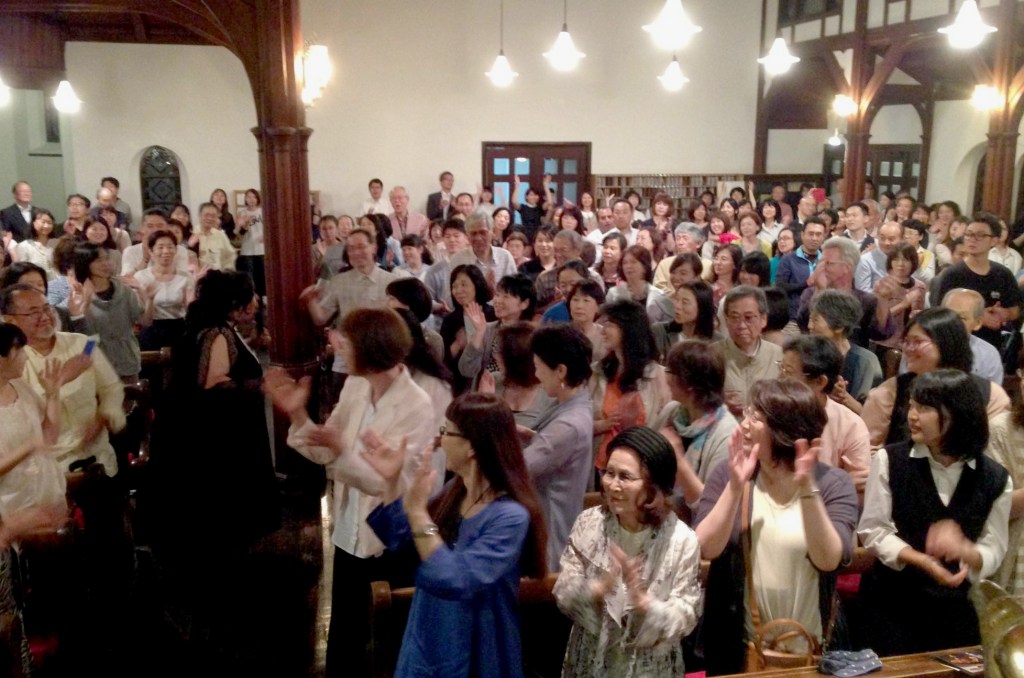
(Oh – the picture is from a visit to the cathedral in Kyoto, Japan where a group of Pentecostal friends held a concert.)
Visit the takenote.ca HOME page for a colourful display of hundreds of other blogs which may interest or inspire you
 Take Note - Reflections on life, music, politics, retirement and more by Ken Gray
Heavy on Tradition/Doctrine and Exegesis, but VERY light on Reason.
Where Is rational thought and scientific process?
What is the Anglican thought on the Quantum theory of ‘the Quanta’ or God-particle?
LikeLike
Yes … the sanctuary …
LikeLike
I
LikeLike