A sermon for the congregation of St. Saviour, Penticton, Maundy Thursday, April 2, 2025 by the Very Rev. Ken Gray
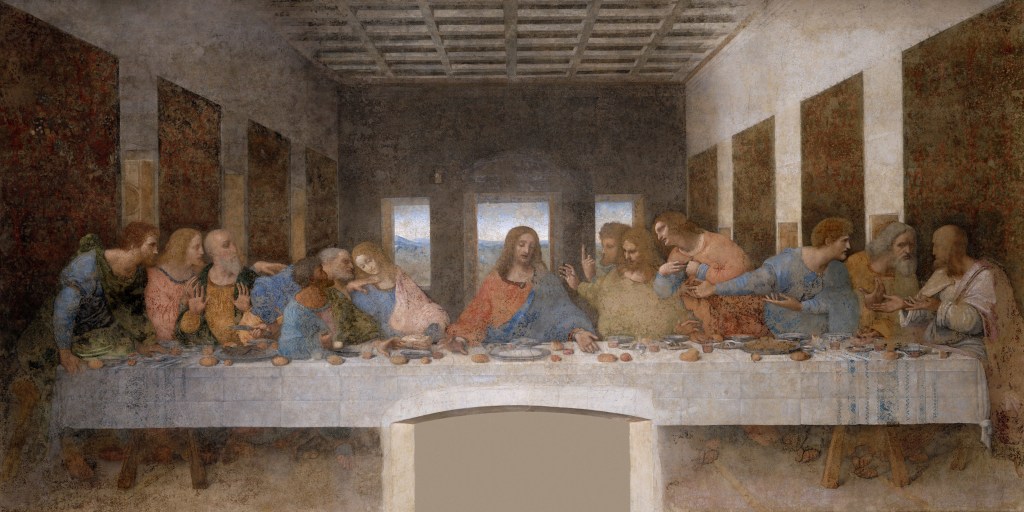
“I don’t think it’s appropriate at all! Please don’t use this image,” snapped a member of one of my former parishes. (Not Summerland I might add.) My critic referred to a setup photograph created at a youth conference, where some ingenious young adults created a “living Last Supper,” an activity which required a lot of planning, research, discipline, and creativity. To create their pastiche, participants had to study images of the original Da Vinci Last Supper fresco in a Milan monastery. They had to familiarize themselves with Gospel accounts of the Last Supper, especially that found in Matthew 26:32-38.
Their recreation was no mere student prank. It did not mock the painting. It respected the Gospel accounts. The project inspired their faith. My critic, however, disagreed. She needed to do some homework — and, frankly get a sense of humour — as did I in preparing tonight’s reflection. I turned to the entry, Last Supper in an online Encyclopedia Britannica.
“Last Supper, one of the most famous artworks in the world, painted by Leonardo da Vinci probably between 1495 and 1498 for the Dominican monastery Santa Maria delle Grazie in Milan. It depicts the dramatic scene described in several closely connected moments in the Christian Gospels, including Matthew 26:21–28, in which Jesus declares that one of the Apostles will betray him and later institutes the Eucharist.
According to Leonardo’s belief that posture, gesture, and expression should manifest the “notions of the mind,” each one of the 12 disciples reacts in a manner that Leonardo considered fit for that man’s personality. The result is a complex study of varied human emotion, rendered in a deceptively simple composition. [. . .] The scene is not a frozen moment but rather a representation of successive moments. Jesus has declared his forthcoming betrayal, and the Apostles react. Philip, who stands in the group to Jesus’ left, gestures toward himself and seems to say, “Surely not I, Lord?” Jesus seems to reply, “The one who has dipped his hand into the bowl with me will betray me” (Matthew 26:23). Simultaneously, Jesus and Judas, who sits with the group to Jesus’ right, reach toward the same dish on the table between them, an act that marks Judas as the betrayer. Jesus also gestures toward a glass of wine and a piece of bread, suggesting the establishment of the Holy Communion rite.”
I commend the full Britannica article to you for study. It is a fascinating study which well illustrates and interprets the Gospel story. The painting’s history is also noteworthy:
“After centuries of maltreatment, the Last Supper underwent an extensive and controversial 20-year restoration that was completed in 1999. Restorers worked in small sections to remove previous retouches, layers of grime, and coats of varnish while adding beige watercolor to the parts that could not be recovered. When the restored painting was revealed, many critics argued that the restorers had removed so much of the painting that very little was left of Leonardo’s original work. Others, however, commended the recovery of such details as the Apostles’ expressions and the food on the table.”
What, you may ask, was my critic’s problem with the re-creation? Apart from a distinct lack of imagination, she could not appreciate all that the youth conference re-creation involved. She determined the exercise was merely fraudulent or idolatrous recreation. The truth is that all art, is in some way representational; ergo, fraudulent. A bowl of cherries is not an actual container of fruit. Once painted or set to music, crashing waves at a seashore are dry, not wet; they are also silent.
If art is not “the real thing” to quote Coca Cola, we all require art in all its forms to take us places we cannot visit, crippled as we are by geography or time. On this Holy night, we gain so much from Da Vinci’s Last Supper to help us receive the Gospel story of the events of the night before Jesus died. Preachers like me know the limits of words, whether canonically sacred, or other non-biblical sources. Maundy Thursday stories are no different from other Gospel sagas. We each have our journeys; we all benefit from the guides of history. We are blessed through the efforts of faith-full artists. The English, Anglican poet, Malcolm Guite helps me conclude my thoughts tonight, so very well:
In vain, we search the heavens high above,
The God of love is kneeling at our feet.
Though we betray Him, though it is the night,
He meets us here, and loves us into light.
—Malcolm Guite
Visit the takenote.ca HOME page for a colourful display of hundreds of other blogs which may interest or inspire you
 Take Note - Reflections on life, music, politics, retirement and more by Ken Gray
Leave a comment