NASA
I don’t get it. We went round the moon first in 1968 and have the pictures to prove it. They were shot with a Hasselblad medium format (2¼ square) film camera — best in class. We all wanted one. Absolutely “cost the moon.” Lived with what we had at the time.
Okay, we went further out into space this time — took about forty minutes — Where’s that Pink Floyd album? Shortly thereafter, we landed on the moon, performed experiments, strolled and drove around a bit. Then we said, “been there; done that; no intelligent life here, Cap’n,” and returned home, supposedly for good. But here we go again. Why bother? Help me out here friends; please.
I know, I know; the Chinese are gearing up to do something similar; so we’ve got to get back in the game. Otherwise when we return to the surface all the labels will be in Mandarin. It’s a second space race friends; book your seat now to avoid disappointment. Race to where, you rightly ask? Reminds me of a native leader who in 2001 told me that “they’re going to send humans to Mars. Ya know why? There’s native land there.” Now we know.
And despite the eviscerated NASA funding, because the great galaxy gangster and his hoods gave money to Elon Musk and SpaceX, it’s important to have jaw-dropping photos to generate (inter)national interest. Hey, everyone loves an astronaut these days. And let’s be clear. These folks are brilliant technicians, skilled aviators, exceptional risk managers, excellent communicators, and if the cabin pictures are to be believed, truly fine human beings. They not only did the job; they loved doing it. Cosmic camaraderie beats earthbound chaos. It’s just great to get away, even for a few days.
And hey, Canada is in the game too. It’s great to see the flags of both Canada and the US on permanent display on the cabin roof. If they can figure things out up there, what’s the problem down here? (Asking for a friend.) When the space module is discovered bobbing around space in a century or so, will the moonraker starship recognize what they find? Or will Canada be the 51st state by then? Never, say never.
But really, apart from doing the same thing again, slingshotting around the moon, albeit with a broken toilet, why are we doing this, again? Sure, we can see Trump’s ballroom from space. We can also see the devastation in Gaza and Iran — not good. We can see the traffic jam in the Strait of Hormuz. The real query, however, is can we see the Epstein files? We are told that others are around, all 3.5 million pages, some still unredacted. But where are they? Maybe this is why we are slinging around the lunar surface? Gotta hide them somewhere. Did anyone see them drop something off?
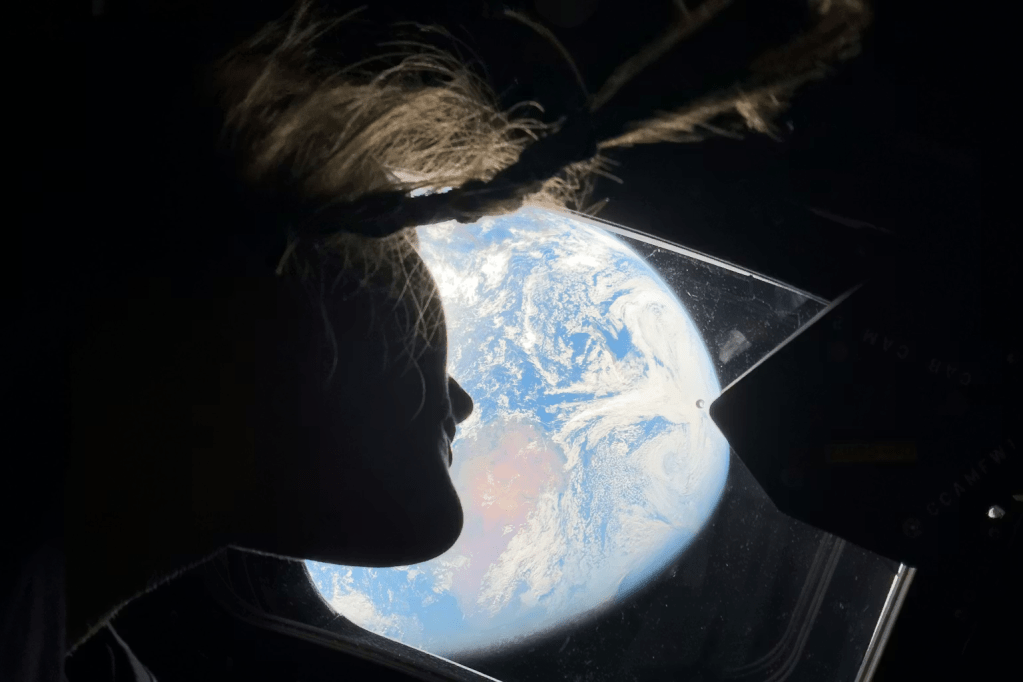
So many possibilities; so many accomplishments. Still, I don’t get it, except, I think, for the images. They are gobsmackingly fabulous. Photographers will go anywhere for a great shot, even into space. You know the photographic rule: “F8, and show up.” Focus one third of the way into the lunar-scape — No more searching for an infinity focus — You are already there. They trained for it; they got the gear; the camera companies got the product placement — Have you checked out Nikon and iPhone prices lately? And you thought groceries were expensive! I wonder, how can we trust what we are shown. AI creates a universe (ahem) of possibilities. How about the moon over a candy bar? I am starstruck by the possibilities.
By the way, check out this great piece, published: April 11, 2026 on The Conversation. I won’t reproduce all the NASA images here. Go to the source; and remember, these are digitally transmitted images. The master copies will be produced in the weeks and months to come. They will be even better. You see, it’s the photo-op that creates the value in this particular mission. You will not be disappointed:
[The Conversation, extracts] At this point in NASA’s human spaceflight story, researchers have a substantial amount of material – documents, artifacts and images – with which to tell the stories of past flights to space. But with NASA’s Artemis II mission around the Moon now in the books, we’re getting a refreshed look at space.
And the digital photographs transmitted back to Earth – even mid-mission – tell a modern story of the crew’s experience. Entire generations born after Apollo 17’s last close-up looks at the Moon in 1972 may hardly believe the reality of Artemis II in the age of AI-generated deep fakes. But this mission was real, and four humans can tell the tale of their adventure using the photographs safely stored on memory cards now in NASA’s hands.
Artemis II crew members Reid Wiseman, Victor Glover, Christina Koch and Jeremy Hansen had weeks’ worth of photography training with a slew of Nikon digital cameras and iPhones. Taking photos with the device so many people have in their pockets is leaps and bounds beyond photography equipment used during Apollo 17 – even the 1960s-era 35mm camera.
NASA’s preference for using the Nikon D5 on the International Space Station has extended to Artemis II. This camera performs well, and NASA likes tried and true reliability when astronauts travel to space.
NASA took a decidedly different path when planning for images of the Moon with Artemis, compared to Apollo. First, the Orion spacecraft used on Artemis is bigger, and it has double the number of windows and cameras inside. Five of Orion’s six windows had live-streaming video cameras capturing the lunar flyby.
Well, in the end, you get what you pay for. The astronauts got the shots. They don’t call it a “moon-shot” for nothing. We get new images. Was it really worth it? Watch this (ahem) “space.”
Visit the takenote.ca HOME page for a colourful display of hundreds of other blogs which may interest or inspire you
 Take Note - Reflections on life, music, politics, retirement and more by Ken Gray
Leave a comment