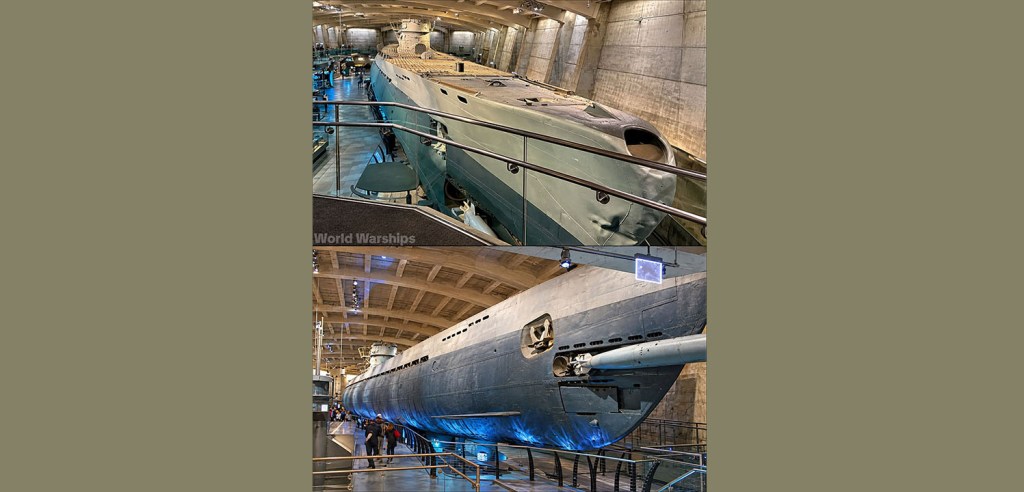
In Chicago several years ago I dearly wanted to visit the Griffin Museum of Science and Technology especially to view the U-505 exhibition. Sadly, time and circumstance did allow for a visit, but one day . . . it’s still on my bucket list. You would never get me down in one, but I remain fascinated by submarines and submariners. Movies such as Das Boot; Run Silent, Run Deep; Ice Station Zebra; and Kursk whet my appetite. The U-505 story below from World Warships on Facebook increases my interest. And possibly yours.
The German U-Boat the Navy Captured and Kept Secret, U-505 is a German submarine the U.S. Navy once worked very hard to make the world believe was sitting at the bottom of the Atlantic. Today she rests in an underground hall at the Griffin Museum of Science and Industry in Chicago, in the middle of America, far from any ocean.
On June 4, 1944, off the coast of West Africa, the escort carrier USS Guadalcanal and five destroyer escorts of Task Group 22.3 found her. USS Chatelain picked up the sonar contact, and a barrage of depth charges and Hedgehog projectiles forced the boat to the surface. Her crew, convinced she was about to sink, abandoned ship, leaving her circling helplessly with a jammed rudder.
Captain Daniel Gallery had trained boarding parties for exactly this moment. Lt. (jg) Albert David led a team from USS Pillsbury down through the conning tower hatch, boarding a submarine that could have exploded beneath their feet at any moment. They closed valves, stopped the flooding, and recovered the codebooks. David would receive the Medal of Honor for his actions. It was the first time since the War of 1812 that the U.S. Navy had captured an enemy warship at sea.
Then came the part almost nobody sees in the photographs. The Navy classified the entire operation. U-505 was towed 1,700 miles to Bermuda and given the cover name USS Nemo, while her surviving crew were confined to an isolated section of a prisoner-of-war camp in Louisiana, beyond the reach of even the Red Cross. The goal was to make Berlin believe the submarine had been lost with all hands. The deception held until Germany surrendered.
Popular retellings tend to focus on the Enigma machine. But the real intelligence prize was much larger: roughly 900 pounds of codebooks, charts, and documents, along with an acoustic torpedo that American specialists could finally examine firsthand.
After the war, the Navy planned to use her as a target. Gallery, by then a rear admiral and a Chicago native, refused to let that happen. According to his own account, the idea of bringing her home came from his brother, a priest named John Gallery.
In 1954, the submarine made the journey up the St. Lawrence River and across the Great Lakes. In Chicago, Lake Shore Drive was shut down overnight so that U-505 could be hauled across the road to her permanent home.
More than 24 million people have visited her since.
Visit the takenote.ca HOME page for a colourful display of hundreds of other blogs which may interest or inspire you


Leave a Reply