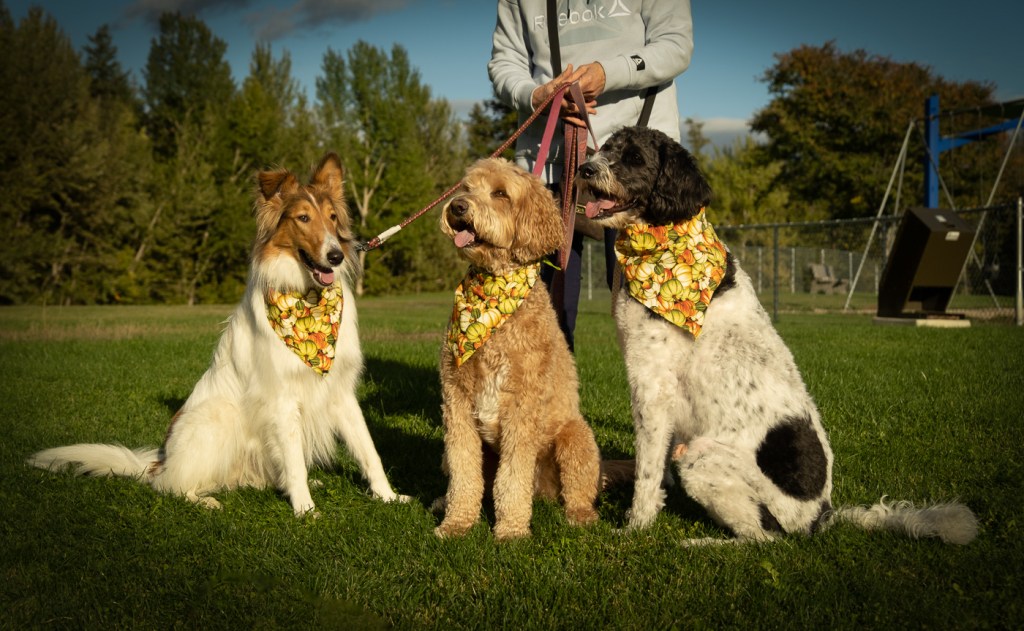
Juno (centre and her friends, ready for Thanksgiving — Kerchiefs by Kathie
Juno’s blogs have now attracted international attention. Search https://take-note.ca/ for other scintillating dog blog titles.
PaPaw and I are reading together Journeys of the Mind: A Life in History, an autobiography by the eminent antiquities historian Peter Brown, an authority on St. Augustine (354-430). I am likely the first dog to read Professor Brown, hopefully, however, not the last. My interest in his voluminous text is piqued not so much by the connection between the author’s Irish roots and the early Christian theologian and doctor of the Church, a connection which explains the inclusion of the quote in his book. What draws my attention and respect is his description of his aunt’s dog, Rory.
Rory was my aunt Mai’s dog. For me he was more than a dog. He was a sibling and a totemic beast. He was a mongrel, the result of an amorous encounter between a pedigree spaniel and a Labrador. That meant, in Irish terms, that Rory was the product of that most charged of liaisons—a mixed marriage. He was, indeed, a striking mixture. His ears went up, and then drooped softly. His tail was as covered with fine hair as a fly whisk. He had a beard like a Chinese dragon. He had bandy legs that combined soft, woolly flanks with robust, gnarled forelegs. He was more than a dog to me. He was a link to the rough earth of Ireland.
What a lovely testament to a dog, that was obviously a much loved pet. While Brown describes Rory analogously, as a way to describe the complex social milieu of the Ireland of his childhood—a land of strange mixtures, of people deeply connected with both history, religion, and geography—his testament demonstrates how humans need dogs for their own self-understanding, as they search for ways to be in good relationship with one another, even across deep historical and cultural divides, though times of ease and times of bitter conflict.
While dogs arguably bear less responsibility than humans for the maintenance of social community, they offer an example of what can emerge over time, when good will and a sense of the common good prevail.
Our four-pawed voice is existentially rich, a resource deserving of both attention and respect. How many times do I hear canis familiaris belittled in literature and in common parlance. The “dog-days of summer,” the insidious notion of being “dog-tired,” or worse still, the voice named “doggerel.” Each of these carry negative emotional and existential freight. The lexicon for disparaging dog language is ample and sometimes angry. Doggonit, we have our own thoughts and feelings too; and I must say that human wisdom is often found wanting, of little depth of understanding, sometimes grievously injurious. Next time friends, when you feel down, well, look down, for wisdom and relief.
Truthfully, time and again, dogs see what others miss, a perspective afforded through our nose-to-the-ground approach to life and love. If you want some academic justification, read Rebecca Wall-Kimmerer, who in Braiding Sweetgrass draws out the authoritative and collaborative voice of creation itself—of nature, with all its workings, systems, and protocols, of flora and fauna and all living things, in combination with scientific precision and Indigenous wisdom. See how such a multi-faceted investigative process proffers rewards, everywhere. Nature has its own “three sisters” (corn, beans, and squash); dogs provide Doodles, Dachshunds, and Dobermans.
Back to Rory, and the quote cited above, which is in fact an obituary. MaPaw and PaPaw recently met Kamloops resident Tamara Vukusic (at the dog park, where else?) who has been reading obituaries for over 20 years. She wrote Obittersweet: Life Lessons from Obituaries. I suggested that she do similar work with dogs. She demurred, which is too bad as I am certain the book would have sold well; I would certainly have bought a copy.
Back to Rory. Brown continues:
“Walking Rory with my beloved aunt Mai . . . ‘we talked about equality and the morality of the Sweepstakes.’ This was the famous Irish Sweepstake, a lottery whose principal office, alight with green neon shamrocks of the most garish kind, faced the austere, classical façade of the Royal Dublin Society in Ballsbridge—the society devoted to the progress of science, which housed a rich library that I would soon come to use.”
This is a fascinating conversation for sure. I have glimpsed many a lottery ticket-holder, or a lifelong gambler over the years; I have seen their smile and delight, and at other times their cringe of defeat. It is not my place to render judgement on such behaviour—for myself however, it is not the life for me. I prefer to manage the known-unknown (Bernard Lonergan) over engaging in a contest for what is serendipitous. My point however is that no one asked me for an opinion on the matter.
Well . . . Life goes on, and the past is as relevant to the future, as both connect with the present. The historian and the project are excellent conversationalists. Thank You Peter Brown for a marvellous autobiography, and for the story of your special friend, Rory.
In closing I would be remiss if I didn’t note a very special connection with my life here in our little town. In their elder years, Peter Brown’s parents lived in a house at the top of Castle Park Road, in Glenageary named, wait for it . . . “Summerland,” How cool is that?
 Take Note - Reflections on life, music, politics, retirement and more by Ken Gray
There you are — the girls — Grace on the left, Juno in the middle and Phoebe on the right. I met you all last week at Sorrento.
LikeLike