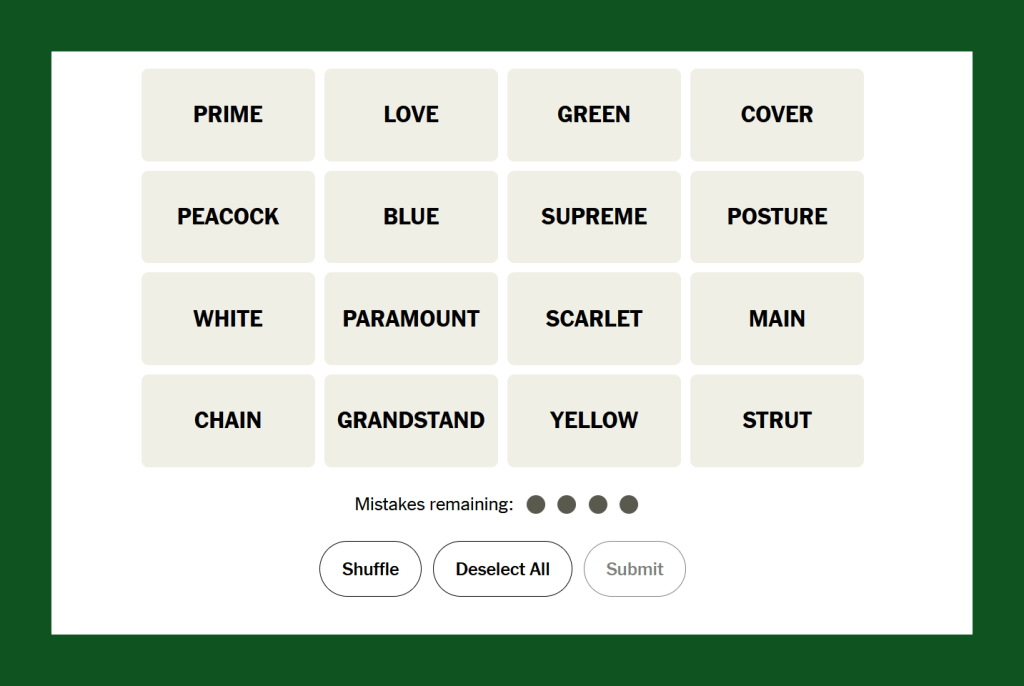
Sixteen squares each occupied by a single word. At first glance, they are simply words, seemingly unrelated to each other. The challenge–in this popular New York Times e-game–is to group these sixteen words into four connected clusters. The clusters are grouped supposedly by difficulty. Much depends however on how aware I am of pop culture, of fads and slang, of technical language, of literature, or any other topic or genre.
Particular connections may include theatre, music, pop stars, internet protocol, science, and an infinite number of other common themes. Sometimes the category is a word which belongs naturally to another word. Sometimes the spatial arrangement of letters—for instance, the last two words I just typed had double consonants.
These connections are discovered over time, as I stare at my phone screen, puzzled, and necessarily patient. Connections require concentration, the elimination of distraction, and intention. Some days I just throw the game away—you only have four chances for error—I decide that life is too short and there are more important things to do in my day. The next day however, I do it all again. Mind the risk of addiction.
As a photographer stares through a viewfinder, bringing the camera into focus, the connections appear, slowly, as they come into focus. They appear, almost by magic. Mirror, mirror on the wall, what’s the bloody connection here? Almost miraculously I discover how “post” can relate to a fence or indicate something that comes after something else.
The creators of the game are mischievous. There are often not four, but five words seemingly connected. So I must eliminate one, but which one? If I guess correctly, the screen takes four words and elevates them to a coloured banner. If I have three of the four words I am told “one away.” One day there were five famous roads named: but only four were in New York City. Grr.
While walking Juno this afternoon (she says Hello to everyone by the way) we met a woman on the path. I did not recognize her at all though she also had a doodle. Initially we had no obvious connection. Kathie sort of recognized her, but could not identify the relationship, or the setting where she had met her. As the dogs exchanged glances and sniffs (don’t ask where) the two women continued their social investigation. Oh yes, now things become clear. This mystery woman has a mother in care at the facility where Kathie and Juno are a therapy dog team. Kathie and Juno have met and enjoyed Carol’s mother. And so on. Carol now has a name, and we have a new friendship.
The game, Connections, has something to teach us about relationships and social interchange. An initial encounter will typically lead to a deeper relationship, if we invest energy in both speaking, noticing, and listening. If we make room for curiosity and civility, who knows where the social exchange will take us.
In a few days I will share with a local group of settler folks of my own story of coming alongside Indigenous persons, especially those who are survivors or descendants of Canadian Indian Residential Schools. As a person who loves to talk, I need to listen, over and over again, continuously, and respectfully. I need to discover our connections, our common experience of life, and earth, gifted by the Creator, our common home.
Then, like the New York Times e-game, connections will appear, like magic, though through a disciplined respectful enquiry. If you are in or close to Summerland, please join us, Tuesday evening, January 23 commencing at 6 p.m. We meet at the Summerland Branch of the Okanagan Regional Library in the multi-purpose room.
Yes, I have been invited to speak, but I will also try to listen.
All my relations (connections)
 Take Note - Reflections on life, music, politics, retirement and more by Ken Gray
Hi Ken, I’ve recently finished reading an informative book titled “Calling My Spirit Back.” Written by Penticton Indian Band member Elaine Alec, it is in part, autobiography and life journey wisdom. A good read on the effects/affects of the ongoing crisis brought on by the Residential School system and the “settler” reluctance to listen. Trev.
LikeLike
I think she was mentioned at a recent meeting. Will find a copy. K
LikeLike