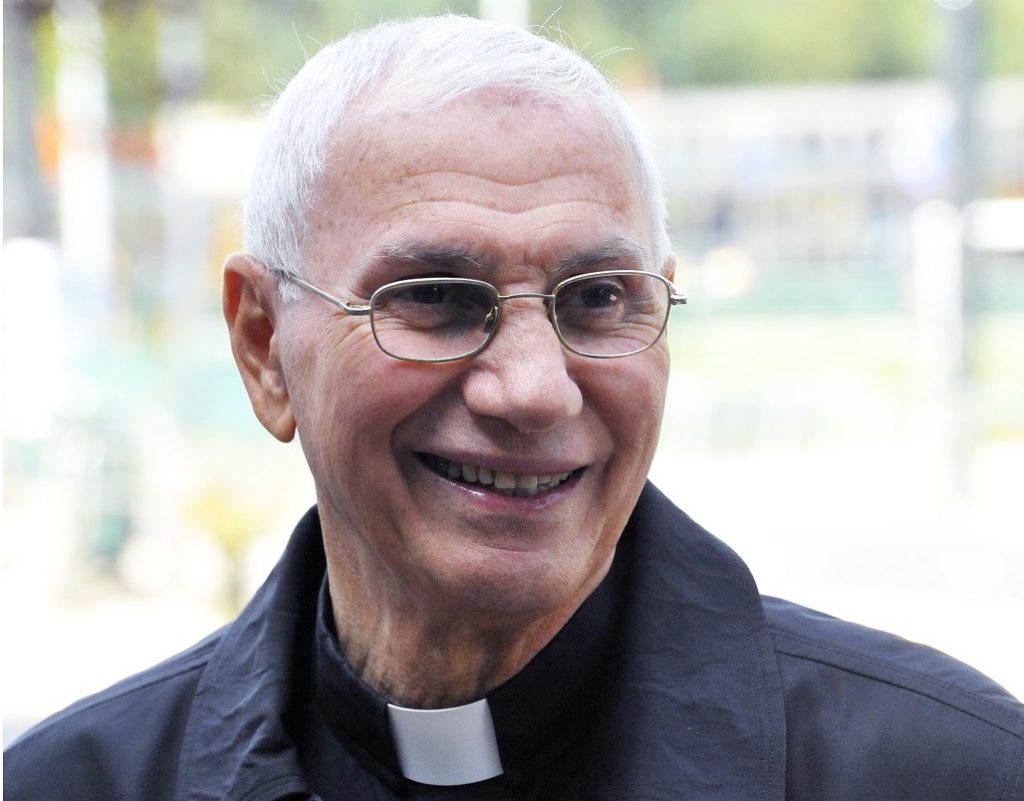
[Assis Naim Ateek, Sabeel Community] Dear Friends, What should our new year’s message be when so many of our sisters and brothers in occupied Palestine, Israel, Lebanon, Syria, and throughout the Middle East are experiencing fear, despair, anxiety, and the prospect of an uncertain future?
I believe that an appropriate message should be of hope and endurance. That is why many of our people have been using the Arabic word “somood” which carries the meaning of resilience and endurance. As we begin the new year we must prioritize HOPE and exercise SOMOOD. Gaza has modeled for many of us the importance of both hope and resilience.
In spite of the destruction and devastation of homes, schools, hospitals, and the unimaginable loss of Palestinian lives in Gaza, and the West Bank including East Jerusalem by the Israeli government forces, we must not lose hope but we must cling to our faith in God, come what may. Our faith is grounded in the living God who loves us and will guide us through “the valley of the shadow of death” because God is walking with us. Our people will fear neither Israeli genocide nor Israeli erasure because, with our Muslim brothers and sisters, we say, God is Greater, knowing that God indeed stands above Israel’s evil snares and conspiracies and God will ultimately defeat the evil schemes of Zionism.
It is important to draw comfort from the words of the Apostle Paul to the church in Rome. He wrote, “suffering produces endurance, and endurance produces character, and character produces hope, and hope does not disappoint us, because God’s love has been poured into our hearts through the Holy Spirit that has been given to us” (Romans 5:3-5). Indeed, our faith gives us hope for a brighter future and the strength to have the somood to withstand and even conquer the evil assaults against us.
Recently I completed the reading of a book written by Professor Rabbi Shaul Magid, The Necessity of Exile. This book gave me a glimmer of hope. He writes: “I try to sever Zionism as an ideology from Israel as a nation-state. In so doing, I fully acknowledge the land of Israel [Palestine] as the homeland of the Jewish people and the same land as the homeland of the Palestinian people. I also fully acknowledge the legitimacy of the right to self-determination for the Palestinian people in their homeland and for the Jewish people in their homeland…” Magid is very clear that Zionist Israel will never give the Palestinians their legitimate equal rights (page 18).
Magid affirms that the Palestinians who live in the holy land have as much right to the land as Jews do. Therefore, he looks to a future where Israeli Jews and Palestinians will live together in one society that protects and promotes the rights, cultures, languages, and religions of all constituencies equally. And although this project might have many obstacles, he says that the main obstacle will be the realization that Zionism constitutes the main obstacle for peace.
Rabbi Shaul Magid ends his book with the words: “If we let go of Zionism, Israel – the country, or even better the land itself – may have the chance of truly becoming a just and equitable polity of all its citizens…” (page 300).
I will add that when the Zionist ideology is overcome, I pray that the door would be opened for Israeli racism and apartheid to start melting away. I like to believe that an increasing number of Orthodox Jews as well as academics, journalists, and even some politicians are subscribing to such an inclusive vision and are speaking about it. As we begin this year, I give thanks to God for all Palestinians and Jews – religious and secular – around the world who are promoting such a vision that can lead all the people of Israel/Palestine to a just-peace that can open the door for healing and reconciliation.
Let us pray to God for the realization of this HOPE.
May the New Year help us turn this hope into reality.
Assis Naim Ateek January 2025
See also Sabeel Wave of Prayer
The Rev. Canon Naim Ateek was the Founder of Sabeel a Palestinian Liberation Theology Group that has been accused of being anti-Semitic, which is a common put down for anyone critical of Israel. This article would indicate something quite different and a generosity of spirit from a distinguished Palestinian theologian quoting an orthodox Jewish scholar.
Thanks to Anglican Bishop Peter Coffin (Retired) who has visited the Middle East many times and is aware of both the region’s history and contemporary challenges.
 Take Note - Reflections on life, music, politics, retirement and more by Ken Gray
Leave a comment