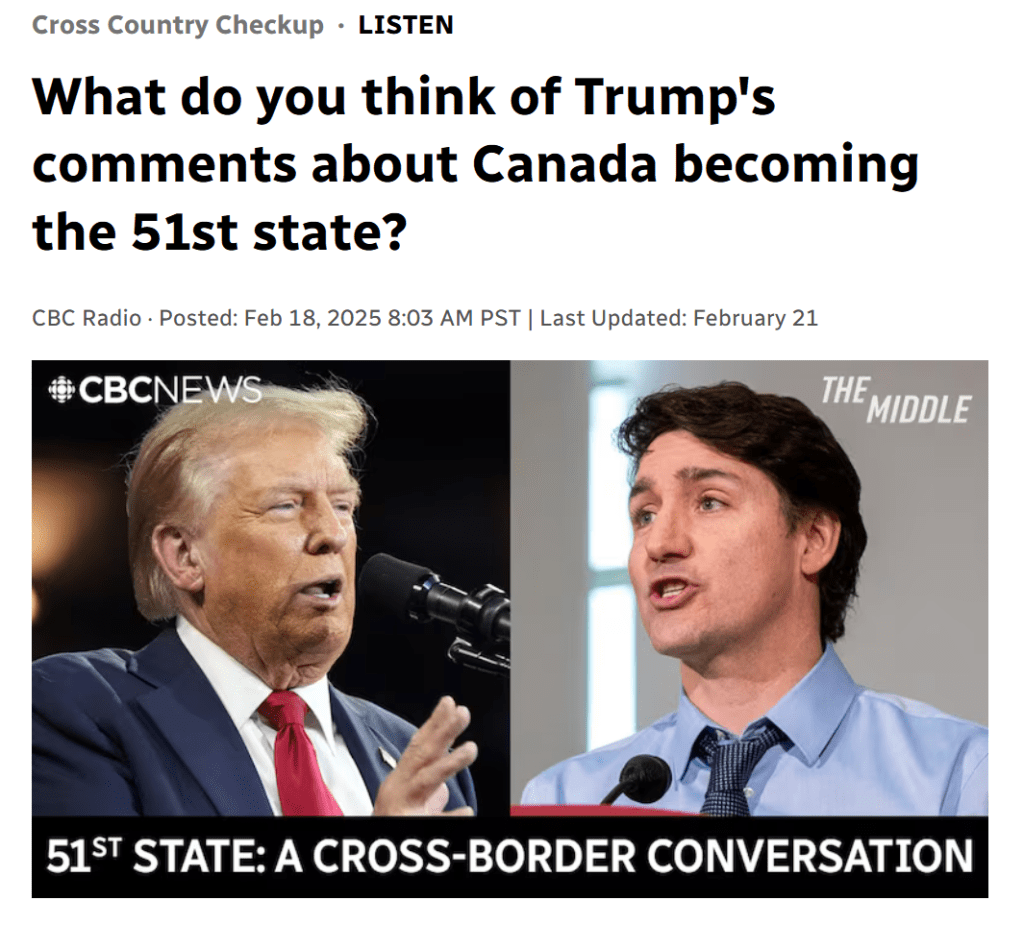
Howls of protest surged online as the CBC News special 51st State: A Cross Border Conversation was announced and broadcast on multiple platforms across the U.S. and Canada this past Sunday. This was an international co-production between CBC Radio Cross Country Checkup with Ian Hanomansing and The Middle with Jeremy Hobson. Both hosts took calls from Canadians and Americans. Callers were asked one question:
“What do you think of Trump’s comments about Canada becoming the 51st state?”
For some Canadians, including a number of friends and colleagues, any focus on the question was out of order. Some felt the topic “dignifies and normalizes the ramblings of a demented narcissist”; such a conversation “is a terrible idea.” For others, including myself, the platform offered a window into the concerns, understanding, and expectations of residents on both sides of our shared border.
During numerous trips to the US in times before internet news was widely available, I remember how difficult it was to find balanced news coverage. Even today, I suspect the average American knows less about Canadian life and politics than Canadians know about US political realities. More than one US caller noted that Americans “have a limited view of events outside of the US.” Even in the most sympathetic quarters I find a certain self-centeredness in my own correspondence. As one caller noted: “Americans want it all, for themselves.”
For some Americans however, the message is Calm Down: “Trump is Trump; plans change daily; this will blow over.” In other words, take a pill, this too shall pass. For others these assertions are no joke, but a sustained attack on Canada, Panama, and Greenland. “Manifest Destiny” still finds new forms. That said, callers spoke emotionally of “deep fear and real anger” and sadness about the antics of “the buffoon in chief.” Most encouraged Canada to stand and stay strong. “We are in the same position as Austria in 1938 in Ukraine today”; this is a “travesty in process.”
What stands out for some Americans is the aggressive meanness of Trump’s blistering claims: “Trump “deserves our ire; he does much harm.” An American military veteran living in Ontario explains how US service personnel must be able “to respect our commander and chief; I, however, cannot; he is not the best of us; his rhetoric is verbal warfare.”
Geographical location in the US significantly influences opinions. Those who live close to the border sometimes work and vacation in Canada. A Detroit resident said that “we are fond of our Canadian relatives; we have our borders, our fundamentals; is this talk just a negotiating tactic? Is it real? It rattles me [so much I might] get fed up with the US and move.”
Canadians David Frum and Arlene Dickenson both wonder what Trump really wants. Robert Reich suggests it’s all about power, ego, and dictatorial control. Kevin O’Leary thinks it’s about a unified economic union, an organic unity well beyond trade agreements. Look at the EU as an example. Best of Luck Kevin with this pitch. He thinks we are wasting our time being angry, a position he states, angrily. In one caller’s words “Canadians have a unique sense of self.” We are more than pawns on an economic chessboard. Some feel abandoned by other nations. “It’s reprehensible, no one else is standing up for us – the UK? King Charles III? What is the threshold for support from other leaders? Will we repeat the dangers and action of appeasement?”
For some callers a particular life history surfaces strong emotions. A Vancouver resident describes how his family from Hong Kong lived under Japanese annexation during WW2. His response was pretty clear, even blunt. NO to annexation.
Many American callers want to remind Canadians that “more than 50% [of us] are being held hostage.” This “crazy uncle does not represent me, nor those I know.” One California resident would prefer the US to become part of Canada. A caller from New Orleans however
“voted for Trump in 2016; he got constitutional judges on the supreme court.” She has no problem with his erratic behaviour; she loves his implementation. “He thinks things through; he’s not a serious threat.” Trump helps her “realize how powerful the US is; he could do the same for Canada and Europe who need “to return to freedom.” No more trucker convoys!
A caller from Detroit is appalled. “We are an exploited people; look at slavery, indigenous [communities and people].” Another caller from Chicago claims that Trump’s comments are an insult to Canadians. Canada “is a better country than we are.” Alternatively, another caller says that the US should take over Canada and that “every move Trump is makin is good.”
North of the border a trans woman from Kitchener is “terrified” for trans folks in the US. While she originally complained about the broadcast on BlueSky, she agrees that “Americans need to hear this.” She likens Trump’s ambition to an abusive husband who seeks to alienate his partner from the rest of the world. John from Vancouver speaks paradoxically. On the one hand, Don’t take this too seriously; don’t give the idea oxygen. At the same time, Trump may be serious, so oppose publicly. The aggression is “insane” and could lead to an “act of war.”
A Canadian oil sands worker thinks that Trump “is serious; If they talk about things repeatedly, then take it seriously.” He argues “this would be a good thing for Canada.” He doubts he gets good value from Canada presently. “I pay half my [income on] taxes and can’t get a family doctor.”
Former Democratic Senator Heidi Heitkamp (N. Dekota) worked with Trump during his first term. For her, “Trump does not face stuff willy nilly” she said, though his conclusions are often inaccurate. If you take oil and gas out of the equation, the balance of trade favours the US. She suggests he’s after our oil and gas. In her wonderful turn of phrase “he has put sovereignty on the ballot in Canada.” To the question why are so many so quiet right now, “folks hope this all goes away” which obviously it isn’t. Resistance is growing in district town halls, courts at many levels, and through growing numbers of squabbles within the Republican party. Still, incredibly, for many the issue of Canada-51 “is on the back burner down south.”
Enough data. What should I take away from this particular conversation?
- I am not sure I know more about public opinion south of the border. Now retired, I have time to search out media stories and analysis. Many however may have heard such notions for the first time. Time will tell is public opinion can influence counter-actions to th blitzkrieg of damage being done to US public life. It does feel like Trump and Musk just want to the burn the whole house down. This isn’t a game friends, but to them, it likely is.
- I am encouraged to hear concern and support for Canadians expressed by many callers. Of course, these folks are most likely to tune in, to phone or email, or respond in other ways. It’s nice to hear that support from the US is real.
- I thought the show did a great job of making space for multiple voices, from the aggressive Kevin O’Leary, to the thoughtful David Frum, the trans woman from Kitchener and the Japanese Canadian from Vancouver this particular table talk was broad and at times deep. Whether speaking to matters of economy, military force, geography and the outdoors, historical memory, or to matters of social inclusion including Indigenous experience, a lot of ground was covered in two hours. Well done team.
I conclude my reflection with a story unrelated to the broadcast itself, a very “Canadian” story in some ways, an event that happened only a few days ago in a restaurant in Windsor, Ontario, itself a border community. Co-owner of Toast in Windsor, Ont., says cheers erupted during Saturday’s lunch hour when a U.S. couple apologized for Trump politics and paid for every meal in the packed restaurant. I encourage you, dear reader, to read the full CBC News story; it’s beautiful. The woman told patrons “she hates what the United States is doing to [Canadians] and she doesn’t support it. And she’s so happy we won the hockey game and it’s a little token of appreciation for Canadians and how much she loves us and how much she loves supporting local.”
Kindness can still be found, in both imagination, speech, and gesture, but wow, sometimes you have to work to find it. So look for it; better still, produce it yourself. It’s not that hard.
 Take Note - Reflections on life, music, politics, retirement and more by Ken Gray
To me, an American-Canadian, please do notice how he doesn’t express the desire to make Mexico the 52nd state, bordering the southern US border the way we do the north. They don’t have anything he wants.
From us he wants three things:
> control over the Arctic;
> all our drinking water;
> all our forests and minerals
–in exchange, we’ll get
> exorbitant health care;
> a multiple-personality disordered Head of State
— and he’ll get an up in arms Quebec, and you never want an up in arms Quebec
LikeLike
This was a very good summary and commentary on the program!
LikeLike