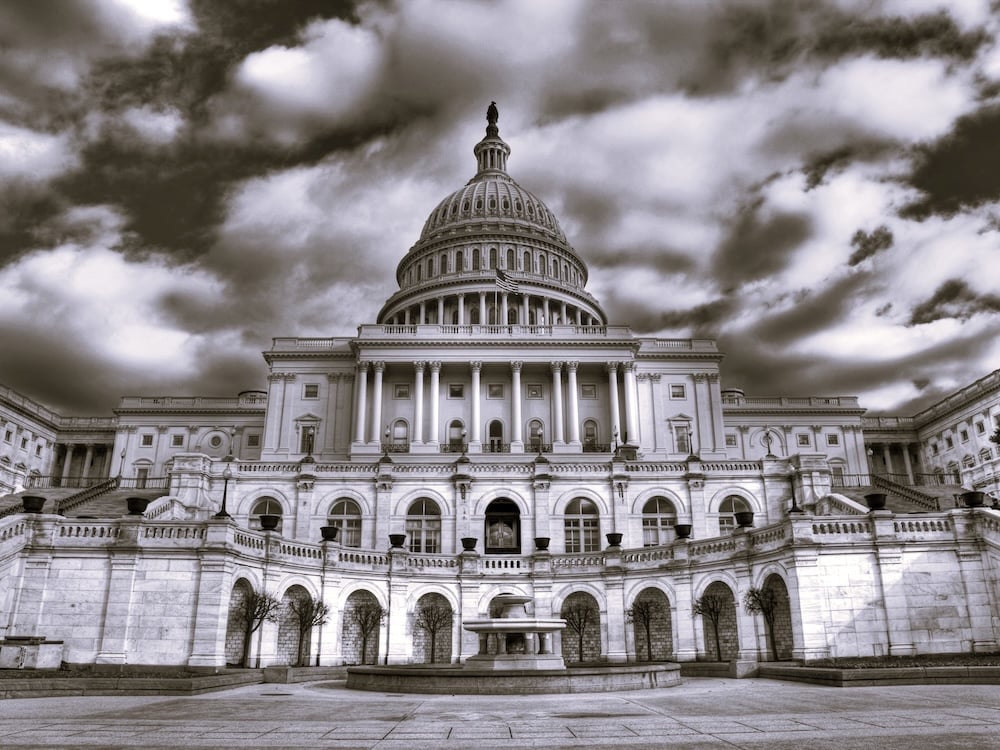
A stylized black and white image of the U.S. Capitol building beneath cloud-dotted skies. Photo by Nicolas Raymond, Creative Commons licensed.
SPOILER ALERT — Long, but worth a careful read. In the words of Gilbert and Sullivan: “Never, say never.”
Reposted from The Tyee — Crawford Kilian is a contributing editor of The Tyee.
We are seeing the early days of a Second American Republic. Let’s imagine what a Third American Republic could be. Photo by Nicolas Raymond, Creative Commons licensed.
Since the second election of Donald Trump, Canadians and Americans have begun to realize the old United States is gone. What hasn’t sunk in is that it’s never coming back. What will replace it remains to be decided, and that decision will affect us as well.
The situation is somewhat comparable to France’s First Republic, which began in 1792 when revolutionaries abolished the monarchy. But compared with the United States, it was very short-lived; in 1804 Napoleon Bonaparte overthrew the republic and declared himself emperor of the First French Empire.
The First American Republic arose with the ratification of the constitution by nine of the 19 states in 1788; the government officially began operations in 1789. This First Republic survived even the stress of the Civil War and a long series of wars thereafter, right up to Iraq and Afghanistan.
But, shaken by Trump’s first term in office, the First Republic expired with his second inauguration on Jan. 20, 2025.
We are now living in the early days of the Second American Republic, and it is already so bad that Americans need to start thinking about establishing a Third Republic as soon as possible.
The First Republic lasted so long because its institutions provided continuity for a population always growing and always changing. Public education ensured universal literacy. Higher education filled the ranks of the federal civil service, the military, medicine and public health, as well as the executive, judicial and legislative branches. A reasonably free press kept citizens informed on the issues of the day. Peaceful transitions of government gave American governments a legitimacy few other nations could claim.
Institutions in decay
But American institutions are now in decay. Higher education is under attack from the Trump regime, and so are the public schools. The federal civil service has been reduced, the military is policing American civilians, and the foundations of medicine and public health are being dismantled.
The Supreme Court passes judgment on ideology, not law, and has made the president above the law. Congress has abdicated its powers over spending and waging war, allowing the president to rule by decrees called executive orders.
Trump is no Bonaparte, but he is where he is because he recognized institutional decay, and he has exploited it ever since he declared himself a candidate for the presidency in 2015.
It’s tempting to imagine that Trump could be removed from power and the United States would revert to the status quo of 2015. But the decay of American institutions arguably began with the onset of neoliberalism in the 1970s and 1980s and the transfer over 50 years of $50 trillion from the bottom 90 per cent of Americans to the top one per cent. As social engineering, it was patient, methodical and brilliantly successful.
A person like Trump in 1960 could not have gamed the system then in force. Since 2016 Trump has gamed it repeatedly, exploiting institutional weaknesses to advance himself and gain power. Now his challenge is to weaken those institutions even further, so that they cannot resist him.
The rise of the Second Republic
In Trump’s Second Republic, a crippled post-secondary, confined to politically approved teaching and research, will sharply reduce the number of students. Some of those who graduate will staff the few government agencies remaining from the First Republic, and they will tell the Trumpists in power what they want to hear.
They will also help to staff the rapidly growing bureaucracy needed if Immigration and Customs Enforcement is going to become the largest agency of its kind in the United States — and, indeed, in the world. At present, ICE is about to hire 10,000 more employees over the next five years. Its budget is rising from $8 billion to $28 billion.
In Trump’s Second Republic the vast majority of young Americans will likely go into community college programs and vocational education, with little exposure to the arts or to rigorous scientific training. They will doubtless have to pay for their tuition or go into debt; both requirements would further reduce the pool of students and therefore the pool of teachers. Some military members might have the option of post-secondary or graduate training, paid for by the government.
With few job prospects, most Americans will have to scramble for any kind of employment, even the agricultural stoop labour they now disdain. Unions, if not dismantled, will be obliged to accept “sweetheart” deals putting their workers’ pay a little above the pay of the non-unionized.
The courts will have no more independence than they do in Hungary or Russia. Their function will be to legitimize the increasing exploitation and oppression of Americans — especially non-white Americans.
Under the Second Republic, both mass media and social media will be closely controlled. People criticizing the policies or officials of the Second Republic will be charged with “terrorism,” much as they are in countries like Russia.
Trumpism minus Trump
Even if all this comes to pass, I would not be surprised to see Donald Trump out of office within a year. He seems diminished in mental capacity since his first term, and his cabinet could remove him through the 25th Amendment. Vice-President JD Vance as president would surely pardon Trump for all the crimes Trump has denied committing. Vance and his government would then carry on with Trump’s policies — or at least those policies supported by the most powerful of the factions that make up MAGA.
Nor would I be surprised if the 2026 and 2028 elections are rigged to maximize Republican wins and Democratic losses. It would be a pleasant surprise to see free and fair elections, but that would require too many changes to red-state gerrymandering and voter suppression laws. Cancelling the elections due to some “emergency” is not impossible.
And if we assume rigged or cancelled elections, Trump’s disastrous policies make sense; however resentful voters may feel about the way Trump has treated them, they won’t get redress of their grievances through the ballot box.
If Democrats inherit a Trumpist government
But let’s assume that somehow the elections of 2026 and 2028 actually result in Democrats taking the House, the Senate and the presidency. The Trumpists, with or without Trump, would attack the elections as rigged, demand recounts, slander election officials and do their considerable best to discredit the vote.
The Trumpist minorities in the House and Senate would bitterly resist every law and executive order, making it as difficult as possible to repeal Trumpist laws like the One Big Beautiful Bill Act. The Supreme Court would remain with a Trumpist majority. Agencies like the FBI and ICE would be full of Trumpists. New legislation, and Democratic legislators, would be subject to a torrent of abuse and threats. Some Democrats (or dissident Republicans) would be the targets of assassination attempts.
In addition, a Democratic federal government would find that it has an immense vested interest on its hands: the enormously expanded ICE, running a gulag of concentration camps across the country. Just as universities used to be the economic drivers for their towns and cities, concentration camp personnel will also be paying taxes for schools and public services — and often taking part in local government. Many Trumpists would remain in municipal and state governments, not to mention police forces and the military.
Even if a Democratic government could cancel all of Trump’s executive orders and take all his laws to the Supreme Court, it would be a long, painful grind to bring the country back to 2024. And it would be futile to do so, because Trump and his followers have already shown they can game the systems of the First Republic. They would certainly try to do so again.
A second constitutional convention
So a Democratic government could declare an emergency, a real one, announcing that the constitution would remain in force while delegates from all the states and territories convene in a second constitutional convention. The convention’s task would be to keep as many as possible of the good qualities of the First Republic while creating new institutions to safeguard them from subversion.
What should go into a new constitution? I can suggest a few measures.
One critical pillar of a new constitution should be the public funding of political campaigns, removing the exaggerated influence of billionaires like Peter Thiel, the Koch brothers and Elon Musk.
The constitutional convention would, I hope, dissolve not only the Electoral College but the Senate as well. Their purpose from the beginning was to give political weight to regions with little population, and the Trumpists have found them easy to game. So a unicameral government would include representatives from the citizens in the states, but the states themselves would be little more than names for regional governments.
Another element, borrowed from Canada, would be Elections America, a non-partisan body that would set the boundaries of congressional districts and oversee all federal and state elections in them. This would prevent gerrymandering and voter suppression while ensuring each election is free and fair.
The Republic of Trumpland?
It’s quite likely that Trumpist delegates to the convention would resist all such proposals. After all, they’re a minority of the population, owing their power to the electoral weight given to low-population states. They would not willingly give up that power. The convention might then offer the Trumpists a deal: the outright partition of the United States.
Trumpists, after all, are the spiritual descendants of the enslavers who ruled the South and heavily influenced the North until the Civil War. While they lost the war, the enslavers won the peace and established another century of Jim Crow and segregation. For the enslavers and their descendants, only white men deserve to rule; Trumpism is only the latest expression of this ancient bigotry.
Many red states are already engaged in what I call artisanal secession, excusing themselves from many federal laws. The offer of their own nation might be an attractive one, but it would be offered in a way to call the Trumpists’ bluff.
Say the new nation, Trumpland, includes North and South Carolina, Georgia, Alabama and Louisiana — or any two or three other contiguous red states. Their residents would have 18 months to move to the 45 remaining states, or to remain to welcome Trumpist migrants from those states.
Those leaving the U.S., or remaining in Trumpland, would be deemed to have renounced their citizenship. Trumpland would pay the U.S. for any federal property and facilities it might require, but military resources including nuclear weapons would be shipped to the U.S.; Trumpland would have to find the money for its own armed forces.
Washington would continue to pay Social Security to emigrants and those remaining in Trumpland, but Medicare and Medicaid benefits would cease. So would federal funding that would normally have gone from Washington to the former states.
Yes, this would disrupt the lives of millions — who have already been disrupted by Trump’s decrees. But it would make clear to many Trumpists how much their well-being has depended on funding from other states, funnelled through Washington.
Starting the Third Republic
If a new constitution were adopted, it would go to a national referendum after at least a year of national discussion. A simple majority of the popular vote would establish the constitution as the law of the land, and Elections America would hold the first national vote under the new terms. With that vote, the Third American Republic would begin.
And if it were not adopted, yet another convention would try to hammer out a better constitution. It would be a maddening, frustrating business, but it would be infinitely preferable to a new civil war.
Canadians would not be detached observers of the American transformation. A certain Trumpist mindset exists among some Canadians, revealing itself in the convoy protests, anti-science attitudes and occasional Islamophobic attacks. We would have to monitor such groups carefully.
We might also try some measures to reduce inequality, like instituting a modest universal income, improving health care and reopening higher education to more foreign students. Immigration should expand again, and not just for Canadian nationals leaving the United States.
All Canadian parties should try to make Canada an example of an egalitarian democracy that contrasts sharply with Trump’s United States. As we now see, the U.S. was never that democratic in the first place, or Donald Trump would never have been anything but a buffoon of the business world. But if we Canadians can sustain and improve our democracy, we might encourage Americans to do the same.
I support The Tyee through monthly contributions. Please consider such a commitment for yourself. We need independent media more than ever right now.
Visit the takenote.ca HOME page for a colourful display of hundreds of other blogs which may interest or inspire you.


As interesting as this is, we have more than enough division, unhealed systemic wounds, separations and wake-up calls like the 2022 ‘Freedom Convoy’ shutting down our entire Capitol for weeks. More recently, quoting the CBC: “. . . current attitudes within the Armed Forces favour white, male and Christian cultures and put groups like women, people of colour, newcomers and the 2SLGBTQ+ community at a disadvantage. . . ” Alberta, not to mention Quebec, reminds us of the tenuousness of our unification. Historically, what Canada is, is what the Old South declared itself to be, a confederacy, a confederation of loosely aligned independent states/provinces with their own policies/laws not always in sync with our weaker central government. Our health care system, much touted by us, is in as much good health as the British version, with many thousands without a doctor.
This detached and rather sanguine examination of the country we’re joined at the hip with should be even longer than it is.
How about now looking past the index, and then at the three fingers pointing back at us.
LikeLike