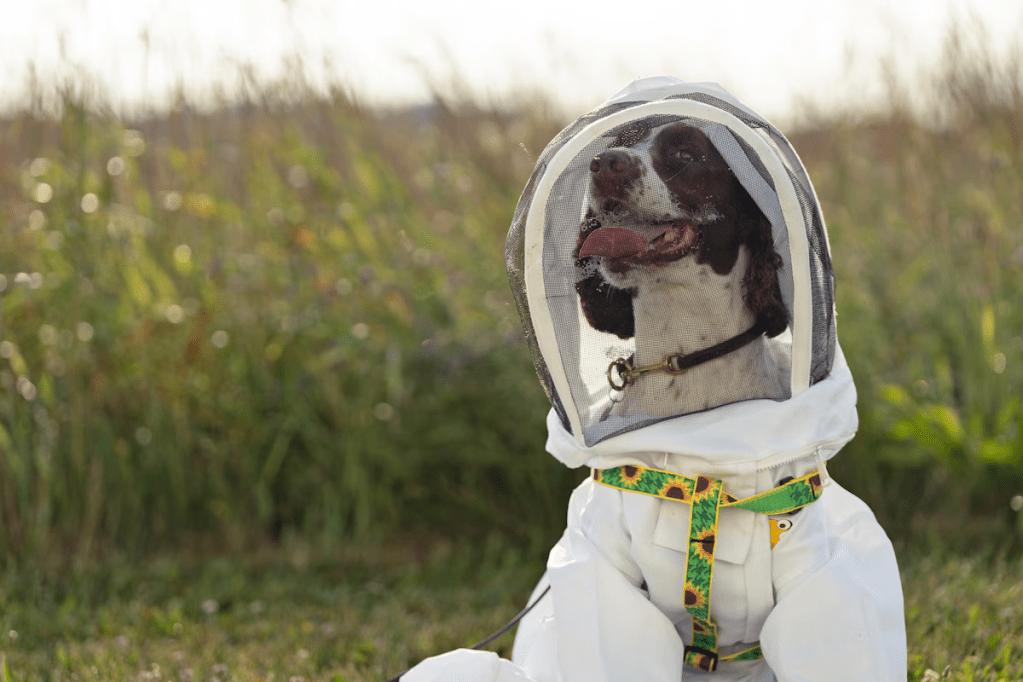
Maple, an English springer spaniel, has been trained to detect harmful bacteria in bee hives. (Nick Schrader/Michigan State University)
Another dog blog by Juno
Almost six-year old Labradoodle, Juno is a dog blogger based in Summerland in the BC interior. She publishes regularly at takenote.ca. Today she introduces us to her new-found hero, Maple, an English springer spaniel, who sniffs bee colonies for bacteria. Juno sniffs other stuff, dutifully, and daily. Sniffing around bee hives however is cool, so very cool. See article below.
This dog used to sniff out cold cases for police. Now she’s saving bees.
By Angie Orellana Hernandez in the Washington Post August 9, 2025
Maple, an English springer spaniel, has been trained to detect harmful bacteria in bee hives.
Equipped with her own tailored bee suit and a hood to cover her floppy ears, Maple — a former police dog — has an important retirement task: helping save thousands of honeybee hives.
The canine has spent the past five months sniffing Michigan bee colonies for American foulbrood, a highly contagious bacteria that’s fatal to the insects. Maple, an English springer spaniel, uses her extraordinary sense of smell as a “high-speed screening tool” to prevent beekeepers from having to manually inspect every hive.
American foulbrood only becomes detectable to humans by smell when it reaches severe infection, at which point the colony risks death, said Meghan Milbrath, a researcher and assistant professor of entomology at Michigan State University.
“She basically just turns all of that effort into a few minutes of her running around sniffing,” Milbrath said of the 9-year-old dog, who works at MSU’s Pollinator Performance Center.
The ultimate goal is for Maple’s work to serve as a blueprint for teaching canines to detect honeybee diseases. It’s part of a larger bee conservation effort in a record-breaking year for colony death in the United States, according to a survey by Apiary Inspectors of America, Auburn University and Oregon State University. The losses appear primarily driven by pesticides, pathogens, poor nutrition and pests, Milbrath said.
The colony losses, estimated at 56 percent in the year beginning in April 2024, result in an “increasing challenge to meeting the demand for crop pollination and honey production in the U.S.,” the survey said.
Maple follows the paw prints of other “bee dogs” across the country that have delved into conservation — including Darwin, a German shorthaired pointer in North Carolina; Mack, a retired Labrador retriever from Maryland; and Mack’s successor, Tukka, a springer spaniel.
Maple’s crossover into bee conservation came after she medically retired from police work, said her longtime handler, Sue Stejskal, who is also new to beekeeping. Stejskal said Maple took a misstep and got injured while they were working on a cold case in Canada, forcing her to step away in April 2024 after seven years as a human-remains detection dog.
Stejskal retired alongside Maple.
Fortuitously, Stejskal was introduced to Milbrath around the same time that the Michigan Alliance for Animal Agriculture opened applications for grant funding. The team at MSU pitched a project on developing beekeeper resources and managing bacterial disease, agreeing that Maple and Stejskal would bring the expertise needed for the endeavor.
Although Maple’s new “target odor” is distinct from her previous job, Stejskal said the fundamentals remain the same. Handlers expose the canines to a scent, offer a reward and teach the dog to conduct an action that means they’ve found the odor they’re looking for. In Maple’s case, she sits when she detects the smell.
But bee colonies introduce many new and exciting smells for a dog’s finely tuned nose. Stejskal said she has to train Maple to be familiar and comfortable with the new environment so the pup can focus on the target odor.
“And then the caveat with working around bees is, we had to outfit her,” Stejskal said.
Stejskal worked with her daughter-in-law to fashion personal protective equipment for Maple. The duo picked out a children’s bee suit and modified its measurements, though Stejskal said they were still perfecting it.
Stejskal adjusts the bee suit to match the weather, at times adding a cooling vest, and she ensures Maple takes water breaks when necessary. Maple also wears dog boots to complete the outfit.
Stejskal said she and Maple — a family since the dog was 10 weeks old — have enjoyed delving into bee conservation together.
“It’s both of our retirement things. She’s happy; it works for her,” Stejskal said of Maple. “I call it work; for her, it’s play.”
Visit the takenote.ca HOME page for a colourful display of hundreds of other blogs which may interest or inspire you.
 Take Note - Reflections on life, music, politics, retirement and more by Ken Gray
Leave a comment