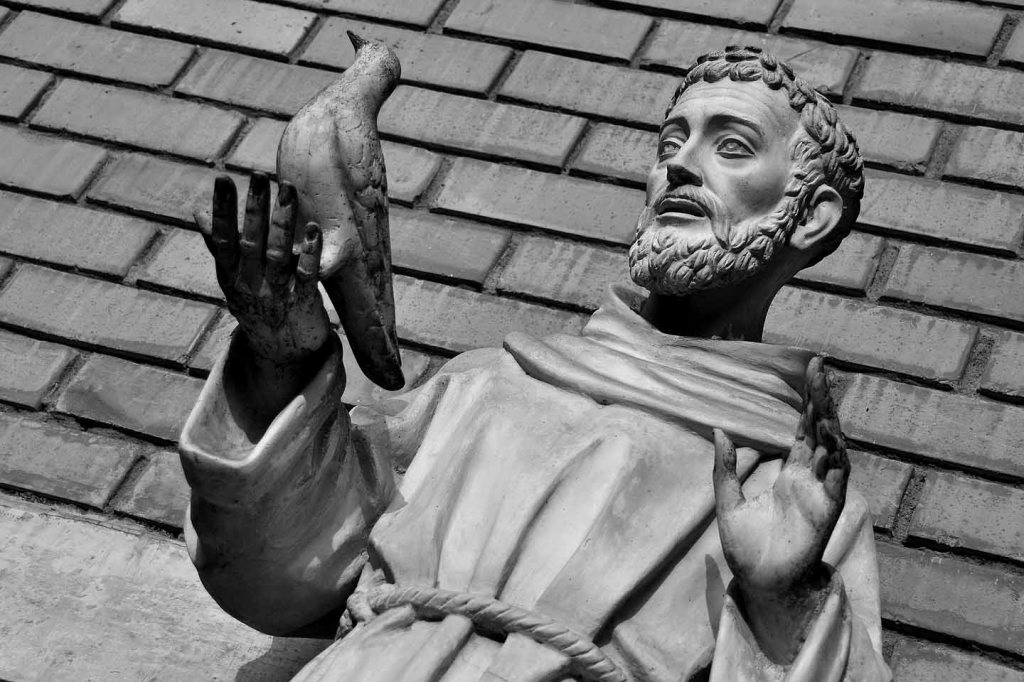
A sermon for the congregation of St. Saviour Church, Penticton on Sunday, October 5, 2025 [St. Francis transferred from Oct 4) by the Very Rev. Ken Gray
“Preach the gospel at all times, and when absolutely necessary, use words”
Attributed to St. Francis, these words embody the thirteenth-century Italian whose greatest honour was to be known as il Poverello, “the little poor one of Christ.”
Francis grew up in a very wealthy family and seemed to have not a care in the world until he was twenty years old, when a chance encounter with a leper left him appalled by his own uselessness. Soon afterwards he heard Jesus speaking to him from a painting of the crucifixion over the altar of a local church. He threw away his wardrobe and renounced his father’s wealth in order to care for the poor and the crippled.
From such an austere beginning the movement of the Order of the Lesser Brethren, commonly called the Franciscans was born. At many points Francis distanced himself from the institutional church of his day; he saw it as self-centred and corrupt; his complaint was not without legitimate cause.
This pure vision of life attracted thousands to a new freedom in the church and in ministry. Religious communities had become more and more entangled with stipends and rich land holdings. Members lived individually simple lives but were corporately secure and even comfortable. Mendicant (begging) orders like the Franciscans were created to break that dangerous marriage between ministry and money. Francis didn’t want his friars to PREACH salvation (although they did that, too) as much as he wanted them to BE salvation. He wanted them to model and mirror the life of Jesus in the world, with all of the vulnerability that would entail.
Francis began his community with a clear intention: “The Rule and the life of the Friars Minor is to simply live the gospel.” The first Rule (the guide for the community’s way of life) that he started writing around 1209 was little more than a collection of New Testament passages. When Francis sent it off to Rome, the pope looked at it and said, “This is no Rule. This is just the gospel.” You can just hear Francis saying, “Yes—that is the point!
From it’s humble beginnings and its focus on social justice, creative engagement with, and within creation expanded throughout Franciscan tradition. The core principle remained however. Francis’ initial inspiration from hearing the words of Matthew 10:9 stayed with him: “Do not take along any gold or silver or copper in your belts.” Poverty was the point; poverty created the possibility; poverty was the practice. It is no wonder that the late Pope, Francis, followed in the paths of his namesake in living a simpler life than his papal predecessors. It is in his magisterial encyclical, Laudato si’ the pope pays homage to the Saint:
“I do not want to write this Encyclical without turning to that attractive and compelling figure, whose name I took as my guide and inspiration when I was elected Bishop of Rome. I believe that Saint Francis is the example par excellence of care for the vulnerable and of an integral ecology lived out joyfully and authentically. He is the patron saint of all who study and work in the area of ecology, and he is also much loved by non-Christians.”
Still mindful of the gift of poverty, he and countless clergy and lay leaders have expanded the ministry of compassion to all of creation:
“St. Francis “was particularly concerned for God’s creation and for the poor and outcast. He loved, and was deeply loved for his joy, his generous self-giving, his openheartedness. He was a mystic and a pilgrim who lived in simplicity and in wonderful harmony with God, with others, with nature and with himself. He shows us just how inseparable the bond is between concern for nature, justice for the poor, commitment to society, and interior peace.”
As Father Richard Rohr OFM writes: “The core is so simple; it’s the living it out that’s difficult . . . Franciscan spirituality has never been an abstraction . . . Francis’ living of the gospel was . . . a simple lifestyle. It was the incarnation of Jesus Christ continuing in space and time. It was the presence of the Spirit taken as if it were true. It was being Jesus more than just worshiping Jesus.”
My hunch is that many of us enjoy reading, as a way to gain knowledge and experience, to think and feel more deeply, and for entertainment. Richard Rohr continues this same theme”:
“Saint Francis, faithful to Scripture, invites us to see nature as a magnificent book in which God speaks to us and grants us a glimpse of his infinite beauty and goodness.” I love that — Creation, as God’s book, through which we know God in Christ, and we know each other, and most importantly, we learn to live with limits. Is there a more timely image for our time? I doubt it.
“Creator, from the depth and breadth of creation, we thank you. Amen.”
Sources include Laudato si’ (§10-12), Richard Rohr and the Centre for Action and Contemplation, and For All the Saints, p. 298-9
Visit the takenote.ca HOME page for a colourful display of hundreds of other blogs which may interest or inspire you
 Take Note - Reflections on life, music, politics, retirement and more by Ken Gray
I chose to listen to the sermon before reading it! Glad I did! (And enjoyed both…)
LikeLike