Readers of my blog may recall my appreciation for the ministry of the late Dean of Canterbury, the Very Rev. Robert Willis. Dean Willis was gay and in long term relationship with his life partner, Fletcher, with whom he lived in the deanery for decades. To those near him he was open about his relationship. To a majority of Anglicans worldwide his sexuality was neither denied nor celebrated publicly.
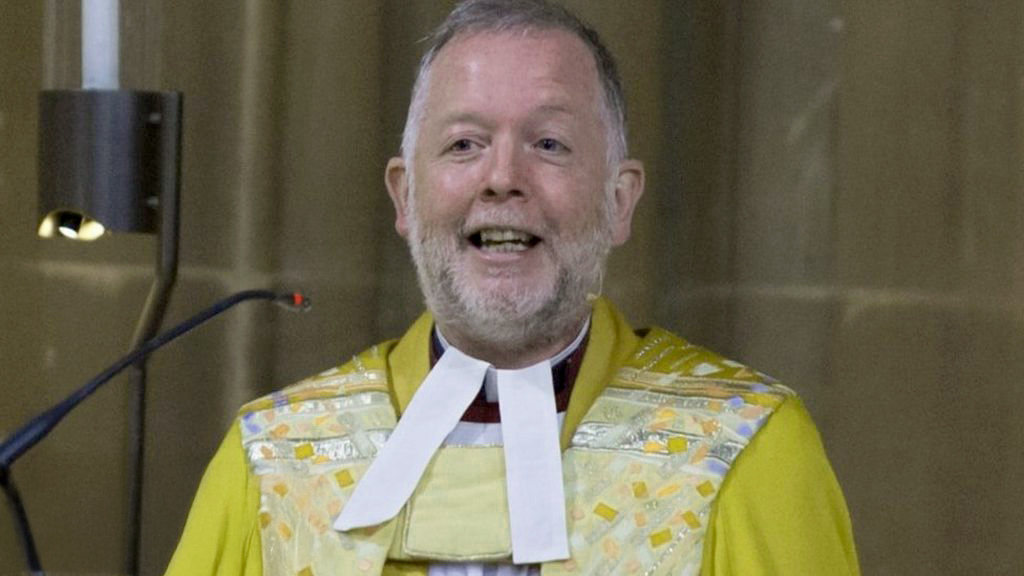
His successor as Dean of Canterbury, the Very Rev. Dr. David Monteith is openly gay and married. He is a most worthy successor to the late dean and has openly spoken to social and environmental issues in sermons and writings. While not a bishop, as a senior cleric in the Church of England he has lived through difficult conversations especially via the Living in Love and faith process noted below — a similar conversation engulfed the Anglican Church of Canada some twenty years ago — a dialogue which for Dean David is not simply theoretical, but deeply personal. Hie words below deserve both our attention and respect.
Winded After the Death of LLF
Posted on ViaMedia.News, October 22, 2025
by the Very Revd David Monteith, Dean of Canterbury
Much metaphorical ink has already been spilt on the announcement from the House of Bishops of the death of Living in Love and Faith (LLF). These reflections add nothing to that discourse but are an attempt to articulate something of what this announcement does to the likes of me as a person. I had intellectually concluded months ago that LLF was terminally ill, but the actual death notice has a far deeper impact.
Firstly, the document was issued about a process not about people. It wasn’t in any way a pastoral letter to the church. I used to mark draft pastoral letters on ordinand selection conferences. This would not have cut muster. The same depersonalising dynamics have gone on at nearly every stage of this process. This just doesn’t upset one or two people as Archbishop Stephen suggested. This is gut wrenching and hurtful for those of us most impacted. It seems there is need to return to a basic course in pastoral care.
Secondly, this multiplies our shame which so many of us have and still experience as LGBT+ people in our families, churches and neighbourhoods. Dealing with internalised homophobia is often a life’s work for many of us, with the kindly welcome and acceptance by our Christian communities often being a key part of that healing. I found my life and heart constrict as I received this news once again; being told loudly and clearly that our minority lives and loves must remain marginal, hidden and uncatered-for like a vegetarian in 1980s France.
Thirdly, I am asked to carry the public shame of this as a priest and in my case as the Dean of Canterbury. Images of our cathedral accompany the press stories of ‘bishops do U-turns on gay blessing’ headlines. No matter what I do or say or no matter how I care or try to love others here, the iconography is clear: that LGBT+ people are never fully welcome here. I am embarrassed and feel a deep sense of personal moral injury without even any remaining left-over crumbs to offer.
Fourthly, the social media storms of recent days about our graffiti exhibition so often focussed on the fact that we worked with marginalised communities. This means I was ‘woke’ and what else was to be expected since I was in a gay relationship. These vulnerable young people asked far from marginal questions; they were those all of us might ask. The haters piled in with force and now they have even more reason to pile in again. What could I say when these young folks asked me if the church excluded them? What could I honestly say?
Fifthly, I realise that all this is so niche and of none or little concern to many people in the church, unlike for those in the wider world who mostly do not comprehend why love does not mean love. None of my clergy colleagues have enquired as to how I am doing. No one from the bishop’s staff on which I sit have said a word. None have even alluded to noticing that the bishops had issued their conclusions. Nothing. We are invisible despite being present and our cares and concerns are best kept to our own little minority lives.
Sixthly, this invisibility intensifies all the other experiences of invisibility. For example, when giving a talk and the last part of my biography is omitted; when a bishop asked me to make sure my partner was not around when certain clergy visited; when as a new Dean I didn’t get invitations from the county set because they didn’t want to invite my partner but were too polite to want to enact a social snub so didn’t invite me either. Being told directly never to mention my sexuality when dealing with visiting bishops from the Communion unless they brought it up, because many would see me as possessed. Talk about making me disappear. So many active processes, not just passive assumptions.
Seventhly, there is little likelihood of anything improving and every likelihood of things getting much worse for LGBT+ people. Many agree that it is now far harder for us in the church than it was 30+ years ago. The tide is turning in the world with gains in equality now being questioned and many, including me, are fearful that what we see with far-right parties elsewhere, we may see here too. From early in ministry, I learnt to respect bishops but not to trust them. I couldn’t begin to make a list of the broken promises and quiet assurances that ‘all will be well’. When the chips are down for the church, both the institution and her leaders find us an easy victim to hurt in playing out politics of so-called normality. Why else was my sexuality highlighted when I was trying to uphold safeguarding during the departure of the last archbishop? I don’t think we can trust the church to defend us if such a terrible day came. We would not justify care.
Eighthly, I have bent over backwards over the years to be gracious and kind, to not walk away from the table, to become vulnerable in sharing myself in conversations and dialogue. I have listened to those of a conservative view with grace. I have watched them behave despicably in meetings, soaking up their violence against me and mine and so often with an annoying smile. Following Archbishop Rowan’s insight, I remember that unity is the quest which keeps on asking ‘who is not here?’ rather than ‘you do or do not belong’. But it is exhausting and sapping of limited energies. Non-reciprocation of generosity breaks the relationship and yet apparently it is me bringing disunity to the church?
Ninthly, many of us simply slog our guts out day in day out. This news has winded me and made me see that no significant change is likely in my life span. The sense of being an ‘alien in the household of God’ grows. As a Dean I spend a lot of energy on taking care not to demoralise our teams, despite the challenges, and to look forward hopefully. There is no hope for significant change in the C of E with respect to LGBT+ people yet many of us are stuck having given our life to this ministry yet not being able to afford to retire nor having the heart to abandon our sense of calling. Pay us all off to get rid of us and I may just rethink, if that is really where you want to head! Why, if you really do think that we are living without true repentance and are unworthy of blessings, do you not just get rid of us as that is the conclusion of the logic now received in this settled view ?
Tenthly and finally, this is akin to a bereavement with all the usual feelings and thoughts. I have no idea what to grieve well looks like in this situation. Of course, I can rely on the church and the bishops not to provide me with any assistance on that. In one theory of bereavement, key to recovery is to invest in the new future beyond the loss. The problem for me is that no new future is articulated in any way for LGBT+ people. That which was perhaps previously imagined is killed off. The hollow words of apology never came to anything. Micro aggressions and visceral fear and anger continue to be experienced by us. The new Christian Inclusion is but fantasy. Apparently, as the bullies of old told me in school, I am to take it on the chin ‘like a man’ (clearly a heterosexual one) and just let these acts of violence and harm keep on coming.
Perhaps the only lasting hope might be another victim who also had to take it – that is about all that remains.
Visit the takenote.ca HOME page for a colourful display of hundreds of other blogs which may interest or inspire you
 Take Note - Reflections on life, music, politics, retirement and more by Ken Gray
Leave a comment