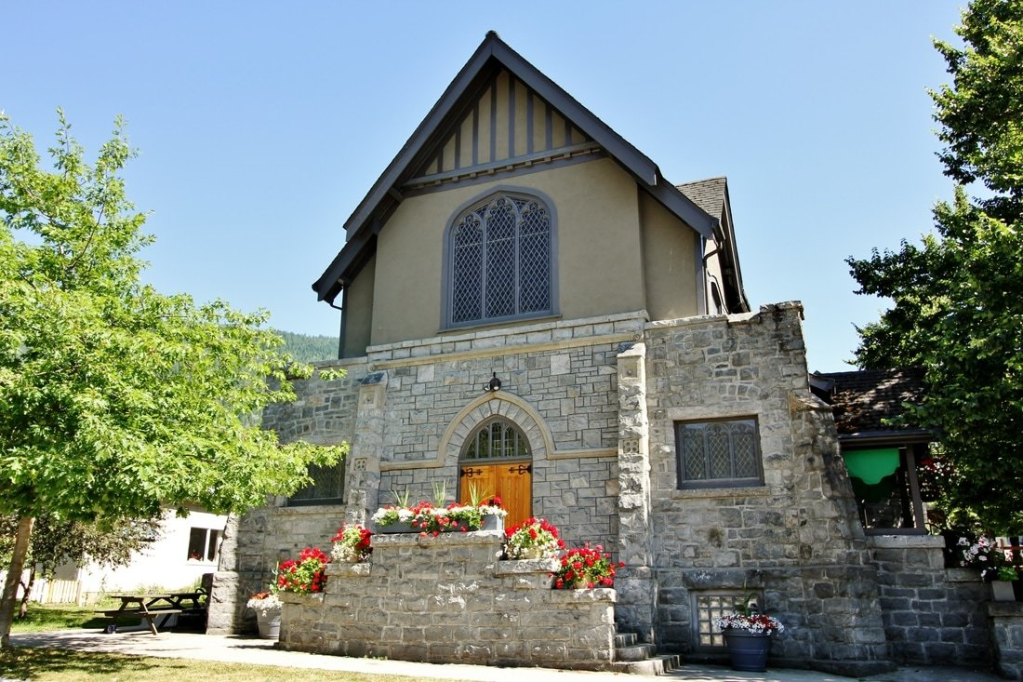
[Ken Gray] This past Christmas Eve while visiting with family in Nelson, BC my wife and I worshipped with the congregation of St. Saviour Anglican Church. In line with Anglican practice, the presider, the Rev. David Burrows, offered a land acknowledgement. It was both fulsome and beautiful. I contacted David a few days later asking if he used a set form and what resources he drew from. His response is below. Thank you David for your fine leadership in this and other ministries.
[The Rev. David Burrows]
Atee, atee! Taamanaq, taamanaq, Davidee Aloushoauk!*
Though I was born a mere 30 miles from Stonehenge, these are some of the first sentences I remember comprehending as a toddler. For the first seven years of my life my greatest cultural influence was from the Inuit of Baffin Island, Nunatsiarmiut. I share this with you, for since relocating to the Kootenays in 2023, I have been asked again and again to offer my words of land acknowledgement that I use in public gatherings.
Since immigrating to Canada in the early 1970’s I have lived in Nunavut, Nova Scotia, Ontario, Newfoundland, and now British Columbia. Each of these provinces has differing relationships with First Peoples here in this country. As an immigrant and settler on this continent I feel the weight, the responsibility of listening and adapting so that I can understand the peoples, individuals, and cultures that have graciously invited me to live and share this beautiful land. Daily I feel blessed to have lived this life of privilege that has enabled me to learn, grow and explore so many different cultural expressions of humanity within the Canadian milieu.
My childhood memories include many Indigenous cultural markers, in many ways I feel as though my way of expressing, understanding, and being as a human continues to be shaped by the early experiences of my life.
These influences affect how I approach understanding and reconciliation with Indigenous peoples. When I read of the colonial legacy within Canada, specifically within the areas I have lived, I cannot but think of my adopted grandmother (Mary Markousee), of schoolmates and close friends in the North. I can’t help but think of the stories I heard first hand of difficulty, abuse, and oppression of those whom I called friends, family.
As a person of faith of the Anglican Christian Tradition, I recognize that I am also immersed in a system, faith and culture that has held too long to the power and wealth of colonialism. I am a person of privilege who represents so much pain, loss, grief, trauma, and anguish for many Indigenous peoples. As an Anglican Priest here in the Kootenays, I am embarrassed to say that after 25 years of ordained ministry, this is the first community where I have regularly, intentionally observed land acknowledgements in my being. Perhaps it is that in these other places in the country there has been less acknowledgement of Indigenous peoples and the destructive legacy of colonialism, especially in relation to faith communities.
Since living here I have shared this land acknowledgement, with some edits in many different contexts. I have shared before worship, at meetings with government and non-profit agencies, and before choir concerts in a local community choir. Many times I have been asked to share my words, for many people have spoken or written to me about how the words resonate in a different way for them.
When I first had these comments shared with me I was a little surprised, because some of the words were not my own (first paragraph developed by Kokanee Parish, Diocese of Kootenay), and also that I don’t know how else one would really offer an acknowledgement, without saying similar words.
For me, these words below are developed through prayerful contemplation. Sitting with the reality of hard and hurtful memories, learning, and being uncomfortable with that reality. It is about imagining how a group of people with power could disregard the inherent dignity of human life, putting value on any one’s education, culture, language, expression, and belief more than others. It is about remembering the pain and sadness I witnessed as a child to a people and culture that loved me and embraced me as their own. It’s about realizing that the message of Jesus in the Gospels, and of God’s Covenant with Israel speak definitively about the subjugation and oppression of vulnerable persons. I strive to loosen the power and privilege I have, for fear of hurting others.
As I have continued in ministry, I have had increasing opportunities to learn and grow. Time serving on National and International Anglican bodies has meant that I have gained resources, perspective, and greater awareness of Indigenous cultures both within and beyond Canada.** I have shared fellowship with Maori and Papuan’s, Palestinians and Pacific Islanders and listened to their experiences of colonialism. In many ways I feel shame as an English, Immigrant Canadian.
So. I share these words below, and I sit with the words. I pray them, remembering friends and family, touching memory and emotion. I remember the places I love, and how I encountered God for the first time, spoke my first words, had my first friends, and hold my first memory of a parish family. I think of injustice present in the world through the abuse of power and the oppression of peoples and cultures. I know it happened to those I love; I strive to hold all Indigenous peoples as my first extended family held me – in love.
Acknowledgment
With gratitude and respect we acknowledge that we gather on the unceded traditional lands of the Sinixt, Siylx and Ktunaxa Indigenous Peoples. (Different communities must be named in other locations, KJG.) We give thanks for their wisdom and care for this place, for our ancestors and for all created beings who are our kindred; all are made and loved by the Great Creator of all.
In particular, I want to acknowledge the immensity of physical, emotional, sexual, physical, economic, cultural, and spiritual abuse that has been inflicted upon Indigenous persons here, and throughout the world, in particular through the church as it partnered with government and others to demand a colonial inculturation, indoctrination to a particular way of life. We were wrong. We need to listen more, to be present in the discomfort, and continue to do the work, make the effort, and bring healing for all.
We need to do this again and again, making efforts to bring healing, listen, and be present in the pain and discomfort. One way for us to address this is to look to the Truth and Reconciliation Commission’s 94 Calls to Action. When we listen and incorporate this learning, we will start on the road of healing. Only then will we heal together, and acknowledge that we are all made and loved by the Great Creator of all.
* Words in Inuktitut, meaning, “Hurry, hurry! Don’t do that, David Darling” (Aloushoauk being a nickname offered to me by the Inuit)
** Two great resources I was given during my time on the Council of General Synod of the Anglican Church of Canada: 1) Mennonite Church Canada resources, Yours, Mine, Ours: Unravelling the Doctrine of Discovery and 2) Wrongs to Rights: How Churches can engage The United Nations Declaration on the Rights of Indigenous Peoples by INTOTEMAK Magazine, Mennonite Church Canada: Winnipeg, 2016.
Visit the takenote.ca HOME page for a colourful display of hundreds of other blogs which may interest or inspire you
 Take Note - Reflections on life, music, politics, retirement and more by Ken Gray
Leave a comment