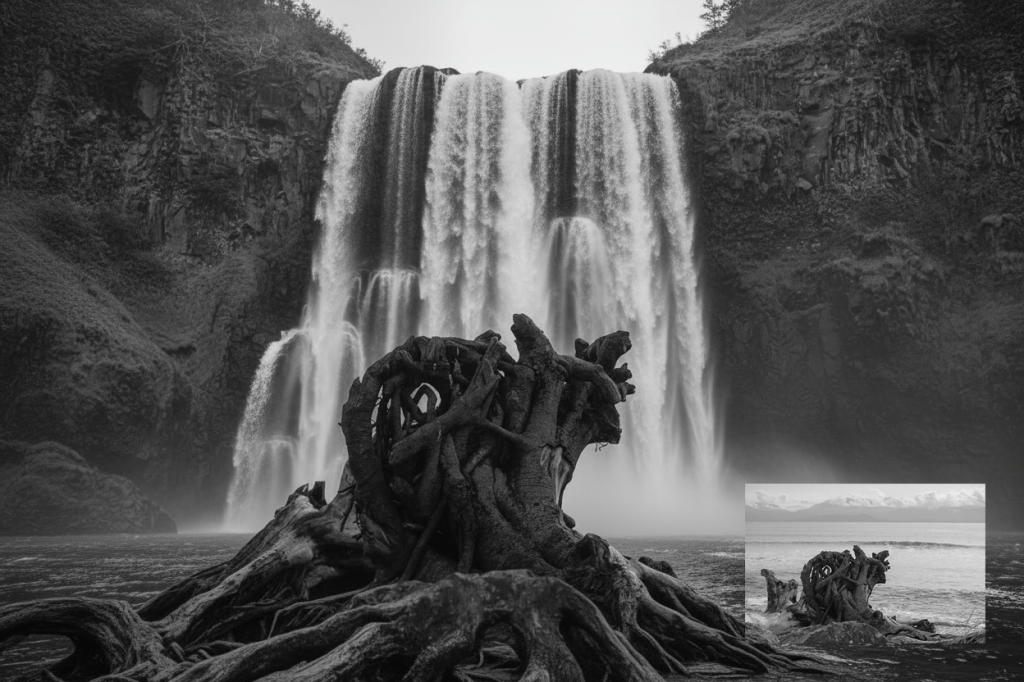
AI generated image by KJG
Reading Phillip Toledano in the Washington Post has me thinking about my own photography. I wonder if it is time for me to up my game, to try something different, possibly to incorporate artificial intelligence (AI) into my workflow. While I try to avoid AI everywhere else — in word processing, email correspondence, meeting records, zoom conversations — I must admit that in some circumstances I am already using it. Recent versions of Adobe Lightroom use it to remove objects and image defects. Sloppy images can be restored or renovated literally in seconds. The result is lovely I must say.
I oppose the use of AI for sustainability and climate related reasons. AI centres use huge amounts of energy, water, and land. Their use at present and increasing rates is unsustainable. AI harms the environment. Such an alarming consequence will collide head-on with the convenience and powerful effects AI can deliver. The printing press; the internet; the electric car; all have been treated as threats to good order and practice. And now, the rapid explosion and intrusion of AI into our lives is almost impossible to ignore or avoid.
Phillip Toledano is a conceptual artist. His book Another England is the second installment in his historical surrealism series. He argues that in the age of AI, photographs no longer express truth. That doesn’t make them any less meaningful however. He continues:
“When I started creating images with artificial intelligence four years ago, it was immediately apparent that our long and complicated relationship with the photograph — or more precisely, the photograph as truth — was over. For roughly 150 years, we believed that the camera told the truth. We believed that a photograph was a kind of evidence, a certificate of reality. You saw a picture in the newspaper, and you knew that what it showed had happened. But that era has ended. We are now living in the era of historical surrealism.”
He’s right. The camera and the photographer must transform a three-dimensional space into a two-dimensional frame. Management of exposure, tone, sharpness, focus, composition, colour, and an almost endless set of adjustment possibilities have allowed the photographic artist to put our own stamp on the experience of being in the original setting.
Think about Ansel Adams directing how each of his Yosemite images is to be processed. Then there’s Annie Liebowitz setting up her concept shots; or Josef Karsh using theatrical lighting techniques in his historic portraiture. The artist has always had a hand in producing the final image, always modified to a greater or lesser degree.
One can easily argue that AI simply extends the palette of interpretive options, even so far as to replace subjects, adjust contexts, incorporate different backgrounds, or change expressions on faces. Toledano welcomes these possibilities for innovation and creation. The amazing array of images shown in the Post opinion piece demonstrate how state of the art technology opens the door to beautiful creativity. As with theatre, the viewer must suspend disbelief in order to enjoy what one sees.
“The age of the image as witness has given way to the age of the image as hallucination. Because AI exists, the photograph, once tethered to the physical world by light and chemistry, is now unmoored — infinitely pliable, endlessly reproducible and fatally untrustworthy.”
For some photographers — and I expect news editors — such innovation is scary. “We’ve arrived at a perfect storm of technology, distribution and psychology,” Toledano says.” In other realms we don’t see such daring substitution. The cardiac surgeon follows strict rules and practices seen through the lens of the history of medicine. The engineer must abide by agreed norms and standards of design and construction. It is in and through the arts, however, that such experimentation, such unique creativity is not only possible; it is welcomed.
Toledano values his images with an appeal to history. “My images create a history that never existed. Instead of capturing the past as it was, the images provide support for inventions, myths and lies. Each AI-generated image speaks to an invented past. For every conspiracy theory, there can be visual documentation.”
For his images, indeed for all images, for both artist and viewer, trust is required. Trust — that the creative artist has drawn on memory, reason, and skill (Anglicans take note) to create something thoughtful, reflective, and meaningful. Again, Toledano:
“The challenge — and perhaps the opportunity — is to rebuild a framework for trust that doesn’t rely on mechanical verification but on something more human: discernment, empathy and shared presence.”
AI takes creativity up a notch or two for sure. We wade through unknown compositional waters presently. It is not the technology we should question. We must question not so much the AI process but consider carefully the one who manages the processing. So I have my own choice to make. AI for ME? Watch this space.
Other blogs on this site that engage the AI challenge are:
Visit the takenote.ca HOME page for a colourful display of hundreds of other blogs which may interest or inspire you
 Take Note - Reflections on life, music, politics, retirement and more by Ken Gray
Leave a comment