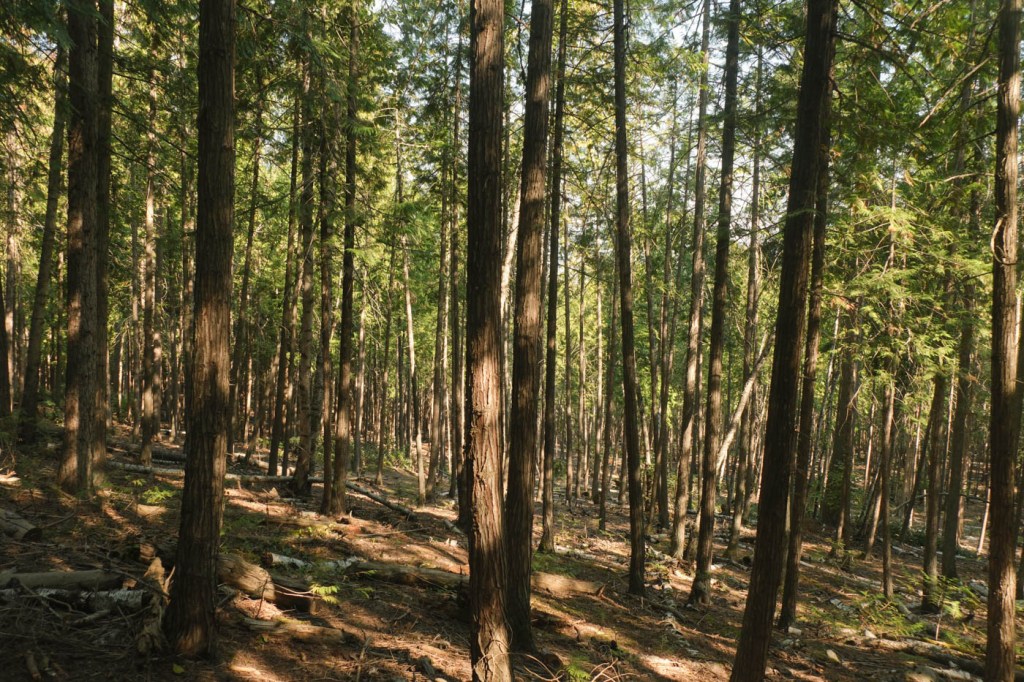
So you think stacking firewood is easy. You are right, but only if you know what you are doing. Depending on the tree species in your region — here, we have easy access to fir, alder, hemlock, and Western Red cedar — there are many things to consider before stacking, even before you venture into the woods. For instance, what are your heating and drying needs throughout the changing seasons? How much wood will you need: Two cords? Four cords? Next, consider your physical fitness. Wood is heavy, especially when wet. Determine what tools you have, and how well you know how to use them: axes, log splitters, saws. Finally, what vehicle will you use to access and transport the wood? Can it safely navigate back roads and slopes? Can you change a flat tire, for instance?
Careful planning will make the job more than a chore; it can become a delight: the joy of being outdoors; the smell of chopped wood, the sensation of sticky pitch on your fingers, and the visual delight of mossy bark — these experiences are shared, in varying degrees, by forest bathers. Don’t lose, however, the thought of a warm fireplace, a kitchen woodstove, or a roaring outdoor fire once all is stacked, dried, and eventually used to fuel your household fires.
The collection and stacking of firewood is a rite of passage here in our forest-loving, little town. I am grateful to Don, who has offered to teach me the art of wood gathering and stacking. He and his family have harvested trees and run small family-owned mills for almost a century. Since he only attends Sunday morning church sporadically, I want to want to find a way to visit with him in a mutually agreeable environment. He has a reputation as a cranky old sod. He has already caused a stir at a church council meeting. That said, he has already arranged for the church house wood stove to be inspected and certified by the fire chief. A woodland adventure seems like an obvious next step.
As I jump into his ancient Ford pickup, he hands me a dog-eared paperback: Tips For Stacking Firewood by Woodie. Woodie who? No one knows; but everyone has a copy it seems. There is a bookmark at page thirteen. Opening the book—a loose page drops to the floor of the truck—I read quietly as we bounce our way out of town, past the youth camp, hugging a ridge atop the steep cliffs along the Kirby River as we creep closer to our destination. On page thirteen I find some suggestions for stacking wood:
Keep the seasoned wood dry — if the wood isn’t covered or sheltered, use a tarp to cover the top only so the rest of the wood can breathe.
I did not know that wood needs to breathe. News to me. Sounds like a warm-up for a yoga class: “In, out; in, out.” CO2 in, O2 out. Really? And how does Woodie suggest you best dry wet wood? I kid you not: “Use wood heat,” he says. I guess you’d better have a supply of dry wood from last year, or pray for hot, summer weather, which is what most people actually do. Typically, wood needs a year or so to dry if stored outside. If stored inside, well, just don’t do it—that’s a fire hazard, at least that’s what the fire chief told me during his inspection. Clearly there’s more to stacking wood than I first imagined.
Use an End Pillar Wood Stacking procedure. The classic, and arguably the most popular method, the end pillar wood stack works best with uniform pieces for pillars fit as snugly as you can. This will help with stability and support.
Good grief, we’re not building pianos here; we’re stacking firewood. But you don’t want the pile to fall over on you. Best advice: Proceed with caution . . .
To construct the towers, take two similarly shaped logs and turn them parallel to each other. Build the next layer with two parallel logs that are perpendicular from the first set. Continue until you have about a dozen levels, or as high as you can.
Complexity intensifies; obviously, I need to work through the theory prior to practice. Woodie provides no illustrations unfortunately. As Don concentrates on the road I read more:
The second tower should be even with, but several feet away from the first. In between, lay the logs next to each other so that the cut ends face the direction of the prevailing wind.
“Ahoy matey: Thar she blows; the prevailing wind; lean into her lads; hoist yer jib.” Thank God for prevailing winds. Swashbuckling stuff for sure. I keep reading.
Keep layering until the pile is the same height as the towers. Place the pieces bark-side up to keep them from shedding moisture into the pile.
As I turn the page, we reach our destination. Don brings the truck to a stop. We have arrived at what is arguably our town’s most popular recreation area. Swimming and cliff diving are favoured by gregarious youth in summer months. Anglers come from all around for a five-kilometer stretch of freshwater fishing — steelhead, cutthroat trout, resident rainbow trout and fall runs of chinook and coho salmon. There are many great trails opening up dozens of smooth rock pools and potholes that were carved naturally into bedrock by the flow of dinosaur-age glaciers.
After ninety minutes of work cutting down smaller trees, of dragging limbs to a growing pile, then cutting straight pieces to shorter lengths, we fill the back of the Ford to the brim and then some. Resting long enough to empty a thermos of hot coffee, we chat:
“Thanks again Don. This has been a lot of fun though I do look forward to a hot shower when we’re back home.”
“There’s a river of clean water just below us. A little cold, but you can stand it.”
“I’m not so sure. I’m a city boy, remember.”
“Don’t remind me. We’ll fix you up in time.”
“I’ve gotta ask. You help a lot around the church, and you do attend sometimes. Why not more often?”
“Truth is that the forest is my religion. Look around you; so much beauty right here, right now. Our church is beautiful, but for me, the best view is out the window. Nothing personal, Minister.”
“But Church is where we learn together and encourage each other. We share the sacrament together. We hear and respond to the Gospel. We sing; we pray.”
“Do all that out here; if you want to sing, then sing. Think of it this way. Out here, the trees talk to each other. Maybe they sing, if we listen carefully?”
“Huh?”
“Here’s what I think. What’s the difference between a lot of people sitting and standing inside a building, and the same group in a circle under ancient trees, surrounded by life on the ground, with water running by, and fresh air for my lungs and nature for my soul? Think about it; buildings create a barrier between humans and nature.”
I begin to think he has a point.
“What about when it rains?” I ask.
“Ever heard of an umbrella?”
“I don’t think people would meet weekly during winter and early Spring.”
“So meet out here once a month, ten months of the year. Out here we use all the senses—sight, sound, smell, touch, and if you’re careful, taste — watch out for mushrooms, mind you. Call it ‘Worship in the Woods.’”
Admittedly, he’s on to something. Clergy are trained to find ways to attract people to go to church. Sure, that’s fine, but it makes good sense to encourage folks to gather in different ways, as church, inside, and outside. I have thought that Don is just lazy and wants another morning to sleep in on Sundays. I may, however, be wrong.
“You just think I’m lazy, don’t you? You think I don’t like being told what to do, or how to act, or what to believe.”
A bit taken aback, his complaint is fair. He suggests an entirely different way of being “church.” We could certainly initiate some kind of outdoor worship which could include education, contemplative prayer, and a conservation project. We could host an outdoor communion service sharing bread and wine. I need to think about these ideas some more.
And this I will do, when I sit by my wood stove, drying out, and zzzzzzz.
Visit the takenote.ca HOME page for a colourful display of hundreds of other blogs which may interest or inspire you
Another chapter in the series Stories from Somewhere, fictional reflections of an unidentified place at an unknown time. Other chapters are listed here.
 Take Note - Reflections on life, music, politics, retirement and more by Ken Gray
Leave a comment