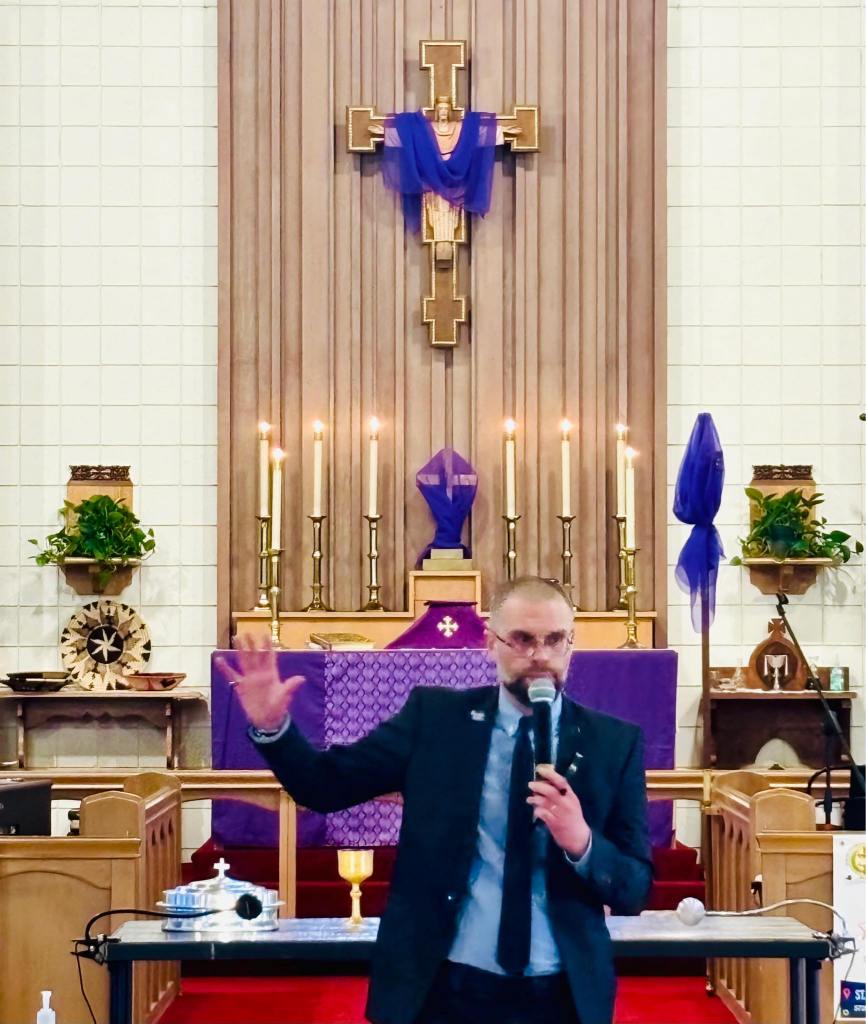
From Andrew DeCourt on Facebook who writes:
I usually script my sermons. I do this to be precise, respect time, and keep a record of what I’ve said.
But yesterday morning, I felt nudged to call an audible. I switched my sermon text an hour before church and preached directly from my heart without any notes. My sermon was titled “The Great Enemy.” I was grateful that Pastor Matt trusted me to do this and said afterward, “Thanks for bringing the fire.”
Two conversations after the sermon linger with me here on Monday morning.
A woman came up to me and said that she rarely attends church. She told me about how hurt and betrayed she has felt by the church. The church no longer feels like “a safe place.” But she said, “I’m glad I came to church today. I felt seen by your sermon.”
Andy Crouch once told me that an excellent speaker must “know your audience.” The truth is that no preacher can speak to every audience. In my work, I aspire to speak to people like this woman. Her testimony meant a lot to me.
Then a kind man asked me about “just war theory.”
He seemed genuinely curious but unsettled by my sermon. He wanted to see if there was another “Christian perspective” to “balance” my message. He said that he believes “the Spirit guides the church” and that he finds it hard to believe that the church could be wrong about just war for 1700 years.
I asked him about American slavery, the German Holocaust, and the Rwandan genocide. All three were perpetrated by overwhelmingly “Christian” populations that went to church. I also mentioned Thomas Aquinas (c. 1204-1274) who was the chief architect of Christian just war theory. Aquinas also championed the evil of the Crusades. Surely “the church” gets things woefully wrong.
My new friend was respectful but still unsettled. When I speak about Jesus’ teaching of nonviolence, some folks seem to assume that I don’t really know or understand the just war tradition. He asked me about the just war tradition in early Christianity.
I said that there was no just war tradition in early Christianity. This is when I mentioned that I was Professor Jean Bethke Elshtain’s last student at the University of Chicago. Jean was one of the world’s leading scholars of just war. She was an advisor to president Bush during the Iraq war and published the book “Just War against Terror” in 2003. With Jean’s mentorship and my own research, I’d like to think that I know just war theory inside out.
I encouraged my new friend to read “The Early Church on Killing.” This book exhaustively collects all of the earliest Christian writings on violence, including war. It conclusively shows that the earliest Christians rejected the use of violence because they followed Jesus’ teaching “Love your enemies.” Soldiers who engaged in violence were forbidden to take the Lord’s Supper. When my friend asked me, “How do you love your enemy in war?” I replied, “You oppose the military and practice nonviolence.”
I also encouraged him to read the research of Erica Chenoweth who has extensively studied violent conflict, especially in their book “Why Civil Resistance Works.” Chenoweth set out to debunk the effectiveness of nonviolence. They looked at 627 conflicts from 1900 to 2019 — a massive data set. But rather than debunking nonviolence, they found that nonviolence is *twice as effective* at transforming violent conflicts compared to violent methods like warfare, which typically escalate and perpetuate conflict. This is what we see in Iran today.
But this is the part of the conversation that lingers with me. At a certain point, it became clear that we were theorizing. The conversation cost us nothing and secured our comfort.
We talked about American bombs raining down on Iran. If we see it as a “just war,” yes, we can lament it as “tragic.” But we can go to lunch and watch TV at home after church without a second, unsettling thought. At least if you’re not in the military, just war is a theology that secures our comfort and the status quo. To his credit, my friend acknowledged that it was his comfort that he was wrestling with.
The sermon I preached on Jesus’ teaching of enemy love is costly. It unsettles our lives and demands countercultural action. Its implications are extremely uncomfortable. As James Baldwin said, the “change” it demands is “the end of safety.”
This is the pattern I observe in much American preaching. In our sermons, we say that Jesus taught ABC and did XYZ; it can be very inspiring stuff. But at the end of the sermon, the unspoken punchline often seems to be that nothing really needs to change. Sure, maybe a few things need to change in our personal lives. But the status quo in our public life is basically untouched.
And so, we leave church and go about our business more American than Christian, more Trumpy than Jesusy. The outcome is that people like the first woman I talked with feel homeless in the church. They are longing for the way of Jesus, but they can’t find it in many churches, even as our churches endlessly talk about “Jesus.”
This woman, Pastor Matt, and Renew San Diego deeply encouraged me. People across the world are longing for the nonviolent way of Jesus and living into it in their neighborhoods. Yes, it is unsettling. It is uncomfortable. It is costly. Jesus was executed by the state for “subverting the nation,” after all (Luke 23:2). But Jesus’ path offers us fierce hope and shows us the way to a new future rather than “the same weary drama,” as Audre Lorde said.
If you’d like to watch my sermon “The Great Enemy,” I’m including the link in the first comment. It begins at minute 34, though the full service was beautiful and nourishing.
Blessings upon all the homeless dissidents who long for the divergent way of Jesus. Ours is the kingdom of heaven.
Visit the takenote.ca HOME page for a colourful display of hundreds of other blogs which may interest or inspire you
 Take Note - Reflections on life, music, politics, retirement and more by Ken Gray
Leave a comment