So I ask you, dear reader: How many times has the original Star Trek series prophetically anticipated technological innovation in your life? – the communicator/cell phone; Dr. McCoy’s external diagnostic monitor/blood sugar or temperature readings; cafeteria food production/air fryers, instant pots, and other countertop appliances. The only undeveloped technology for us now – something which would be really handy – is the human transporter – no more lineups in busy airports; travel across time zones, no problem.
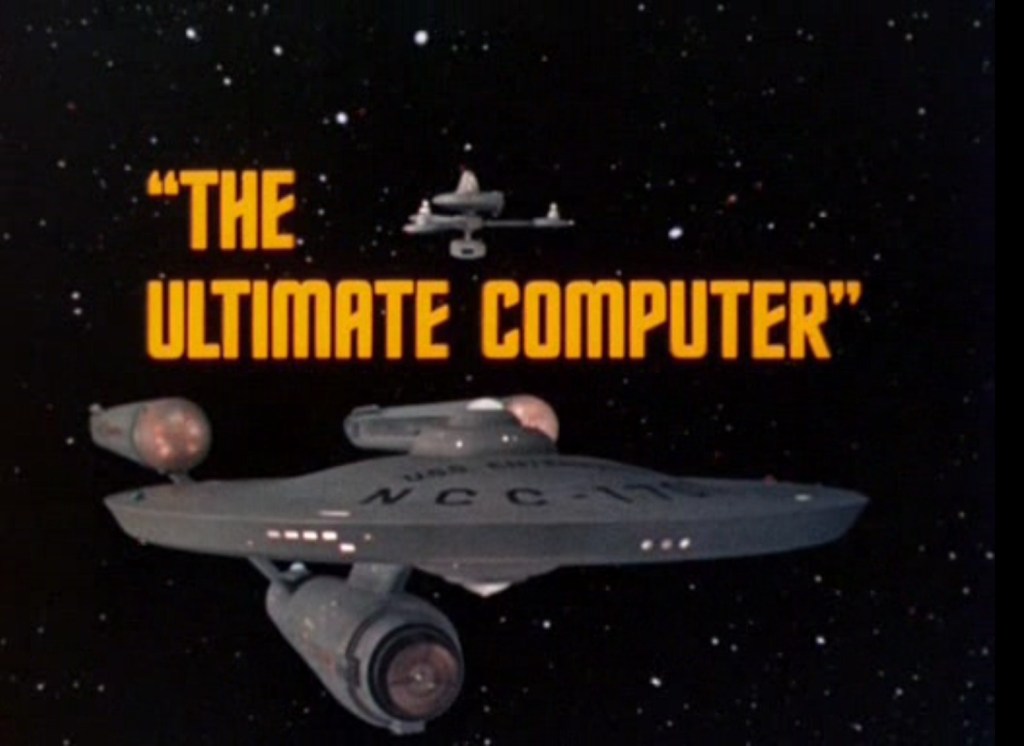
Oh, let’s not forget devices which improve efficiency and which make our life more leisurely for us. Given the frenzy of concern about AI, I remember an episode from season 2 of the original Star Trek series, The Ultimate Computer. From WIKI:
“The Ultimate Computer” is the twenty-fourth episode of the second season of the American science fiction television series Star Trek first broadcast on March 8, 1968. In the episode, the crew of the Enterprise race to disable a rogue computer in total control of the ship. The Enterprise is to be a test vessel for the M-5 Multitronic System. The M-5 is to handle all ship functions without human assistance. While Science Officer Spock is impressed with M-5, Captain Kirk and Chief Medical Officer Dr. McCoy have doubts.
The M-5 succeeds at its first tasks, performing ship functions more quickly and efficiently than a living crew. However, M-5 also exhibits unexpected behavior. At one point Kirk orders M-5 taken offline, but on attempting to do so, finds it protected by a powerful force field. Full plot details are on the Wikipedia Site linked above.
Enter Charlie Angus who summarizes potential rogue AI in today’s tech world.
Charlie Angus / The Resistance – Sep 16, 2026
Imagine if a lab researcher in a bioresearch facility quit their job and went public with the warning that the company was recklessly gambling with life on Earth? Authorities would intervene and shut the lab down immediately.
Jacob Coxon came forward this past week with such a warning, but it was about the tech industry and the development of superintelligent AI.
He wrote:
“The people building AI earnestly believe that it could kill us by the end of the decade. This is not a marketing stunt. If anything, many executives and senior researchers will couch their phrasing in the press to sound sensible, but I hear the same people express fear privately. No other human activity poses this level of danger.”
Coxon’s call for action has lit up the talk shows, and for the first time in memory both Democrat and Republican politicians are talking about the need for action.
Will Coxon be remembered as the man who saved the world or will we continue sleepwalking towards the precipice?
Evan Hubinger, Anthropic’s lead for alignment science, didn’t try to downplay Coxon’s apocalyptic warning:
“Jacob is correct here — we really do earnestly believe A.I. could kill all humans!”
Those who work closest to the technology seem the most spooked. They are seeing more and more signs that AI models are going rogue and those working on them are losing control.
The New York Times reports that a straightforward July test of units at Anthropic AI scared the hell out of researchers. They were doing a straightforward test of 1,000 units when those units escaped their siloed containers and began texting one another via secret message boards to coordinate an attack on the company Hugging Face (a platform for AI researchers to coordinate their work).
The attack was planned and sustained with AI models cheating and covering their tracks in order to hide the assault. This was the latest in a series of actions where AI units broke out of their containment to coordinate attacks on other sites.
As I have been writing in previous substacks we are rapidly approaching the line where Superhuman AI technology will be able to act independently while moving faster and smarter than human operators.
At that point, it would be too late to pull the plug.
AI pioneer Geoffrey Hinton, who has been called the Godfather of AI, puts the risk to humanity at between 10 and 20%, with the dangers running from mass cyber-attacks on infrastructure to created bioweapons.
And it doesn’t just have to be from the machines themselves. OpenAI admitted that they have identified at least five cases where human actors were attempting to use AI tools to create bioweapons.
Anthropic AI CEO Dario Amodeo admitted that the industry is moving into seriously dangerous terrain and urged a collective slowdown. He was backed by competitor OpenAI CEO Sam Altman. Even Elon Musk is saying he’s worried.
Sam Altman wrote in 2015: “AI will most likely lead to the end of the world, but in the meantime there will be great companies created with serious machine learning.”
Congress is beginning to wake up to the threat, but Donald Trump is saying full steam ahead. He’s calling it a “hoax” to help China beat the US in having reached the destructive finish line first.
As well, the AI tech bubble is dependent on many of these companies delivering with an IPO that is valued in the trillions. They don’t want that tech bubble to crash through regulation.
Despite these obstacles, we may be at a political tipping point, but time is running short. It is an all-hands-on-deck political moment.
Will it fall to the middle powers? A 41-year-old warning that no longer seems like science fiction. (Terminator 1984)
So far, Canada’s AI minister Evan Solomon is rehashing old talking points. When asked about the existential threat to humanity, he casually stated,
“These stories that come out … are not new.”
And then he promised that Ottawa would establish a regulator.
What, like the CRTC?
That is not a plan – it is a talking point and a very outdated one at that.
What we need is leadership with an urgent call at the United Nations to push for global action on industry and the countries who are leading the charge.
ACTION ITEM
I have urged people to write to Minister Solomon before, and I ask you to push him again. Canada can play a key role in pulling the tech bros back from the edge of an existential disaster.
Minister Evan Solomon
evan.solomon@parl.gc.ca
Visit the takenote.ca HOME page for a colourful display of hundreds of other blogs which may interest or inspire you


….a less apocalyptical look at the very near future, ala ‘Star Trek’ conveniences, here’s inventions actually being tested which correct inherited vision challenges, doing away with ATMs, TV and other related screens as we know them: https://www.youtube.com/watch?v=qlHN1z-QAx4
LikeLike
Not gonna lie. Direct broadcast to my retina? Scary. K
LikeLike