Either as a musician or as a priest I have attended a number of funerals where no living person besides myself was present.
I once received a call from a funeral home to provide some sort of rite for a deceased person who was just “passing through” for some reason I cannot now recall. Over to the funeral home I went. Ushered into an empty room (apart from a closed casket) I was left to offer some sort of prayers. No other instructions. No name. Nothing. I don’t remember now what I did, said, or thought. After what seemed an absurdly long time (likely five minutes) I returned to the front desk wearing a confident smile (I did good ya know) to collect a cheque and return to my lively day.
On another occasion I was asked to say prayers at the site of a double murder. As I had buried the deceased I was the likely official to assist with what amounted to an exorcism. No one met me nor provided any instruction. I assumed that in preparing the property for sale they wanted to be able to cross off the list of declarations something like “no recent brutal murder” or “residual spirits.” Again, the cheque arrived in the mail. No thank-you note.
Prior to these, and during my musician days, I joined a minister for a memorial service with the two of us and an ash-filled urn. No one, absolutely no one turned up. On another occasion, also from my music days, a different minister worked hard to get both information and some attendees prior to the service. In the end there was about a half dozen of us in the room. BUT in his research he heard only destain from those suggested as friends; one replied “I never liked the guy and doubt you will find anyone who did.”
My point: Funerals, celebrations of life, and memorials in general come in all shapes, sizzes and conditions. Some are beautiful; some are not pretty. Recalling my experiences I found in a recent social media post a solution to the question: “What to do when no one is there, or doesn’t want to be there.” The answer is poetry.
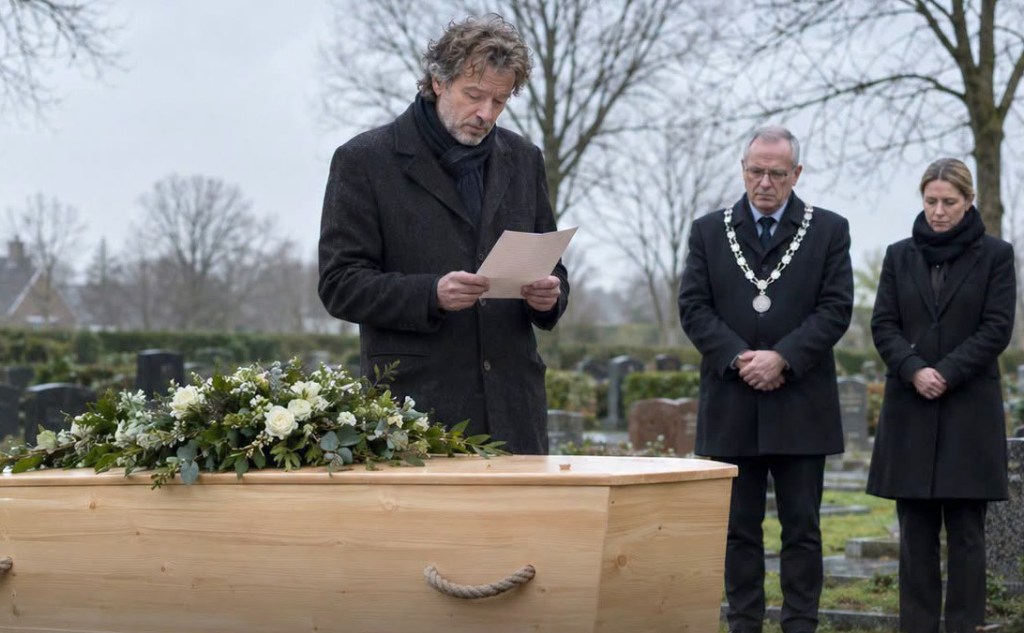
In 2002, Bart FM Droog, the city poet of Groningen in the northern Netherlands, decided that no one in his city should die without being acknowledged. Some people die with nobody left to mourn them, no family, no friends and no one to stand at the graveside, and Droog’s answer was to send a poet.
Later that year, the poet and visual artist Frank Starik brought the idea to Amsterdam, where he set up a formal foundation. Its rotating group of poets is known, with some dark humor, as the Poule des Doods, or Pool of Death. The project became known as the Lonely Funeral, or Eenzame Uitvaart in Dutch.
Before each funeral, the poet on duty works closely with the municipal officers who investigate the person’s life. They gather whatever details survive, a few remaining possessions, medical notes or a landlord’s recollections, and from those sparse fragments the poet writes a poem meant to honor that one particular person.
At the service, the poet acts as both eulogist and mourner, standing beside the coffin at the graveside or crematorium and reading the poem aloud. Often the poet and a few officials are the only people there to hear it.
The tradition has since spread to cities across the Netherlands and Belgium, so that even people who die isolated or unidentified leave the world with a goodbye written just for them.
Visit the takenote.ca HOME page for a colourful display of hundreds of other blogs which may interest or inspire you


Leave a Reply