A sermon for the congregation of St. Saviour Anglican Church, Penticton BC
Fourth Sunday in Lent — Mothering Sunday, March 30th 2025 — The Very Rev. Ken Gray
Happy Mothering Sunday to you all.
Since the middle ages, Mothering Sunday has been celebrated in the United Kingdom on the fourth Sunday of Lent. I grew up with its celebration here in Canada. At this, the midpoint of the penitential Lenten season, it is a time for taking a deep and refreshing breath as we move through some of scripture’s most stirring Gospel stories.
On Mothering Sunday, Anglican Christians return home to their “mother church” wherever that place may be. We arrive bruised and broken, blessed (and possibly cursed) by life experiences. We return with more truth, experience, and insight in hand, possibly with a stronger faith, to a space where we can receive the unqualified welcome from Creator God.
Mothering Sunday, now morphed into Mothers’ Day in the US and Canada, helps us focus our attention on “family,” no longer just the nuclear family of mom and pop and kids and possibly pets. Relationships called “family” enjoy a much wider definitional scope these days, and it’s about time.
As Kathie and I will shortly celebrate thirty-eight years of married life together I am thinking about the many challenges and opportunities that have come our way over almost four decades as we lived in and shaped our own family life together. I think of parenting challenges and responsibilities, and yes, fears. There was always one or two hanging around.
I grew up in Victoria where on March 24, 1991 Michael Dunahee disappeared from a local playground never to be seen again. We were shocked! All of a sudden, public spaces were no longer safe. On November 14, 1997 also in Victoria, Rena Vurke was attacked and killed by a group of teenagers. Again, the spectre of violence hung over the city.
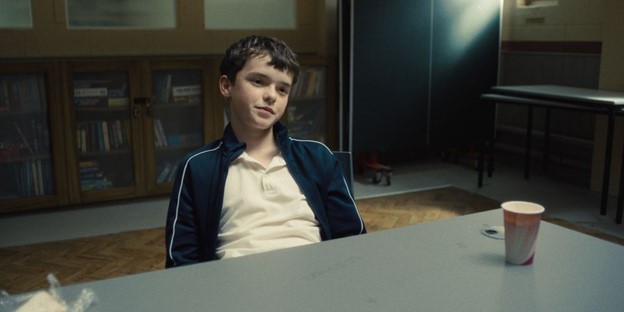
For parents and grandparents, and those who specially care for the wellbeing of children, each age seems to have its own danger and fears. Kathie and I have just watched Adolescence, a four-episode crime drama that has left us traumatized. I do not recommend this series for everyone; it’s a tough watch. But given that we have a number of younger parents or potential parents in our congregation I think it deserves mention on this, a Sunday concerned with mothers, fathers, families, siblings — and relationships, love, trust, and respect.
Released on Netflix on March 14 over 24M viewers worldwide watched one or more episodes during the first few days. (The last total I saw was 66.3M.) It has struck a massive chord with viewers, most watching from the UK, others from North America, and some from places as distant as India.
[From Serena Smith in Dazed] “Adolescence is, unquestionably, the TV show of the moment. Created by Jack Thorne and Stephen Graham, the four-part Netflix series centres around Jamie Miller (Owen Cooper), a 13-year-old boy who stands accused of murdering his classmate Katie. It begins with the police battering down the door of the Miller family home and arresting Jamie on suspicion of murder, much to the bafflement of his father Eddie (Stephen Graham), mother Amanda (Christine Tremarco), and sister Lisa.”
The series is part television, part theatre. Each episode is shot in a single take with the camera being carried and passed from one operator to another (and at one point, on and off a drone) in real, unbroken time. You feel like you are in the room with the characters. Everything about this production, its creation, writing, acting, sets, cinematography, research, even hairstyling, everything is brilliantly and accurately presented.
SPOILER ALERT: Jamie did murder Katie. This is made abundantly clear during episode one. The question is why? Adolescence is no whodunnit; it is more of a “what was he thinking” exploration.
All of us here this morning are variously informed of the benefits and dangers of online social media. Through all four episodes of Adolescence we discover how the ubiquitous presence, and at times nefarious influence, of misogynistic and inflammatory ideas affect Jamie and his peers. Mobile phones are a constant in these students’ lives. It is to me no surprise that politicians in the UK and Australia are considering cell phone bans in schools. Good luck with that.
You will ask, what do social media inquirers find online? At one point, the son of the principal police investigator tells his dad that “you don’t know what’s going on out there.” No he doesn’t, nor do most of us, including me. Many young men and boys are threatened by women and girls, sometimes leading to contempt if not actual violence, sometimes death. Jamie and his peers try to locate themselves in a nervous and tempestuous teen culture. There, and here, it is time for the church and the secular community to join in a serious social conversation around power, relationship, and identity.
Except in fundamentalist communities, few people now turn to the church for authoritative direction in matters of culture — at least in the global north. (Things are still different in the global south.) As Christians we have an important message to share in this particular conversation. The Good News of Jesus Christ demonstrates that all people, regardless of age, gender identification, and socio-economic status are valued — absolutely, and without condition. In our baptismal rite we all proclaim that we will respect the dignity of every human being, as does Creator God who urges us to do likewise.
Today we hear the Gospel story of the prodigal son, the kid who pulled up stakes and left home to sow his wild oats, to cut loose from family ties and have a good time. In what is arguably the most important of the biblical parables, the wayward vamp returns home. There is no rebuke whatsoever from the father of the household — just the “welcome of all welcomes”; fatted calves are roasted, the table is set, and everyone celebrates. The Jewish younger brother who plays with pork and the pigs, finds a welcome.
To return home is to never forget our origins. To return home in any way is a frank admission that we are more than our stories. Our stories shape us, even the crummy ones, the stories of our failures and bad decisions — the life disasters which befall all of us. Creator God seeks our presence, passionately, now and always. This is Good News people.
God of mercy and compassion,
your Word calls us home to faith and love.
Accept all we offer you this day,
in the name of Jesus Christ the Lord. Amen.
SELECTED COMMENTARY
‘We’ve Got to Start Talking About This’: Stephen Graham on Making ‘Adolescence’
Star and co-writer of the hit Netflix show explains the inspirations behind the story, how they pulled off the single-shot episodes, and why he hopes “this is just the beginning of the conversation”
The Flawed Heart of “Adolescence”
The creators of the British miniseries think of the contemporary English boy as a fragile creature, abandoned by society.
OFFICIAL TRAILER here
 Take Note - Reflections on life, music, politics, retirement and more by Ken Gray
Leave a comment