A sermon for the congregation of St. Saviour Anglican Church, Penticton on the Third Sunday of Easter, May 4th 2025 — The Very Rev. Ken Gray
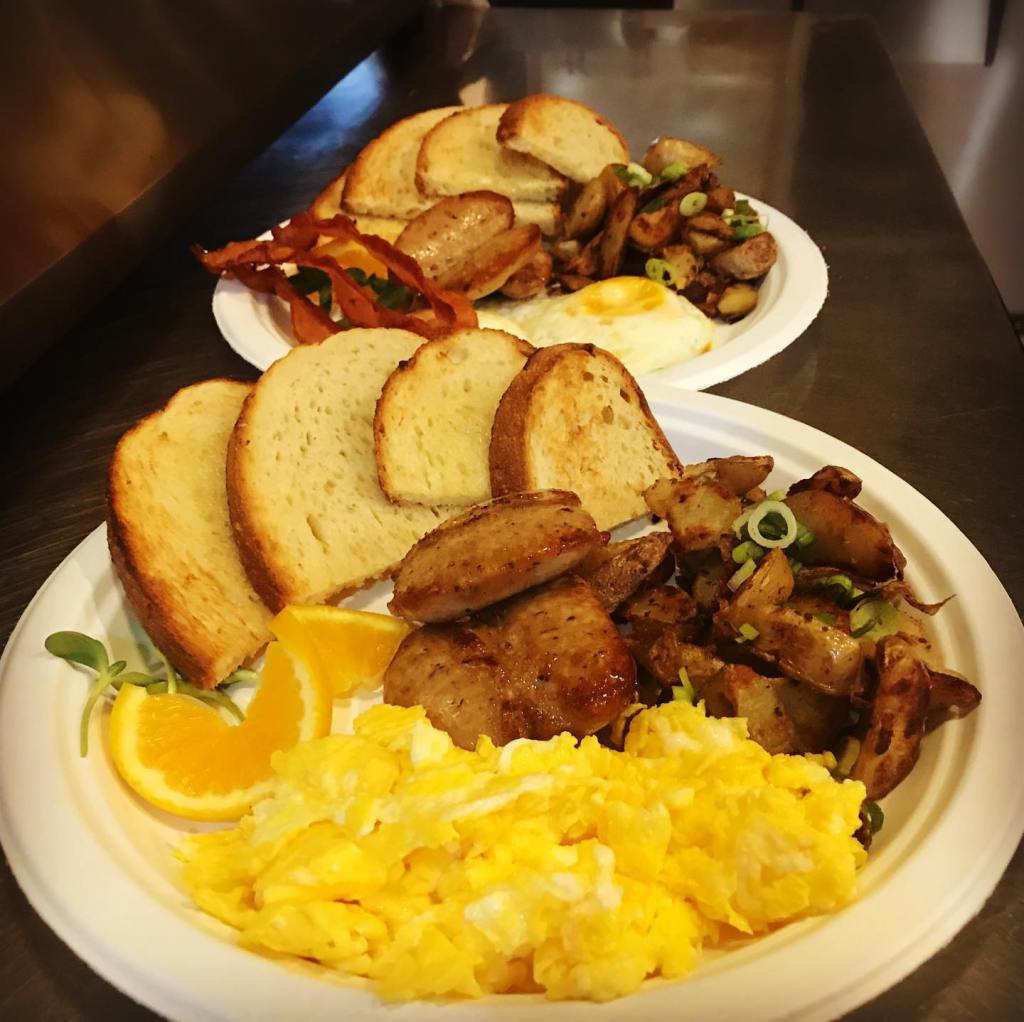
I don’t know about you, but I love breakfast. It’s my favourite meal, not because many claim it is the most important meal of the day, but because I love savoury food in the morning.
Enjoying a few days in the Kootenays last weekend, Kathie and I discovered Frog Peak Café and Restaurant beside the Slocan River in beautiful Crescent Valley. Arriving at lunch, the breakfast menu was thankfully still available. I enjoyed one of the best goat cheese Bennys I can remember. Homemade hollandaise sauce, lots of fresh crispy bacon, and a tender bun, combined with strong black coffee all came together memorably. My enthusiasm for breakfast is, as a result, intensified.
Still thinking of breakfast, and now of music and film let’s go back to 1961 (I was three years old at the time) and the pop culture movie Breakfast at Tiffany’s. “In the realm of pop culture, this iconic phrase captured the imagination of a generation. Audrey Hepburn “played the leading role of Holly Golightly, a free-spirited, enigmatic young woman navigating her way through New York City. Central to the film’s plot is the idea of Holly’s affinity for having breakfast outside the famous Tiffany & Co. jewellery store, a practice which “becomes a metaphor for the pursuit of happiness, personal identity, and the quest for a perfect life.”
Let’s just stop for a moment to consider for ourselves, what we desire — out of life, of others, of ourselves? Years ago while ministering on the island I invited the late Chris Lind to come and lead a workshop on Christian vocation. We titled it: “Our heart’s desire,” in other words, what I just said: What do we desire — out of life, of others, of ourselves; and how does God fit in with all this as the source or end of delight?
Let’s jump even further back in time, to the days when Jesus walked the earth, and specifically to those days immediately following his resurrection, when he appeared in various ways to various people including his disciples. (John 21.1–19)
We are at the edge of the Sea of Tiberius with Simon Peter, Thomas called the Twin, Nathanael of Cana in Galilee, the sons of Zebedee, and two others of his disciples. They have been fishing all night with little success. Jesus stands on the beach, visible, though invisible to those present. Jesus says to them, “Children, you have no fish, have you?” They answer him, “No.” He said to them, “Cast the net to the right side of the boat, and you will find some.” They did as they were told, and caught many fish, a miraculous haul caused the disciple whom Jesus loved to exclaim to Peter “It is the Lord!”
The drama next moves to land: “When they had gone ashore, they saw a charcoal fire there, with fish on it, and bread. Jesus said to them, “Bring some of the fish that you have just caught.” So Simon Peter went aboard and hauled the net ashore, full of large fish, a hundred fifty-three (153, someone counted?) of them; and though there were so many, the net was not torn.
Jesus said to them, “Come and have breakfast.”
In other words: “Come and get it.” Nothing formal here — and no one even said grace! Just “come, and have breakfast”; or as elsewhere in John’s Gospel “come and see” (1:39, 46), and “Come . . . see the Messiah” (4:29); and “Let anyone who is thirsty come to me and drink (7:37); and “Come and have breakfast (21:12).
The invitation is to all and so that all may be fed and their thirst quenched. We behold a parable of abundance, sufficiency, and gracious desire. There is no force applied, no sense of desperation on Creator’s part, just an invitation.
I return for a moment to an author I have introduced before, Elizabeth A. Johnson, a Roman Catholic religious sister, scholar, and author whose devotional book “Come, Have Breakfast: Meditations on God and the Earth” continue to inspire me. Dr. Johnson writes:
“Come, have breakfast” are the words of the risen Jesus in the Gospel of John (21:12). It is an interesting project to ask people if they can identify who in the Bible said these words. The majority draw a blank. Compared with other sayings of Jesus, such as “Love one another,” or “Blessed are the poor,” or “This is my body,” his invitation to breakfast is practically unknown . . . In the story itself, the inviting words “Come, have breakfast” are obviously an expression of Jesus’s care for the bodily well-being of the fishers.
She continues: “Reading this gospel in our time of ecological crisis, the invitation opens onto a wider perspective. “Come, have breakfast” is a bugle call of divine hospitality toward all people and all living creatures, revealing a passionate divine desire that all should be fed.”
I love the phrase “divine hospitality.” Returning to our trip last weekend to the Kootenays I sat down with our priest in Nelson, the Rev. David Burrows. He is proud of their new community meal initiative. Every Sunday afternoon from 2:00 to 4:00 p.m. everyone is invited to a free meal. I asked David about who comes to such meals. Amongst others, he named a special group, those who arrived in Nelson as American draft resisters in the late 1960s and early 1970s. Many arrived with nothing, with no family connections or pre-existing community. Many could never purchase land or a home; they had poor access to education and lived as a fringe community for decades. Now, the cost of living has caught up with them and many are destitute. Time does not always mend things.
I wonder how the demographics and special needs of Penticton Soupeteria clients has changed over the years. The evolution of drug consumption practices amidst an increasingly competitive economy that leaves many with few and fewer options every day continues to take its toll on everyone — visitors, and caregivers.
At breakfast, and throughout each day, God wills that all be fed; hence Jesus’ careful interrogation of Peter, to whom he says “feed my sheep.” From Peter to pope to pauper, the challenge is identical for all of us. Feed those whom God loves, in all ways, at all times. No one said it’s easy; it is however necessary. The poor are always with us.

 Take Note - Reflections on life, music, politics, retirement and more by Ken Gray
I love this post! Brings back past memories of “God’s Kitchen” street breakfast for quite a few years here in Penticton, and “Sunday Soup” (and later “Wednesday Soup”). Wonderful times 🙂
LikeLike