
How one of Canada’s richest women transformed the island of her birth
Highlights from Deirdre McQuillan in The Irish Times Sun Aug 24 2025
Having made a fortune in fibre optics, the ‘culturally responsible’ entrepreneur Zita Cobb helped reverse the fortunes of Fogo island, Newfoundland
At the age of 13, in 1971, Zita Cobb, an eighth-generation Fogo islander, witnessed an event that was to change her life.
One of seven children of a fisherman and his wife of Irish and English descent on this remote Newfoundland island (often described as the most Irish island in the world outside Ireland, and “far away from far away”), she grew up with parents who could neither read nor write in a house without electricity or water.
For centuries the island had been sustained by near-shore cod fishing and a barter economy, but in the 1960s large commercial trawlers arrived and depleted the cod stocks, destroying the traditional livelihoods of the islanders.
Her father, Lambert Cobb, came home one evening with a single cod in his hand, slapped it on the floor, walked out the door, drenched his boat in kerosene and set fire to it. “It was,” she recalls, “a cry of pain and anger. He said to me, ‘You are going to have to go away and study business and figure out this money thing, or it will eat everything we love.’”
By the time the Canadian government declared a moratorium on fishing, Zita Cobb had left to study in Ottawa. She certainly figured out “the money thing”, going on to make a fortune in fibre optics (she was once the third-highest-paid female executive in America, according to Forbes), and to become one of Canada’s richest women.
In her early 40s she retired, having earned millions, and spent four years sailing around the world in a 47ft yacht. She then decided to return home to Fogo, to give something back to the place of her birth and help reverse the island’s fortunes and the haemorrhaging of its population and knowledge.
“As a child when you are an islander, you think of the island as a ship, as safe as the island keeps me, so it engenders a sense of stewardship in us,” she says over the phone from Fogo.

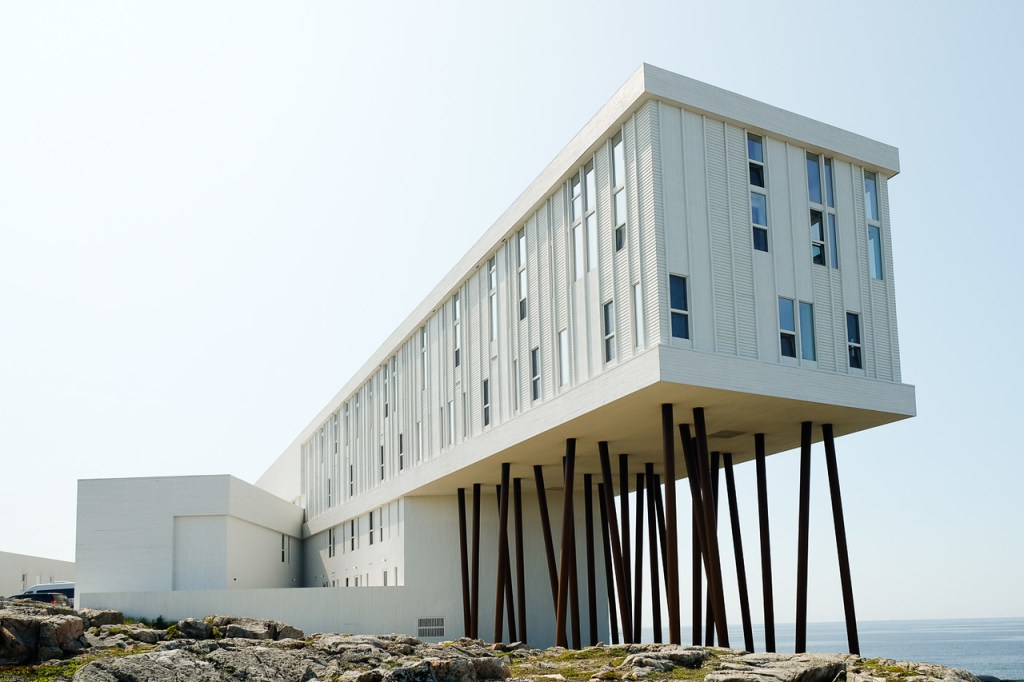
In 2004 she set up a foundation with two of her brothers, a registered charity called Shorefast (the name comes from the line used to fix cod traps to the shore), and other projects to help economic development in the 400-year-old fishing community in Fogo. Initially she set up scholarships, and then invested $20 million in a luxury hotel called the Fogo Island Inn – a bold, contemporary building standing proud on a headland, designed by Norway-based Canadian architect Todd Saunders. With nods to traditional Newfoundland outport traditions, it is propped up on stilts that are two storeys high. It was constructed in part by Irish workers from Toronto.
Cobb’s philosophy and radical ideas about tourism are based on an economic model where tourism is in service to the community rather than the other way around.
It’s about how to build an economy that underpins the place we live in. It’s about asset-based community development. Place has the answer
— Zita Cobb
Her approach has been described as a culturally responsible form of entrepreneurship. On the island, it has taken shape with an array of projects including restaurants, a library, a furniture workshop, boat races and artists’ studios. There’s also an ice cream parlour called Growlers, the name locals call the icebergs that float by in winter.
She is also very clear and specific on the difference between experience and information. “Knowledge is experience, whereas what you get with social media is information. Human joy comes from nature and culture. And experience can only be had in the natural world or tangled up with each other.”
A place-based approach capitalises on the unique strengths and assets in the places we live to transform local potential into national prosperity
— Zita Cobb
“Lessons can always be learned from small islands because they have natural boundaries, and it is much easier to see cause and effect. A small island is a good proxy for a small planet,” Cobb argues. She highlights the documentaries made from the late 1960s by the National Film Board of Canada called Challenge for Change as seminal in illuminating rural and urban poverty. “It really activated things here and drew communities together. People are still learning that you have to co-operate if not collaborate, and through that you can learn different ways of thinking about an economy.”
The Fogo Island Inn, balancing high-quality visitor experience with community benefit, has become a success story. “Last year was the best we ever had at the inn. We don’t have money to advertise, but it slowly builds every year.”

Cobb has also developed what she calls an economic nutrition bar code explaining where the money goes to on the island when anything is purchased, and another new trailblazing initiative launched this year called the Shorefast Institute for Place-Based Economies, harnessing the power of place. Its stated values are that “we live, work and make meaning in physical locations. When these places thrive economically, so do the people, nature and culture within them. A place-based approach capitalises on the unique strengths and assets in the places we live to transform local potential into national prosperity.”
Images above by Ken Gray. For images from elsewhere on Fogo, visit The Irish Times for the complete article here.
Visit the takenote.ca HOME page for a colourful display of hundreds of other blogs which may interest or inspire you.
 Take Note - Reflections on life, music, politics, retirement and more by Ken Gray
Leave a comment