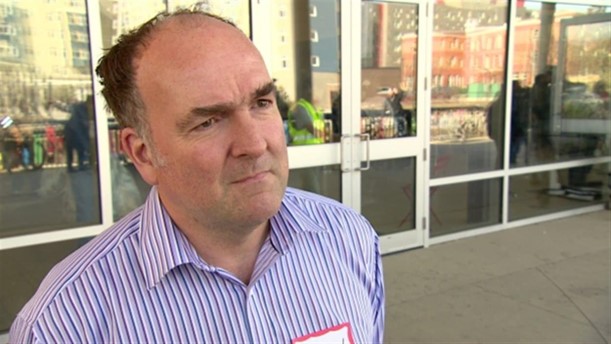
Like most cities, large and small, the City of Victoria in British Columbia still struggles how best to harmonize the lives of rich and poor, of those who live comfortable lives with those who live at great risk, on the streets or elsewhere in the community. Despite massive amounts of money spent on programs, no agreed way forward exists. Local media hear regularly from politicians, church groups, the business community and concerned citizens on both sides of what is typically a polarized conversation.
The comment below from Julian Daly, CEO of Our Place Society, a long running social agency located centrally in downtown Victoria resonates with my own experience in Anglican parishes over the years. I find his approach well informed, appropriately analytical, realistic, compassionate, and hopeful. See what you think.
A commentary by the CEO of Our Place Society
Julian Daly in the Victoria Times-Colonist, Oct 1, 2025
Housing alone isn’t enough. We need to stabilize people with health care and addiction recovery before they can sustain housing — and we must balance compassion with accountability.
Walk down any main street in our city and you’ll see it: tents, people in crisis, open drug use and businesses struggling with the impact. Street homelessness and a degree of disorder in our downtown are undeniable. What’s harder to agree on is how we respond.
Too often, the debate is reduced to a false binary: compassion on one side, enforcement on the other. But this framing gets us nowhere. The truth is more complex — and the solutions have to be, too.
I write this from the perspective of leading Our Place Society, which works daily with people experiencing homelessness, poverty, addiction and mental illness across Greater Victoria.
From our community centre on Pandora Avenue to our shelters, housing and addiction treatment programs, we see the reality up close: lives unravelling under the weight of trauma, addiction and untreated mental illness.
Seventeen years ago, when I began this work, most people we helped were struggling with alcohol. Today, fentanyl and meth dominate — substances designed for maximum addiction and devastation. They can kill quickly, and for those who survive, they often leave permanent brain damage. The drugs changed, and the drugs changed everything. I cannot stress that enough.
The fact is, the majority of people who are entrenched on our streets — and who are the sources of real and perceived disorder, the people screaming threats and in psychosis, the people lying prostrate on our sidewalks and slumped in our doorways — are there as a result of untreated mental illness and addictions.
COVID worsened the crisis. Isolation and despair deepened addiction. At the same time, we drifted into “endless accommodation” of behaviours on our streets that make many — including other unhoused people — feel unsafe. In our compassion, we sometimes lost the balance with accountability. And when anything goes… it really does.
Decriminalization, while well-intentioned, has also had unintended consequences. It normalized public use, leaving police with fewer tools to prevent open drug use. Furthermore, “catch and release” policies have undermined police officers’ ability to enforce the law and created a sense of impunity among those engaged in criminal activity.
And the impact goes beyond the streets. At Our Place, we serve more than half a million free meals a year — but many who need them most, especially low-income seniors, are now too frightened to come inside.
At the same time, longtime donors have told me they’ve stopped giving because they believe we’ve somehow created the very disorder outside our doors. That perception is painful — and incorrect — but it costs us dearly. The result is a double cost: The most vulnerable people are denied services they need, and our community loses the resources required to provide them.
For years, we’ve embraced Housing First as the answer. And for many, it has worked. But for those most unwell, housing alone doesn’t stick. Without addressing addiction, trauma and illness, housing is often lost.
We need a Health First approach, stabilizing people before housing them. That means addressing the addiction, mental illness and trauma that make housing unsustainable. It means giving people a real chance to succeed once they are housed, rather than setting them up for failure.
That stabilization requires more detox, treatment and recovery spaces — and, in some cases, secure or involuntary care.
This is the hardest conversation, but one we can no longer avoid. When someone is so unwell that they cannot make informed decisions about their care, leaving them on a sidewalk with nothing but their civil liberties intact is not compassion — it is abandonment.
Sometimes the most compassionate act is to intervene — even involuntarily — to stabilize someone and give them a fighting chance at recovery. Secure care is not about punishment; it is about protection, dignity and the possibility of life beyond untreated illness.
At Our Place, we’ve seen what works. Our New Roads recovery communities for men and women achieve a 70 per cent success rate, with participants rebuilding lives once thought lost.
Recovery works, but only if people can survive long enough to enter it. Involuntary or secure care, while controversial, can provide that bridge from chaos to stabilization, so that housing can actually last.
We also need targeted enforcement on our streets by the police. Let’s be clear: I am not calling for criminalizing poverty or mental illness. But enforcement must play a role — targeted not at the vulnerable, but at the predators who exploit them: drug traffickers, sex traffickers and those committing acts of violence and theft. Enforcement, used wisely, is not the enemy of compassion. It is a tool of protection for all.
Equally, we need to recognize that not everyone on our streets is the same. Some are unhoused and unwell, some are opportunistic campers, some are criminals. Each requires a different response: health care and housing for some; enforcement for others. One-size-fits-all solutions fail.
The biggest lesson I’ve learned is that no single agency — not the city, the health authority, police, housing, or nonprofits — can solve this crisis alone. Progress comes only when we act together.
During the pandemic, a small group led by then-mayor Lisa Helps did just that. Around one table sat housing providers, Island Health, B.C. Housing, police, nonprofits and city staff. Meeting weekly, we found housing and supports for nearly 700 people. What seemed impossible became reality because we set aside politics and focused on solutions. Where there is a will, there is a way.
Street disorder is not inevitable. It is the result of choices. And that means we can make different choices, such as:
• Put health first by stabilizing people before housing them, so housing can truly be sustained.
• Restore balance between compassion and accountability.
• Target enforcement against those who exploit the vulnerable.
• Build truly integrated housing and health systems.
• Choose collaboration over silos.
And above all, refuse to demonize those suffering, seeing them instead as fellow human beings in desperate need of help.
This is not naïve optimism. I have seen it work before. And I believe, if we act together, it can work again.
Visit the takenote.ca HOME page for a colourful display of hundreds of other blogs which may interest or inspire you
 Take Note - Reflections on life, music, politics, retirement and more by Ken Gray
Yes!!!!
LikeLike
Yes!!!!
LikeLike