Both COP30 and the Tapiri closing service described below are now history. There are however excellent suggestions named below for action following COP, suitable for all regions as the World Council of Churches (WCC) Ecumenical Decade of Climate Justice Action (2025-2034) continues.
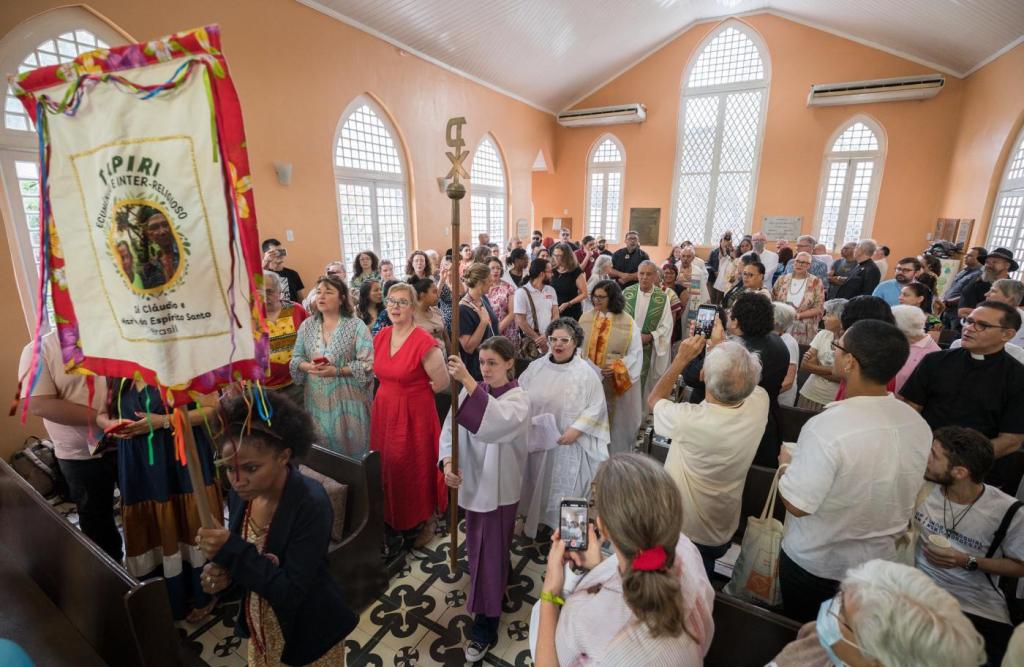
Six days of intensive dialogue among faith communities concluded on 16 November with a moving prayer service at Belém’s Anglican Cathedral of St Mary, in Brazil, that brought together diverse faith leaders from Christian, Indigenous, Afro-Brazilian, and other spiritual traditions for the historic Ecumenical and Inter-religious Tapiri closing celebration at COP30.
A procession opened the service with representations of air, fire, earth, and water – each element accompanied by prayers linking the natural world to climate justice. The scripture reading from Isaiah 32:14-18 proclaimed that “justice will dwell in these lands” and “justice will produce peace.”
Following the scripture reading, the World Council of Churches (WCC) Ecumenical Decade of Climate Justice Action (2025-2034) was presented. Rev. Dr Angelique Walker-Smith, WCC president from North America, shared the decade-long commitment – formally adopted by WCC member churches in Johannesburg, South Africa, in June 2025.
“The World Council of Churches is aligned with you in this great movement for climate justice,” Walker-Smith told the congregation. She explained that the WCC has organized decades in solidarity with women, against violence, and against racism. “Now we say climate justice brings all of that together,” she said.
The decade focuses on four areas: spiritual journey, prophetic witness, practical actions, and living witness. “So we think with head and heart. We bring our spirit, but we also act in the world, and that is why [we have been] in Belém at the COP meeting these weeks,” Walker-Smith explained.
She outlined the commitments: “Together we commit to repent and transform, to stand with the vulnerable. Yes, to transition from fossil fuels to renewable life-giving energy, to advocate for systems change, to embody the economy of life itself, and by doing these things to renew the church’s witness and to walk together in hope.”
Walker-Smith emphasized sustained commitment: “So for the next 10 years, we will go deeper. We will be sustainable in our witness and continue to express hope in the midst of the challenges.” Faith leaders also presented “A Call to Action towards COP30,” with advocacy call and the final Tapiri document.
Organised by ecumenical, interreligious, and human rights organisations, the Tapiri is an itinerant initiative that has travelled through nine Brazilian Amazon states since 2022. In 2025, it expanded globally, bringing international voices into dialogue with Brazilian realities around COP30 and its implications for a more equitable and sustainable future.
Visit the takenote.ca HOME page for a colourful display of hundreds of other blogs which may interest or inspire you
 Take Note - Reflections on life, music, politics, retirement and more by Ken Gray
Leave a comment