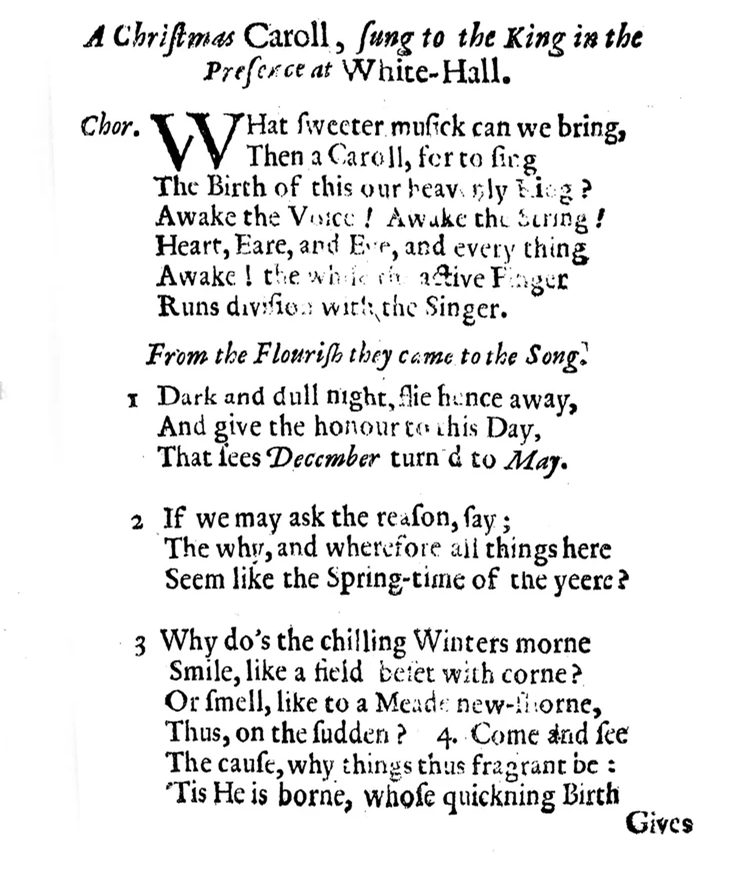
It is hard to identify to which English carols Robert Herrick (1591-1674) refers in his nativity text, What Sweeter Music:
What sweeter music can we bring
Than a carol, for to sing
The birth of this our heavenly King?
Awake the voice! Awake the string!
When children would reach for their stockings
And open the presents they found
The lights on the tree would shine bright in their eyes
Reflecting the love all around – Full text here
Long before the carol form’s expansive development in 19th century cathedral and parish church orders of worship, “caroles” from the 15th Century Trinity Carol Roll manuscript (held at Trinity College, Cambridge from where the performance below originates) provide the earliest examples of polyphonic (multi-voice) music written in English. Thus, by the time Herrick penned his own carol text, carols were out and about in both church and secular settings.
Written for the King’s College, Cambridge Festival of Nine Lessons and Carols, in 1987, John Rutter’s setting of Herrick’s words was published a year later, one of his earliest published compositions, by Oxford University Press.
John Rutter’s name is synonymous with carols throughout the English speaking world.
[From Wiki] Sir John Milford Rutter (born 24 September 1945) is an English composer, conductor, editor, arranger, and record producer, mainly of choral music. He founded the Cambridge Singers who premiered and recorded many of his works for his own label Collegium Records. His compositions, extended pieces for choir and orchestra, such as Requiem and Magnificat, and many choral works including For the beauty of the earth, Christmas Carol and A Clare Benediction, are popular, especially in the UK and the United States. He is known for Christmas carols, in both arrangements of traditional melodies and new compositions, and Carols for Choirs anthology series compiled with David Willcocks.
I was first introduced to Rutter’s carols in the mid-1970s as a member of various choirs which worked our way through Carols for Choirs II — “Shepherds Pipe Carol”; “Candlelight Carol”; “Star Carol”; and the larger “Gloria”’ along with so many more anthems and hymn arrangements. I did not discover “What Sweeter Music” until years later while conducting my own choir here in Summerland.
Described by the publisher as “easy” such an assessment is greatly understated. Rutter’s melody is not to be rushed. His melody is typical of his style — as much a classical as a popular tune — beautiful, memorable, and evocative. Through modulations, chromatic variation, and divisi parts, the long text meanders off only to return home several times to a soft organ string tone. In this fine performance by the adult mixed voice choir of Trinity College, Cambridge (no longer gentlemen and boys), phrasing, rubato, and vocal blend combine to warm any heart on a cold winter’s night. One online comment says it best for me:
“There is no finer instrument that a perfectly tuned human voice. Put them in a choir and it is heaven on earth. Well done and thank you.”
Indeed; thank you John Rutter and the choir of Trinity College, Cambridge.
Visit the takenote.ca HOME page for a colourful display of hundreds of other blogs which may interest or inspire you
 Take Note - Reflections on life, music, politics, retirement and more by Ken Gray
Leave a comment