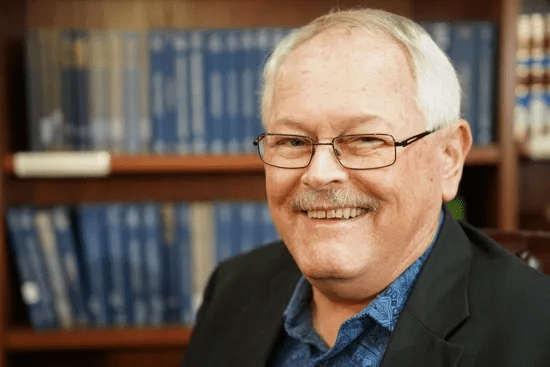
From Ron Rolheiser March 9, 2026. Still a prairie boy at heart, Fr. Ron Rolheiser is one of the most prolific and respected Roman Catholic teachers and scholars alive today.
Thomas Moore, the author of Care of the Soul, teaches that our most important spiritual task is to listen to the promptings of our own soul. If listened to in honesty, it will guide us, protect us, and keep us healthy.
I heard him present this to an audience in a church setting and after he had finished his presentation, someone voiced this strong objection: “I’m a married man, what if my soul tells me to have an affair?” Moore responded to this effect: Your soul will never tell you that. Your soul is your moral and spiritual immune system. Just as your physical immune system will never prompt you to do things that are bad for your physical health, so too your soul will never prompt you to do things that are bad for your moral and spiritual health. Your soul, just like your body, has an immune system that protects your health.
What Moore says of the individual soul is also true for the soul of this world. Reality has an immune system, a moral arc, which protects our health and lets us know when it is violated.
This has various expressions. For example, Jesus teaches this clearly: The measure you measure out is the measure that you will receive. (Mark 4, 24) What’s implied here is that reality has a moral structure, ultimately grounded on love that cannot be violated without consequence. It gives back in kind, rewarding goodness with goodness and malice with malice. The air we breathe out is the air we will re-inhale (even true literally).
In Buddhism and Hinduism this takes expression in what they call the Law of Karma. In street language, the Law of Karma teaches that what goes around comes around. Reality is so structured that we always eventually reap the consequences of our own actions. When we act altruistically, good things will come to us, and when we act selfishly we will reap some unhappy consequences. In essence no one gets away with anything, and no virtuous deed goes unrewarded.
What both Jesus and the Law of Karma teach is that just as our physical bodies have an immune system that guides and protects us and that can never be ignored or violated without consequence, reality too has an immune system, an inviolable moral structure, that cannot be ignored or violated without consequences. Ultimately, we reap what we sow, with no exceptions. Virtue is its own reward, sin its own punishment.
However, this doesn’t always appear to be true on the surface of things. Sometimes it looks like sin is being rewarded and virtue is being punished. But that is mostly at the level of our emotions. Emotionally, it’s natural to envy the amoral. Nikos Kazantzakis puts this rather colorfully: “Virtue sits completely alone on the top of a desolate ledge. Through her mind pass all the forbidden pleasure which she has never tasted – and she weeps!”
We see this kind of envy in the older brother of the Prodigal Son. He resents the fact that his younger brother gave himself over to sensuous hedonism, while he himself stayed the moral course. To him it seemed his younger brother had grasped life, while he, in timidity, had missed out on it.
However, his father’s words to him are meant to dispel his (and our) envy of the amoral. The Prodigal Father, God, tells the older brother not to envy his younger brother’s promiscuity and hedonism. From outward appearance it may have looked like life, but in the father’s words: Your brother was dead!
There is a moral arc inside all created reality, a moral immune system, that is meant to protect the universe and all of us in it. Virtue is its own reward, sin its own punishment. Both the Law of Karma and Jesus assure us that the measure you measure out is the measure that you will receive. No good deed goes unrewarded and no selfish deed enhances one’s life.
I did my doctoral thesis on the proofs for the existence of God. I examined Thomas Aquinas’ famous Five Ways, Anselm’s intriguing Ontological Argument, Descartes’ take on this,and numerous commentaries on these various arguments that attempt to prove the existence of God. In the end, I concluded that we cannot prove the existence of God, as one might prove a truth through a mathematical equation or a strict scientific hypothesis.
But this doesn’t mean that these proofs aren’t helpful. They work in another way. They point you to a certain way of living, namely, where you don’t look to find the reality of God at the end of an equation, but where you look to experience the reality of God through living in an honest, moral way.
There’s a moral arc inside all of reality, an immune system, that, I believe, is a clear proof for the existence of God, for it tells us that a personal, altruistic love lies at the basis of everything and it may never be violated.
Visit the takenote.ca HOME page for a colourful display of hundreds of other blogs which may interest or inspire you
 Take Note - Reflections on life, music, politics, retirement and more by Ken Gray
Well said!!!!
LikeLike