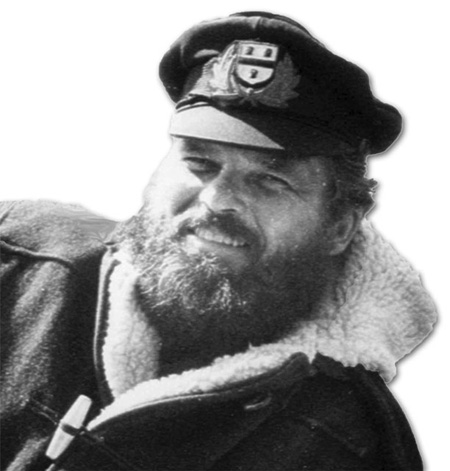
Bob Blackmore — Texada’s master storyteller has spun his last yarn
By Isabelle Southcott in Powell River Living, February 2009
With thanks to fellow dog park companion, Dena Wilson
He was an adventurer, a bushman, a marksman, a photographer, a journalist and a master storyteller. He wasn’t motivated by money but rather by a burning desire to see, learn and then tell others what he’d discovered.
When Texada Island’s Bob Blackmore died on December 9, 2008, he was 77 years old. He’d done most of what he wanted; he was a man with few thirsts left to quench.
As a newspaperman, Bob worked for the Calgary Albertan, The Nelson News, and freelanced for several television stations. He was an award-winning photographer and the official photographer for the Calgary Stampede and several football and hockey teams. Bob photographed The Queen of England, movie stars and ordinary people. He was the official photographer of the first killer whale in captivity, Moby Doll, and was the first human to swim with a killer whale in a tank.
Born in Rosetown, Saskatchewan, May 25, 1931, Bob was an only child. He moved around so much that as a young boy he went to three schools in one year. He loved the bush, and enjoyed hunting, shooting and fishing and had a trap line. He excelled in marksmanship.
Friend John Smith recalls a trip he made with Bob to bring a boat Bob had purchased called the Fort Ross from the east coast out to the west coast in 1969. The Fort Ross had been a Hudson Bay Company freight boat serving ports throughout the Arctic.
“The life of Bob Blackmore has been a source of constant amazement and interest for me,” writes John. In 1993 John told Bob he’d visited the Ninstints – Skang Gwai, Queen Charlotte Islands. “Bob told me of his first visit to Ninstints in the early 1950s. Almost everyone in the village had died of smallpox during the epidemic in the last few years of the 19th century. Bob told me that when he walked ashore no one had visited the village since the epidemic and he was walking knee deep in human bones.”
Bob’s life was one of adventure. It was a life of bear attacks, avalanches, forest fires, floods, snipers and sharks. He ran from bandits, bombs and Molotov cocktails.
People were always calling him to join their adventures. “One day I got a phone call from a guy while I was at work,” said his wife Bev. “This fellow said he was going to ski across the Arctic Circle, would Bob like to come?”
Bob met Bev on the Kettle Valley Railway on New Year’s Eve, 1949. “I saw this good-looking guy and I asked him if he’d like to play Canasta.”
Bev thought Bob was exciting and loved his sense of adventure. They married the following August and moved to the Kootenays in 1953. There they had to snowshoe 18 miles to town and back again to pick up their mail and supplies. One time they were nearly killed by an avalanche.
Around here, Bob was well-known for preserving the history of the Powell River area. His research was meticulous; he left no stone unturned. Teedie Kagume of the Powell River Historical Society says he went to infinite pain to make sure his research was absolutely perfect.
With his deep voice and captivating manner, Bob brought history to life. The Sinking of the Cheslakee, a video made by Bob and Bev, is a fascinating account of what happened to the Union Steamship the night it sunk in the frigid waters alongside the wharf at Van Anda on January 7, 1913.
Other videos, such as The Pochahontas Whiskey Still raid of the 1920s preserves the island’s history. In a Children’s Farm Video, he tells the story of life on the farm.
Bob was a humble man. In researching his life I came across an email he sent me after the first issue of Powell River Living rolled off the press in 2006. I’d asked him for a bio as he was writing a piece for a future issue. “I always wanted to write. In between heating our home with rejection slips I was a trapper, a guide, worked on ranches, in mines and in construction. I took up photography to illustrate my wildlife articles and eventually went to work full time as a reporter and then switched to news photographer and photojournalism,” he wrote.
In the early 1960s Bob’s father bought Blackmore Marine Services in Vancouver and Bob took to the boats like a duck to water. Father and son rebuilt the boats and ran a charter business. Bob and Bev (a school teacher) took timber cruisers and tree planters to the west side of Vancouver Island where there were no roads. The crew would get off and go to work but return at the end of the day and use the boat as a hotel. Bev would cook and Bob would run the boat. “Sometimes we’d carry a helicopter on deck,” Bev recalls.
It was tough work but it was fun. Finally, Bob and Bev got tired of the rainstorms, hurricanes and windstorms so they headed south. They met the owner of a big food chain who told them there was a great demand for protein and so the couple headed to Costa Rica and then to Nicaragua to fish sharks.
At first, sharks were plentiful and the Blackmores soon became the local experts on the shark fishery with professors from universities hunting them down and asking them questions.
Shark fishing was exciting. “You’d get a 17-foot shark on a huge hook on a long line. You’d have three or four of these animals on the same line at one time, writhing and bashing the boat,” said Bev.
The sharks had to be shot while in the water and Bev remembers how she had to take the wheel of the boat while Bob and the boys killed the sharks.
They fished for five years before quitting.
By this time, their boat, the Fort Ross, was in desperate need of repairs and there were no shipways large enough to take the 120-foot boat. “So we abandoned the boat and moved ashore to a little farm we bought in Nicaragua,” said Bev. They planted avocados, oranges, papayas and sorghum, raised chickens, cows and goats. Life was blissful.
“Then along came the revolution and it was obvious that things were getting quite bad and we had quite a few bombs dropped near us,” said Bev.
When the Communists came in it became dangerous for Bob and Bev to remain in the country. Because they’d been issued fishing permits by the president they were on a hit list and snipers were out to get them. Bob had a couple of close calls but when they were told Bob had been moved to the top of the list they knew they needed to get out immediately.
The airports and roads had been bombed and it was impossible to leave. The authorities had taken the Blackmore’s passports to renew and would not return them.
Many months earlier, Bev had stashed money in a bottle she’d wrapped in several layers of plastic and hid it underneath the goat’s bed where she figured it would be safe from looters.
They retrieved their “very smelly” money from the goat’s bed and headed for Corinto, the nearest, biggest seaport, “A Swedish banana boat, the last boat the Communists were letting leave the country finally got permission to leave.”
“It was nip and tuck, telexes were flying asking for permission for two refugees to come and board,” said Bev describing their desperate bid to leave.
The Blackmores wanted on that boat but the stairs had already been pulled up by the time they’d been given the go ahead. They jumped on the conveyor belt that took the bananas on board; made it on the boat and left Nicaragua just two hours before the firing squad sent to “interview” them arrived.
The Blackmores returned to Vancouver and one day, Bob’s mom, who had early Alzheimer’s, announced out of the blue that she wanted to buy a newspaper. She bought a Buy and Sell and said: “Here Bobby, I think there is something in here for you.”
There in the middle of the Buy & Sell’s miscellaneous column was a farm. “We had been looking for a place but hadn’t found anything we liked. We drove up to see it and the minute we crossed the bridge and saw the creek and the privacy we said, ‘This is it,’” said Bev.
The Blackmores bought the 100-year-old homestead in 1979 and tried farming and butchering for a while. Bob worked on the ferry. After retiring, he kept busy doing more and more documentaries. He reported on Shelter Point’s “killer seal” attacks for TV stations.
When the bow hunters became a menace on Texada, Bob took up the cause. “One day our baby deer came home with an arrow through her head and Bob did a video. CTV came out with camera crews.”
Another time, frustrated with the “washboard roads” and the government’s lack of action, Bob did another video and sent it out to TV stations. “Soon after that they were fixed,” Bev said.
Bob had a hunger for life. He selected what he wanted from the smorgasbord and was quite well satisfied when he died. It was his time to go. It was his time for another adventure.
Visit the takenote.ca HOME page for a colourful display of hundreds of other blogs which may interest or inspire you


Leave a Reply