I still miss Chris Lind, very much. Aged 61, he died far too soon during his time as director of the Sorrento Retreat and Conference Centre. Decades earlier he was my ethics professor at the Saskatoon Theological Union. Later we served together on the General Synod EcoJustice Committee. Finally, when I was in Kamloops we reunited at Sorrento where he invited me to lead both musical and course offerings.
He was a large man in so many ways. I admired his confidence, his brilliance, and ballsy conviction. He never wavered in debate; he would, however, listen, carefully. He was both a life-long student and a gifted teacher. At one EcoJustice committee meeting he gave us all environmental positions to defend. One other member took me to task on mine, sharply. (It was her style.) I backed down, and cowered. Shortly afterwards Chris challenged me: “Why did you back down?” he chided. Well, I was unsure of my position. He seemed surprised.
Many years later, as we sat on his Sorrento terrace one summer evening. I asked him how he remained so confident. He said that he “doesn’t take things personally.” “That must be nice,” I thought. I have always taken things personally. He simply asked, “why?” Good question.
One year I asked Kathie what she wanted for Christmas. Like me, she has sometimes taken things personally. So she asked for a “thicker skin.” So off I went to the fabric store and found a lovely small piece of skin-toned leather. When I told the lady at the store why I needed such a small piece of fabric she gave me a really strange look. Anyway, I wrapped it up in a bow and presented it to Kathie. It hung on our Christmas tree for years. Now lost, it didn’t solve the problem, but it was funny at the time.
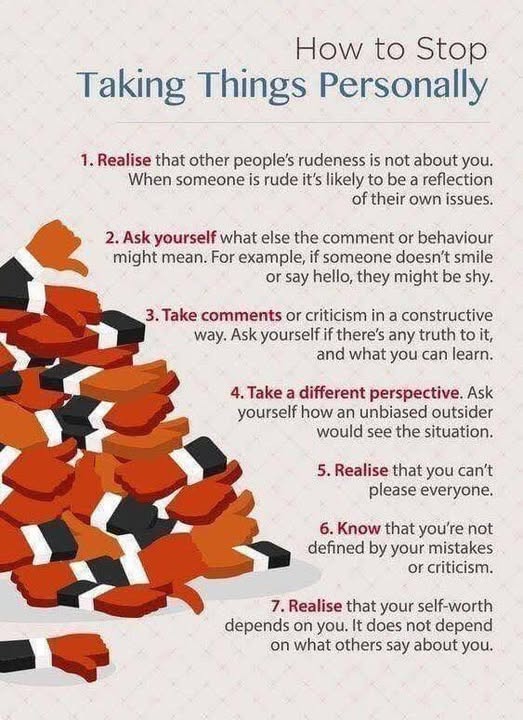
There is much wisdom in the graphic above from Street Level Counselling and Consulting. I shall try each suggestion over time and as opportunity permits. In conversations, both formal and informal, reframing expectations of self and others can certainly lead to better understanding of each other and an improved sense of shared community. Such practices require, well, practice . . .
My Myers-Briggs Personality Type Indicator (MBPTI) identifies me as “intuitive-feeling” (NF) in temperament. We NFs are imaginative; we tend to think out loud; we prefer “big-picture” thinking over the in-the-weeds detail kind of analysis. We are easily mis-understood by others who sometimes react to our thoughts and feeling with frustration. (Don’t blame them.)
If personality type contributes to my own insecurity, I have recently become aware of studies which identify Rejection Sensitive Dysphoria (RSD) as a possible influence in my relationship with others, both on the giving and receiving end. A feeling of rejection is definitely a common response for me when I feel threatened by other opinions and convictions. It all seems so unnecessary, but it’s real for me. RSD researchers name my situation well. Criticism does affect me deeply? For some, it physically hurts. I am in awe of those who can seemingly brush it off. As I likely exhibit some characteristics of ADHD behaviour, if indeed ADHD and RSD are part of my biological or cultural self, then it is somewhat reassuring that this is part of who I am. It is not something to fear and avoid. It is a challenge with which to engage and work with going forward.
So here’s my formula: ADHD + RSD = KJG? As my title above suggests, behavioural change comes slowly. That said, a little more insight helps. Hope the same is true for you dear reader.
Visit the takenote.ca HOME page for a colourful display of hundreds of other blogs which may interest or inspire you


Leave a Reply