By Prof. Dr. Mathew Koshy Punnackadu, Kerala, India
This post is edited for length. The full post with additional context is here
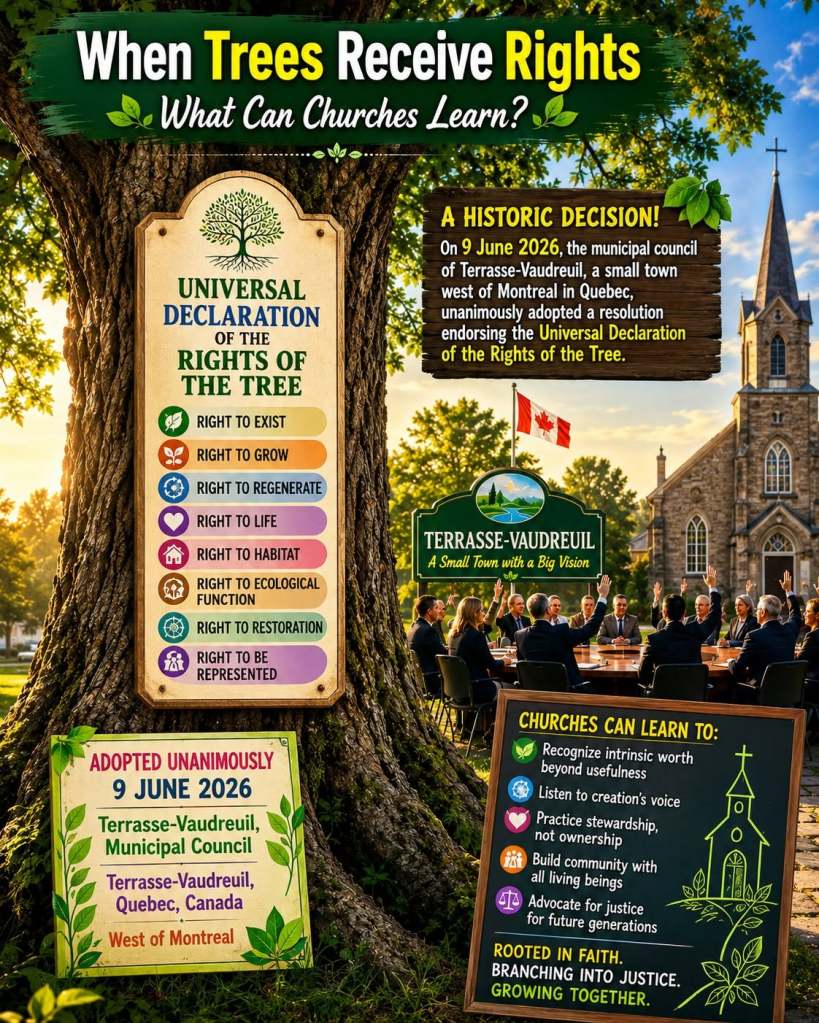
A centuries-old assumption was dramatically challenged on 9 June 2026, when the municipal council of Terrasse-Vaudreuil, a small town west of Montreal in Quebec, Canada, unanimously adopted a resolution endorsing the Universal Declaration of the Rights of Trees.
Though taken by a municipality of only a few thousand people, the decision has attracted worldwide attention. It is the first municipality in Canada — and according to the Declaration’s promoters, the first in the world — to formally endorse the Declaration through an official governmental resolution.
The Declaration recognises that trees are not merely landscape features or economic resources but living beings essential to the Earth’s ecological balance. It affirms that trees possess fundamental rights, including the right to exist, to grow naturally, to maintain their integrity, to regenerate, and to sustain their ecological relationships with other living organisms. In essence, it calls upon governments and citizens to respect trees not simply because they are useful to humanity but because they possess intrinsic worth as members of the Earth’s community of life.
Modern ecological science strongly supports this new perspective. Forests are now understood to be complex living communities rather than collections of individual trees. Through vast underground fungal networks — popularly called the “wood-wide web” — trees exchange nutrients, share water, communicate chemical signals, and even warn neighbouring trees of insect attacks. Forests regulate rainfall, stabilize soils, recharge groundwater, store enormous quantities of carbon, moderate temperatures, and provide habitat for countless species. Without healthy forests, neither biodiversity nor a stable climate can survive.
From Trees to Rivers
In February 2021, the Magpie River, known to the Indigenous Innu people as Muteshekau Shipu, became the first ecosystem in Canada to receive legal personhood. Concerned about proposals for future hydroelectric development, the Innu Council of Ekuanitshit and the Minganie Regional County Municipality jointly recognised the river as a legal entity possessing enforceable rights.
The Magpie River was granted several fundamental rights, including the right to flow naturally, the right to maintain its biodiversity, the right to remain free from pollution, the right to regenerate, and the right to legal representation through appointed guardians acting on its behalf. For the Innu people, the river is not simply a body of water but a living relative that has sustained their communities for generations.
Together, the Magpie River and the Rights of Trees declaration signal a remarkable transformation in environmental thought. Nature is gradually moving from being treated as an object of law to being treated as a subject of law. Behind this legal change lies an even deeper moral transformation—from ownership to relationship, from exploitation to responsibility, and from domination to respect.
A Christian Eco-Theological Perspective
For Christians, the emerging Rights of Nature movement should not be viewed as a radical legal innovation but as a rediscovery of a biblical truth that has often been overlooked. Long before environmental law began to speak of the rights of rivers, forests, and trees, Scripture proclaimed that “The earth is the Lord’s, and everything in it” (Psalm 24:1). The Bible consistently teaches that creation belongs first to God, not to humanity. Human beings are therefore not owners of the earth but members of God’s larger community of creation.
What Can Churches Learn?
First, churches must learn to see trees differently. Trees in church compounds should not be treated as obstacles to construction, parking, or beautification. Mature trees are living witnesses to God’s creative generosity. They provide shade, oxygen, beauty, habitat, carbon storage, and spiritual calm. Before any tree is cut, a parish should ask serious ethical questions: Is this absolutely necessary?
Secondly, churches must recover the spiritual meaning of rivers, wells, wetlands, and water bodies. In Scripture, rivers are symbols of blessing, healing, justice, and life. Yet many rivers today are treated as drains for sewage, chemicals, and waste. Churches should become defenders of local rivers and water sources.
Thirdly, churches must connect environmental care with climate justice. Climate change is not only a scientific issue; it is a moral and spiritual crisis. The poor, coastal communities, farmers, fish workers, children, and future generations suffer most from a crisis they did least to create. Protecting trees, biodiversity, and ecosystems is therefore a way of standing with the vulnerable.
Fourthly, churches must protect biodiversity. Church compounds, schools, colleges, retreat centres, and hospitals can become small sanctuaries for birds, butterflies, bees, medicinal plants, fruit trees, native species, and soil organisms. A green campus should not mean only lawns and ornamental plants. It should mean living biodiversity.
Fifthly, churches must include creation in worship and teaching. Prayers should remember the groaning earth. Sermons should speak of God’s covenant with all living creatures.
Finally, churches must adopt practical policies. Every parish and institution can prepare a tree register, protect old trees, avoid unnecessary felling, harvest rainwater, reduce plastic, install solar energy, compost organic waste, preserve local seeds, plant native species, and support community climate action. Such practices show that faith is not merely spoken but lived.
A New Vision for the Future
The Rights of Nature movement invites us to move beyond an age of domination toward an age of partnership. For Christians, this movement offers an opportunity to recover the biblical vision of creation as God’s household. The Church is called not simply to save souls but to participate in God’s mission of reconciling “all things” in Christ. This includes healing broken relationships between humanity and the rest of creation.
Visit the takenote.ca HOME page for a colourful display of hundreds of other blogs which may interest or inspire you


Leave a Reply