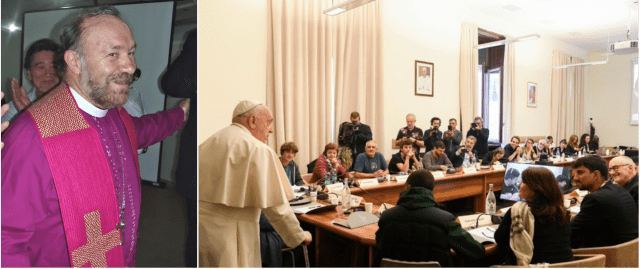
Left: Bishop Duque at a Methodist assembly in Medellín in 2012. Right: Pope Francis meets representatives of social movements in 2024.
With thanks to Jim Hodgson whose post is here.
As the world remembers the late Pope, I join with others who reflect on his legacy. Commenters identify his work as a church reformer, some with appreciation, others with distain. Many cite his modest gains in respecting those who identify 2SLGBTQI+ though less so regarding the place of women in the church. Some cite his deepening engagement with Indigenous persons especially following his Penitential Pilgrimage to Canada.
Curiously, I find less interest in his cry of the poor in the midst of a fragile creation, articulated in his Papal Encyclical Laudato si’. For me, this work will be his greatest legacy, affecting all people in all places in faith communities anywhere and everywhere on our planet. In this regard I invite you to enjoy this reflection by Bishop Francisco Duque of the Anglican Church in Colombia.
Francis, pope of Amazonia and our common home
The world mourns the loss of a spiritual leader who transcended borders, creeds and generations. Pope Francis not only was the first Latin American pontiff. He was, above all, the pope of the Amazon and caretaker of our Common Home. His legacy, immense and profoundly humanist, will remain inscribed in the planet’s memory as a prophetic voice that urges us to hear the clamour of the earth and the cry of the poor as a single call.
From the time of the publication of his encyclical Laudate Si’ in 2015, Pope Francis illuminated the ways of global ecological awareness. With valiant and committed language, he denounced the structural causes of environmental collapse, unlimited resource extraction, climate injustice and indifference toward the suffering of communities that are most vulnerable, especially those who live in the lungs of the world: tropical forests, the Amazon in particular.
His spiritual leadership was also political and ethical. He convened scientists, Indigenous leaders, activists and religious authorities from around the world to make a new pact between humanity and nature. He promoted an integral ecology that did not separate the environment from the social. He recognized in Indigenous peoples that they are millennial guardians of wisdom. His encouragement of the Synod of the Amazon in 2019 marked a before and after: Amazonia was heard in the heart of the Vatican, not as a forgotten periphery but as a vital centre for the future of the planet.
From the Inter-Religious Initiative for the Tropical Forests (IRI-Colombia), we hold up a prayer of gratitude and hope. Gratitude for his strong words, for his planetary vision, for having returned to the faith its active dimension of protection of creation. Hope because the fertile seeds he planted will continue to bear fruit in the struggles of those who do not resign ourselves to ecocide or silence in the face of injustice.
Pope Francis leaves us a road map for humanity. There will not be peace without environmental justice. There will be no future without forests. There will be no reconciliation without a deep ecological conversion. His legacy challenges governments, businesses, religions and people. His voice remains alive, inspiring a global inter-religious movement that is committed to life. In these days of farewell, we echo his own question, charged with urgency and tenderness:
“What kind of world do we want to leave to those who come after us, to children who are now growing up?” (LS 160).?”
Good question, a call which we must now answer.
Enjoy the video comment here by Elizabeth May, an active Anglican and one time leader of the Green Party of Canada.
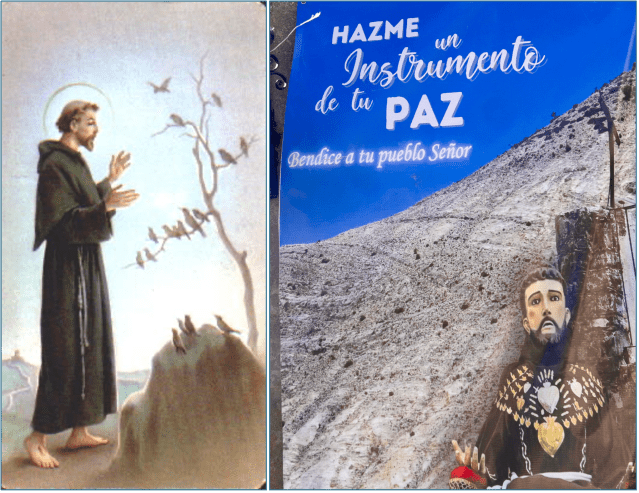
Images of St. Francis. Left: preaching to the birds. Right: “Make me an instrument of your peace / Bless your people, Lord” seen in Real de Catorce, San Luis de Potosí, October 2024.
 Take Note - Reflections on life, music, politics, retirement and more by Ken Gray
I totally agree. His nod to some social Justice causes were just that. A nod. But his concern for the environment, which thanks to the USA is taking a beating and moving some of us in the same direction, is by far his greatest and most important contribution. The Columbian Bishop is right on! Climate is the existential crisis and often takes the back sear to other shiny things.
LikeLiked by 1 person