A sermon for the congregation of St. Stephen, Summerland
Sunday, July 12, 2026 — The Very Rev. Ken Gray
Thou visitest the earth, and blessest it:
thou makest it very plenteous
Thou crownest the year with thy goodness:
and thy clouds drop fatness
— Anthem by Maurice Greene (1696-1755)
I used to sing this anthem by Maurice Greene as a boy Chorister growing up in Victoria. At the time, we mocked the fanciful style, though hearing it again through this beautifully rendered performance by the choir of New College, Oxford, it’s charm is restored to my ear at least. From this musical setting of Psalm 65:9 and from neighbouring verses, I take my theme today. (Psalm 65: 9-13)
You visit the earth and water it abundantly;
you make it very plenteous;
the river of God is full of water.
You prepare the grain,
for so you provide for the earth.
You drench the furrows and smooth out the ridges;
with heavy rain you soften the ground and bless its increase.
You crown the year with your goodness,
and your paths overflow with plenty.
May the fields of the wilderness be rich for grazing,
and the hills be clothed with joy.
These five verses describe a creation in perfect balance, a state of being where enough water soaks the soil, to the point of overflowing, so that fields can feed livestock, and the hills can appear beautiful. It is hard to imagine such a scene in the arid climate of the Middle East. It is perhaps easier to imagine such balance here in the interior of British Columbia, except, possibly in recent years, where the language of drought and wildfire is now commonplace in community conversations. Fires storm and rage around Kamloops, in the Fraser Canyon, around Fort Simpson in the North West Territories. Thus far we have been spared. Fingers crossed and prayers ascending.
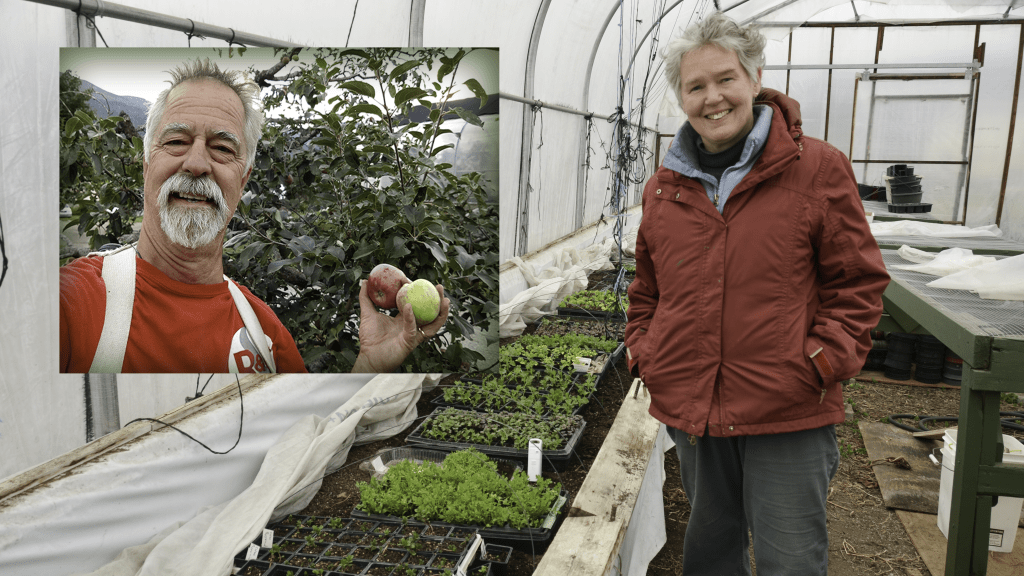
Kathie and I continue to support and encourage our friends, Ron and Jennifer at Notch Hill Community Growers, parishioners from our Kamloops Cathedral days, who in their late sixties bought a dilapidated farm in order to create a permaculture agricultural operation. Such has been their lifelong dream. Initially we thought their venture was ill-considered at this stage in their life. In many ways, we still think they are nuts. It is however their money, their energy, and their life. For Ron and Jennifer, Permaculture Farming is a passion, a vocation, a way to show the world that agriculture can be done differently through a deep reciprocal collaboration between land and farmer.
I joined with Ron, Jennifer, and a couple of others this past Monday for a time of prayer, support, and encouragement. In notes Ron and Jennifer sent prior to the gathering I read:
It’s the beginning of July and that means we are half way through the farming season. Back at the beginning of March we started putting seeds in flats and now some of them are being harvested for locals to eat. It’s a kind of miracle, really. In spite of the erratic weather, the land still produces. And the more we care for the land, the more it cares for us.
So we continue to explore and ask God how to care in the best way possible. Part of what this means is:
- adding more diversity to our perennial rows, a la syntropic farming;
- considering how to improve the pasture/hay fields while moving them in the direction of silvopasture;
- continuing our work to improve the water holding capacity of our hillside;
As we write this email, the smell of wildfire smoke is drifting into the house, a potent reminder of the need to do the work of creation care.
In these notes I hear dedication, strategic initiative, struggle and success, faithfulness, and a huge desire to do things differently for the benefit of all. I hear something similar in today’s Gospel parable, arguably one of the most well known and widely appreciated in the Christian Gospels. Used as an analogy for living the Christian life, the agricultural imagery would be very familiar to Jesus’ hearers. They all know that you start with seed, which must be spread on the land; but how? And when? And where?
The placement and timing of seeding is important and directly proportional to its success in growing plants. The wise farmer spreads the seed as best they can, at the right time, and in the right conditions. Sometimes circumstances interrupt or frustrate growth. Undeterred, the faithful farmer keeps doing the work, year after year. The Good News for farmers, and gardeners, for those who “put their hands in the dirt,” and anyone who contributes to food security, is that they don’t labour alone. Returning to Ron and Jennifer’s note, I am struck by one sentence:
It’s a kind of miracle, really.
In spite of the erratic weather,
the land still produces.
Growth itself is a miracle. Humans cannot produce or create growth. Much energy is spent on creating wealth; but less on growth. Ironically, the creation of wealth often mars the chances of growth by manipulating the processes of human exchange within economic and environmental systems. Initiative and impetus for growth comes from outside the natural system, from what lies beyond the processes of earth — literally, metaphysics, that which is above and beyond all-tings physical.
Growth comes from the One we name Creator, the God of heaven and earth. We can certainly frustrate this gift of growth and Grace. We can meddle with it; we can ignore it; we can despise it; we can deny it. Beyond ethical considerations, however, growth is real; growth is powerful; growth is of God; growth is miraculous. And time after time, year after year, even in earth’s most barren regions, the land still produces . . .
Growth happens, silently, furtively, wilfully, generously, as God visits the earth and blesses it, and us in the process. Thanks be to God.
Visit the takenote.ca HOME page for a colourful display of hundreds of other blogs which may interest or inspire you


Leave a comment